
‘Bharat’s Unity Must Remain Our Priority’: RSS Chief Bhagwat
At the Vijayadashami Utsav in Nagpur, RSS chief stresses cultural identity, responsible conduct, balanced development and the five initiatives of Panch Parivartan.

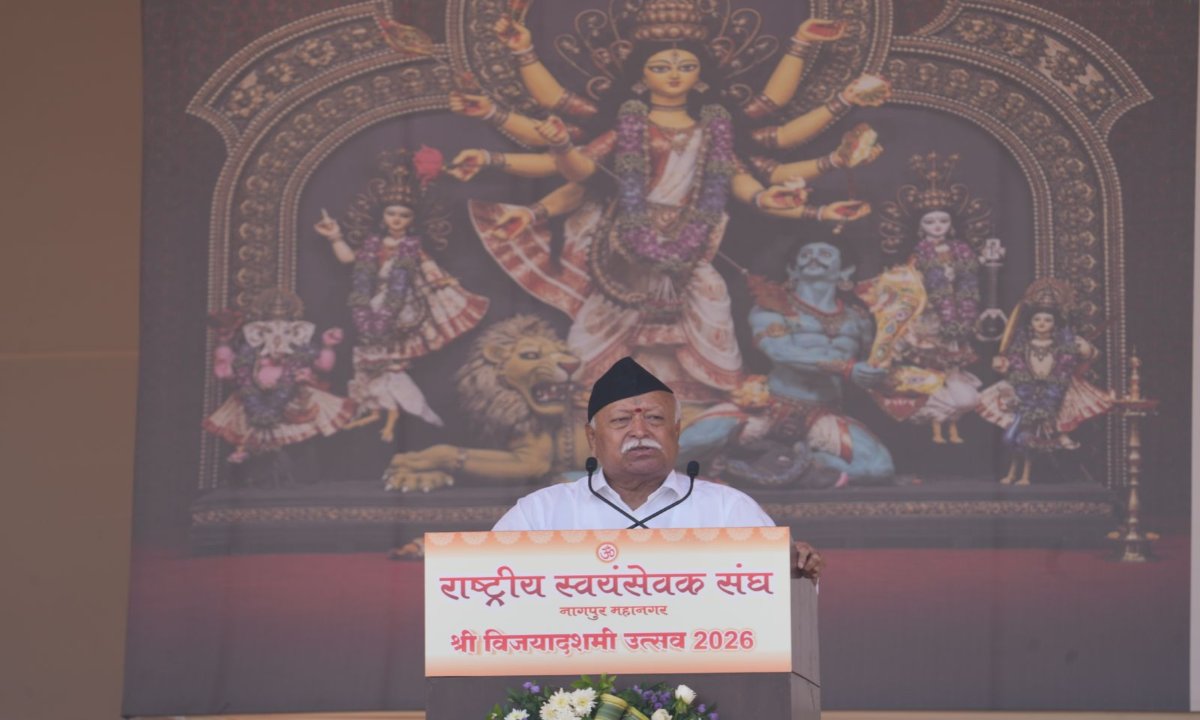
- RSS marks conclusion of centenary celebrations
- Bhagwat stresses unity, Swadeshi and social harmony
- Five Panch Parivartan initiatives highlighted
- Chief calls for balanced and responsible development
GG News Bureau
Nagpur, 20th Oct: Rashtriya Swayamsevak Sangh (RSS) chief Mohan Bhagwat on Tuesday called for greater social unity, cultural awareness, self-reliance and responsible conduct, emphasising that Bharat’s progress depends on collective effort, mutual goodwill and a strong sense of national identity.
Addressing the RSS Vijayadashami Utsav in Nagpur on October 20, Bhagwat spoke about the organisation’s centenary celebrations, the importance of preserving cultural traditions, the role of young people and the need for a balanced approach to development. The address also highlighted the Sangh’s five initiatives under Panch Parivartan, aimed at bringing changes in individual and social conduct.
The occasion marked the conclusion of the RSS centenary celebrations. Bhagwat also referred to the 650th birth anniversary year of Sant Shiromani Ravidas Ji Maharaj, the centenary of Swami Laxmanananda Saraswati Ji Maharaj’s birth, the 100th anniversary of Swami Shraddhanand Ji’s martyrdom and the 200th birth anniversary of Raj Narayan Basu.
Cultural Identity and Social Harmony
Bhagwat recalled the contributions of Sant Ravidas Ji, highlighting his life of hard work, sacrifice and commitment to social harmony. He said the saint’s teachings continued to inspire people to remain devoted to their faith and duties while promoting harmony in society.
He also remembered Swami Shraddhanand Ji, describing him as a revered ascetic, educationist, freedom fighter and defender of Dharma, and referred to Swami Laxmanananda Saraswati Ji Maharaj’s service among forest-dwelling communities in Odisha.
Referring to Raj Narayan Basu, Bhagwat noted his role in founding the Hindu Mela, which sought to awaken a deeper consciousness of the nation’s cultural identity.
He said the Sangh’s work over the past hundred years had focused on organising and strengthening society around a shared sense of identity and cultural values. He stressed that Bharat’s diversity of faiths, languages, regions, castes, traditions and lifestyles should be respected and embraced as the foundation of national unity.
According to Bhagwat, the country’s spiritual traditions offer a vision of unity that recognises diversity while emphasising the underlying interconnectedness of existence. He called for this understanding to be reflected in people’s conduct and relationships.
Five Initiatives Under Panch Parivartan
Bhagwat highlighted five initiatives identified during the RSS centenary celebrations: social harmony (Samajik Samarasata), family awareness (Kutumba Prabodhan), environmental protection (Paryavaran), self-awareness and Swadeshi (Swa-Bodh and Swadeshi), and civic discipline (Nagarik Anushasan).
He said these initiatives were not intended merely as temporary programmes but as a way of life aimed at transforming behaviour, habits and character.
The RSS chief said the initiatives had received a positive response across sections of society and that their relevance was also being recognised in other countries. He emphasised the importance of carrying these efforts forward continuously so that their values could become part of everyday life.
He also outlined activities conducted during the centenary year to expand the Sangh’s outreach. According to the figures presented in his address, the Sampark Abhiyan reached more than 10.19 crore households across 4,61,527 villages and 41,076 urban settlements.
The address also reported that public meetings involving prominent citizens were held in 1,117 districts, Sadbhavana Baithaks took place in 5,036 blocks or taluks, Hindu Sammelans were organised in 34,187 mandals, and more than 39 lakh young people participated in Yuva Sammelans.
Bhagwat said Sangh workers had also visited countries in the West to present their understanding of Bharat, Hindutva and the organisation’s work, with the aim of promoting dialogue and a better understanding of Bharatiya culture.
Calls for Responsible Use of Technology
Addressing contemporary social concerns, Bhagwat stressed the need for responsible conduct, particularly among young people who increasingly receive information through social media and digital platforms.
He said families, schools and the wider social environment had an important role in teaching the younger generation to distinguish between appropriate and inappropriate content.
He also raised concerns about the growing problem of drug addiction, describing it as a serious national issue that required timely action by the government, administration and society.
Bhagwat called on parents and elders to help young people develop sound judgement and urged the younger generation to stay away from influences and activities that could lead to harmful habits. He said Sangh volunteers would seek to bring together organisations and individuals working to address the problem and build a nationwide effort against drug addiction.
On science and technology, he said new knowledge and technological advances should be welcomed, but their use must be guided by ethics, discernment and discipline.
He cautioned against a development model driven exclusively by consumerism and material comfort, arguing that technological progress must be accompanied by an understanding of its broader social and environmental consequences.
Referring to artificial intelligence, he warned that useful technologies could also be misused to mislead people, spread falsehoods and deceive the public.
Balanced Development and Environmental Responsibility
Bhagwat advocated a holistic approach to development that balances scientific progress with environmental protection, social well-being and ethical responsibility.
He referred to the devastation caused by a recent tragedy in Nepal and linked such disasters, at least in part, to the consequences of one-sided development in the Himalayan region. He expressed sorrow over the loss of life and stressed the importance of providing assistance to affected communities.
He said development should be guided by human judgement and a broader vision of well-being rather than material considerations alone. According to him, Bharat should present a model of integrated development rooted in harmony, restraint and its philosophical traditions.
The RSS chief also highlighted the importance of family life, community participation and the transmission of values between generations. He said social responsibility and collective effort were necessary to build a society capable of addressing complex challenges.
Emphasis on Goodwill and Constitutional Conduct
Bhagwat called for mutual goodwill and respect in interactions among people belonging to different communities, regions, languages and traditions.
He said historical grievances should be acknowledged without allowing them to create new divisions. He urged people to avoid being provoked by trivial issues and called for efforts to build mutual trust and social harmony.
He also emphasised that public campaigns, government policies and social movements should be conducted with courtesy and respect for citizens’ dignity. Even when disagreements arise, he said, speech and conduct must remain within the bounds of the Constitution and the law.
Bhagwat cautioned against allowing electoral calculations, the pursuit of popularity or political interests to undermine prudence and goodwill. He said social problems could not be resolved by the government alone or through agitation alone, and that community participation and dialogue were also essential.
Citing examples of community-led work in rural schools, he said a study covering 1,296 schools across 210 districts in 21 Sangh regions had reported improvements in student attendance, learning levels and parental involvement where villagers participated and volunteers extended support.
He said similar community-based efforts were underway in thousands of villages, with an emphasis on education, infrastructure, sports, cultural activities and value-based programmes.
Unity, National Responsibility and the Road Ahead
Bhagwat reiterated the importance of a shared sense of belonging among the people of Bharat, saying national unity could be strengthened through devotion to the motherland, pride in common ancestral heritage and commitment to the country’s cultural values.
He referred to the Swadeshi movement and the role of Vande Mataram in the opposition to the proposed partition of Bengal, describing the national song as a continuing source of unity and patriotism.
He urged citizens to remain vigilant against divisive tendencies and to avoid allowing differences of opinion to turn into hostility, resentment or social fragmentation.
In his address, Bhagwat also spoke about Bharat’s responsibility to contribute to global well-being by offering a development approach that combines material progress with the wisdom of Dharma and a broader vision of human welfare.
He said the country’s progress and its aspirations to emerge as Vishwaguru would depend on the dedicated efforts of individuals in their personal, family, social and professional lives.
Concluding his address, Bhagwat said the Sangh would move forward after completing its centenary programmes, continuing its efforts to build an organised and active force within society.
