

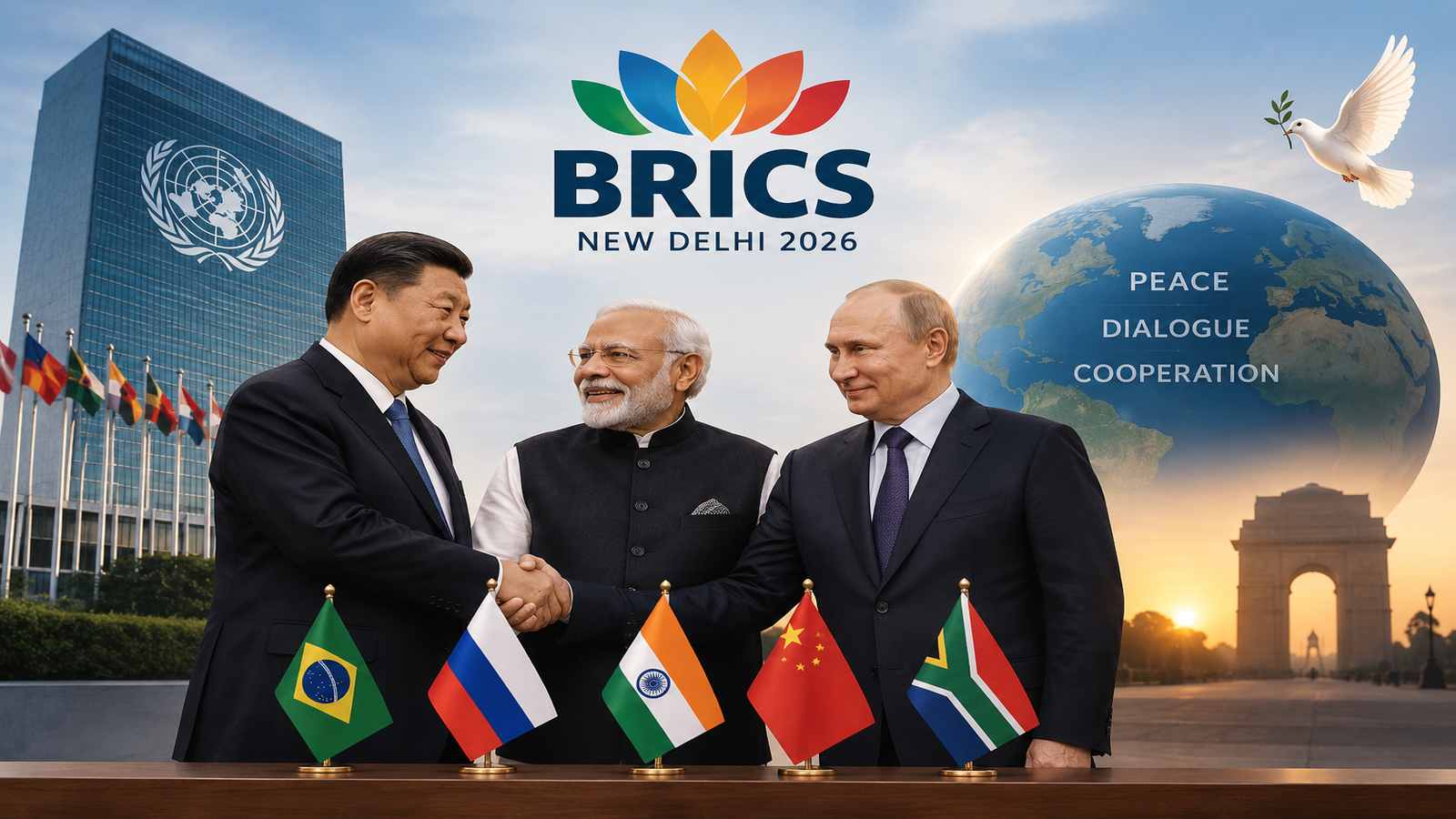
New Delhi: The New Delhi Declaration adopted at the 18th BRICS Summit has placed reform of global institutions, greater representation for emerging and developing economies and peaceful resolution of conflicts at the centre of the grouping’s political agenda, giving fresh diplomatic momentum to India’s longstanding push for a more representative international order.
The declaration, adopted at the summit held in New Delhi on September 12-13, 2026, explicitly backs comprehensive reform of the United Nations, including the UN Security Council, and calls for greater representation of developing countries in global decision-making structures. It also specifically records that China and Russia, both permanent members of the Security Council, reiterated their support for the aspirations of India and Brazil to play a greater role in the UN, including the Security Council.
For New Delhi, the language is significant because it goes beyond a general call for multilateral reform. The declaration says the Security Council reform process should amplify the voice of the Global South and recognises the aspirations of developing countries from Africa, Asia and Latin America to have a greater role in international affairs.
India and Brazil have separately maintained a coordinated position on Security Council reform. In their bilateral joint statement, the two countries reiterated support for expanding the Council in both permanent and non-permanent categories and reaffirmed mutual support for their bids for permanent membership in an expanded Council.
The BRICS declaration also places the reform debate within a broader argument about the changing structure of international power. It calls for greater and more meaningful participation of emerging markets and developing countries in global decision-making and stresses the need for international institutions to better reflect contemporary realities. It also highlights the role of the Global South in addressing geopolitical tensions, economic disruptions, technological change, climate challenges and development gaps.
Economic weight strengthens the political argument
The political message was reinforced by the economic narrative presented at the BRICS Business Forum in New Delhi.
Russian President Vladimir Putin said BRICS countries had accounted for more than 40 per cent of global GDP over the preceding five years, compared with 29 per cent for the G7. He also said BRICS had contributed more than half of global economic growth during the period, while the G7 accounted for 18 per cent. The figures were presented by Putin as evidence of a structural shift in the global economy towards emerging growth centres.
The figures are Putin’s assessment and should be read in that context. Separately, BRICS’ economic significance has expanded substantially with the group’s enlargement, strengthening its role as a forum through which emerging and developing economies seek a greater voice in global economic and political affairs.
For India, the significance of the expanded grouping lies not merely in its economic size but also in its ability to bring together countries with divergent political systems, regional interests and foreign-policy priorities under a consensus-based framework.
Dialogue and diplomacy take centre stage
The summit’s political agenda also put conflict prevention, mediation and diplomacy prominently on the table.
The New Delhi Declaration states that international disputes should be addressed through dialogue, consultation and diplomacy. It specifically identifies preventive diplomacy and mediation, with the consent of the relevant parties, as important tools for preventing crises from escalating. BRICS members also agreed to explore cooperation in conflict prevention, peacekeeping and mediation and peace processes.
That language closely mirrors India’s own diplomatic messaging.
During his meeting with Putin on the sidelines of the BRICS Summit, Prime Minister Narendra Modi said dialogue and diplomacy remained the way forward for resolving conflicts and that India was ready to assist in peace efforts. The two leaders discussed regional and global developments, including conflicts in West Asia and the Black Sea region, which have affected maritime trade and the safety of Indian seafarers.
The meeting was also significant in the context of the broader India-Russia relationship. Modi and Putin reviewed cooperation spanning political, economic, defence, energy, space, skills and people-to-people ties. Putin also invited Modi to Russia for the 24th India-Russia Annual Summit, an invitation the Prime Minister accepted.
Ukraine, West Asia and India’s diplomatic channels
India’s diplomatic positioning on conflicts has increasingly centred on maintaining communication with multiple sides rather than aligning itself exclusively with one geopolitical camp.
On Ukraine, New Delhi has consistently advocated dialogue and diplomacy. In May 2026, Modi reiterated to Russian Foreign Minister Sergei Lavrov India’s position that dialogue and diplomacy were the way forward, while the Prime Minister’s engagements have also included discussions with other international partners on the conflict.
The same approach has been visible on West Asia. In his August 2026 meeting with Iranian President Masoud Pezeshkian, Modi expressed concern over escalating tensions and reiterated India’s position that outstanding issues should be addressed through dialogue and diplomacy. He also stressed the importance of protecting civilians, commercial shipping and freedom of navigation.
This network of relationships gives India diplomatic channels with Russia, Iran and Western partners at a time when geopolitical tensions remain high. However, India’s ability to translate these channels into formal mediation will ultimately depend on the willingness of the parties to a conflict to accept such a role.
Culture and people-to-people diplomacy
An important, and sometimes overlooked, dimension of India’s BRICS diplomacy is the emphasis on cultural and people-to-people ties.
The New Delhi Declaration itself treats cultural and people-to-people cooperation as one of the three principal pillars of expanded BRICS cooperation, alongside political and security cooperation and economic and financial cooperation. It also welcomes academic, civil-society and think-tank exchanges among BRICS countries.
The symbolism of India’s engagement with Russia was visible during Modi’s September meeting with Putin, when the Prime Minister presented the Russian President with a Russian translation of the Thirukkural, the classical Tamil text attributed to Thiruvalluvar. Modi described the work as carrying Thiruvalluvar’s wisdom across languages and borders.
Such gestures do not constitute mediation by themselves, but they form part of a wider diplomatic toolkit through which countries build familiarity, trust and communication beyond formal strategic negotiations.
From institutional reform to a wider diplomatic role
The New Delhi Declaration therefore gives India several strands of diplomacy to pursue simultaneously: reform of the UN system, a larger voice for developing countries, conflict prevention, dialogue, mediation, economic cooperation and people-to-people exchanges.
The declaration’s language is particularly notable because it explicitly links Security Council reform with the aspirations of India and Brazil, while recording the support of China and Russia for those aspirations.
For New Delhi, the challenge now lies in converting diplomatic support within BRICS into broader international momentum for Security Council reform, while maintaining its established relationships across competing geopolitical blocs.
The summit has also reinforced India’s stated preference for diplomacy over confrontation in addressing international crises. Whether that translates into a direct mediation role in conflicts such as Ukraine or those in West Asia will depend on circumstances and the consent of the parties involved.
What is clearer is the broader direction emerging from India’s 2026 BRICS chairship: New Delhi is seeking to combine its traditional emphasis on strategic autonomy with a stronger push for reform of global institutions and greater participation of the Global South.
In that sense, the New Delhi Declaration is not simply a statement on BRICS cooperation. It is also a document that reflects India’s effort to position questions of representation, development, dialogue and multilateral reform closer to the centre of the emerging international debate.
