
Centre Acts to Stabilise Sugar Prices
Government announces anti-hoarding measures, duty-free imports and early crushing to ensure adequate supply during festive season

- Sugar prices rose from ₹48.18/kg to ₹55.70/kg in one month
- Centre says ethanol diversion is not responsible for price increase
- 10 LMT duty-free raw sugar imports approved to boost domestic supply
- Stock limits, anti-hoarding checks and early crushing planned to stabilise prices
GG News Bureau
New Delhi, 21st Aug: The Central Government has announced a series of measures to curb the recent rise in sugar prices and ensure adequate availability during the upcoming festive season, while asserting that the increase is not linked to ethanol production.
According to the government, retail sugar prices increased from ₹48.18 per kg on July 20 to ₹55.70 per kg on August 20, prompting close monitoring of the market and intervention to prevent artificial shortages.
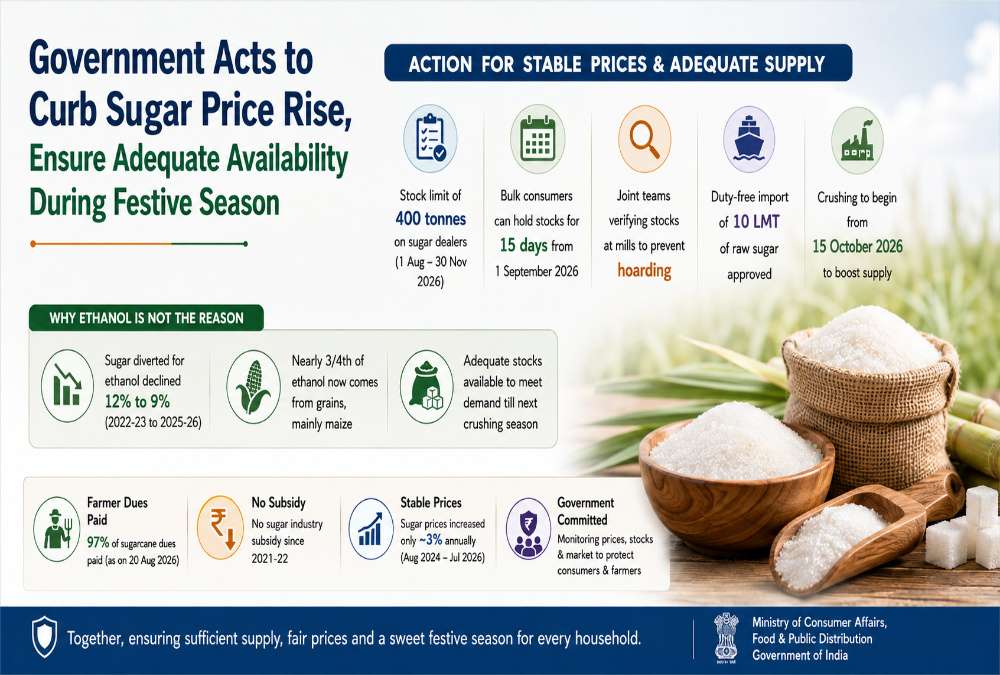
Rejecting claims that ethanol production has reduced sugar availability, the government said the share of sugar diverted for ethanol has declined from around 12 per cent in 2022-23 to about 9 per cent in 2025-26. It added that nearly three-fourths of the country’s ethanol production now comes from grain-based feedstock, particularly maize.
Officials attributed the recent price rise to a combination of factors, including lower-than-expected sugar production, higher festive demand, weather-related damage to sugarcane crops, tightening global supplies, and speculation and hoarding by some market participants.
The government said sugar production for the current season is now estimated at 306 lakh metric tonnes (LMT) against the initial estimate of 343 LMT made by sugarcane-growing states. Production has been affected by Red Rot and Top Borer disease, along with waterlogging caused by excessive rainfall. However, it maintained that domestic stocks remain sufficient to meet consumption until the new crushing season begins in October.
The government also pointed to global factors behind the price surge, noting that the world sugar deficit for 2026-27 is estimated at around 33 LMT. International sugar prices have climbed from $474 per tonne on June 30 to $552 per tonne on August 20, an increase of over 16 per cent in less than two months.
Highlighting the benefits of the ethanol blending programme, the government said diversion of surplus sugar has improved the financial health of sugar mills and ensured faster payments to farmers. As of August 20, 2026, around 97 per cent of sugarcane dues for the 2025-26 season had already been paid. It also noted that no subsidy has been provided to the sugar industry since 2021-22, compared with nearly ₹14,600 crore extended between 2014 and 2021.
To prevent further price escalation, the Centre has introduced a series of market interventions. A 400-tonne stock limit has been imposed on sugar dealers from August 1 to November 30, while bulk consumers will be allowed to hold stocks equivalent to only 15 days of consumption from September 1.
The government has also deployed joint Central and State inspection teams to verify sugar stocks at mills and check hoarding and artificial scarcity.
In addition, it has approved the duty-free import of 10 LMT of raw sugar to augment domestic availability and advised states and sugar mills to begin crushing operations from October 15. This is expected to increase October sugar production from the usual 3–4 LMT to over 10 LMT, strengthening supplies during the festive season.
The government reiterated its commitment to protecting both consumers and sugarcane farmers, stating that it will continue monitoring sugar stocks, prices and market practices while taking necessary steps to prevent hoarding, ensure market stability and facilitate timely payments to farmers.
