
Ceuta’s Night of Chaos: How a Mass Border Surge Exposed Spain’s Migration Fault Lines

Alok Lahad
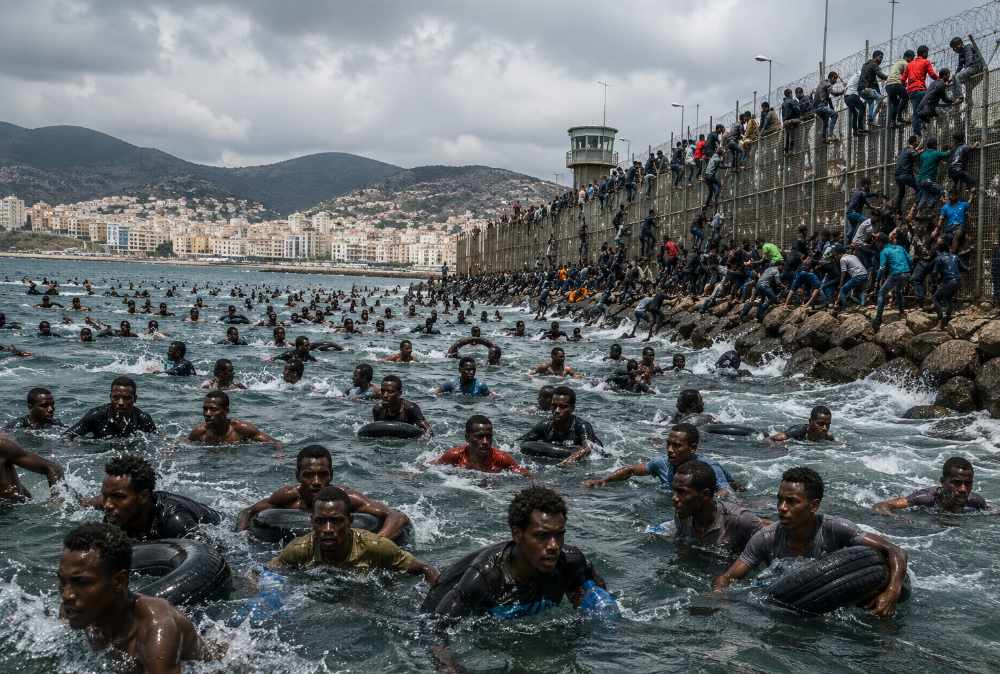
Ceuta / Madrid — 1 August 2026: In the final days of July, the Spanish autonomous city of Ceuta experienced one of the most dramatic migration events in recent European history. Within roughly twenty-four to forty-eight hours, an estimated 70,000 people—predominantly young men—crossed from Morocco into the enclave by swimming around coastal breakwaters using rubber tunes and floating aids or moving on foot along the shoreline. Local officials described the scenes as absolute chaos. At least 67 people died, most by drowning or in the crush of the rush. Reception centres were overwhelmed. Streets filled with exhausted arrivals. Ceuta’s president called it a humanitarian and social emergency that the city’s ordinary resources could not sustain.
Ceuta and its sister city Melilla are Spanish territories located on the northern coast of Africa, not on the Iberian mainland. They form the European Union’s only land borders with the African continent. Both have been under Spanish (or previously Portuguese) control for centuries. Morocco claims sovereignty over them and regards them as occupied. Spain considers them integral parts of its national territory. This geographic reality makes the enclaves permanent pressure points. Smaller surges have occurred before, most notably in May 2021 when around 8,000 people entered Ceuta in two days. The 2026 episode, however, was unprecedented in scale. A near-doubling of the city’s population of roughly 83,000–85,000 in a single concentrated wave inevitably raised questions about organisation, timing and intent.
Morocco’s Leverage and the Regional Triangle
Migration flows across the Ceuta and Melilla borders have long been shaped by politics as much as by economics. Morocco has repeatedly demonstrated that it can tighten or relax controls according to the state of its relations with Madrid. In 2021, a sudden increase in crossings followed Spain’s decision to allow the leader of the Algeria-backed Polisario Front to receive medical treatment. Many in Spain interpreted that episode as deliberate pressure.
The broader context is the long-running dispute over Western Sahara and the rivalry between Morocco and Algeria. Spain’s earlier shift toward supporting Morocco’s autonomy plan for the territory improved ties with Rabat. In July 2026, however, Prime Minister Pedro Sánchez visited Algeria, signalling a thaw after years of tension. Analysts noted the proximity of that diplomatic move to the border surge. Some migrants told reporters that Moroccan forces initially directed or failed to stop groups heading toward the frontier. Official Spanish statements rejected the suggestion of a manufactured crisis and blamed trafficking networks. Morocco denied encouraging the crossings. The pattern, nevertheless, fits a known form of asymmetric leverage: migration pressure is cheap, deniable and immediately visible in a small, enclosed territory.
Spain’s Migration Message
Spain faces genuine demographic and labour-market pressures. Low fertility and an ageing population create real demand for workers. The question is which immigration pathway the government prioritises and what signal that sends.
In April 2025 the Sánchez government terminated the Golden Visa programme, which had allowed non-EU nationals to obtain residency mainly through property investment of €500,000 or more. Officials argued the scheme fuelled housing speculation in stressed cities and was incompatible with the model of country Spain needed. Critics called the decision ideological. Whatever the merits of the housing argument, the move closed one relatively straightforward legal channel for high-net-worth individuals.
Months later the government launched an extraordinary regularisation process aimed at roughly 500,000 (the number has a symbolic message) undocumented migrants already living in Spain. Eligibility required presence before a cutoff date, a minimum continuous stay, and a clean criminal record. Applications ultimately exceeded one million. The government presented the measure as both an act of justice and an economic necessity—bringing people already in the informal economy into the formal labour market and social-security system. Opposition parties warned it would act as a pull factor and reward irregular entry.
The combination—ending an investment-based legal route while conducting a large-scale regularisation of people already present irregularly—has been widely read across Europe as a particular policy preference. It is not illegal for a sovereign government to choose this path. It does, however, shape expectations among potential migrants and among Spain’s EU partners.
Contradictions in Legal Channels
Legal student and skilled-worker routes continue to exist. Spain issues student visas and has procedures for employment-based permits. Applicants must meet standard requirements: admission to an institution, proof of funds, accommodation, and credible intent. Refusal rates for applicants from certain non-EU countries, including India, are often higher than for lower-risk nationalities, typically for documentary or financial reasons rather than a declared nationality ban. Claims that students from specific Indian states such as Punjab and Haryana face systematic unofficial barriers circulate in diaspora networks, yet public data do not show a formal policy of targeted denial. What is clear is that legal pathways remain bureaucratic and selective, while the political energy of the current government has focused more visibly on regularising the existing irregular population.
This contrast fuels the perception that the system privileges those who have already entered without authorisation over those attempting orderly, skills- or study-based routes. Whether or not that perception is fully accurate, it is politically consequential.
European Reactions
Other EU governments have responded with both legal clarification and political pressure. The Spanish regularisation permits are national: they authorise residence and work in Spain only. They do not grant the right to settle or take employment in other member states. Short-term travel within the Schengen area remains possible under the usual third-country-national rules, but secondary settlement is not automatically authorised. European partners have insisted on this distinction precisely to limit spillover.
The Ceuta events intensified the criticism. Italian leaders, including Prime Minister Giorgia Meloni, publicly called for suspending Schengen arrangements with Spain or considering stronger measures. Italy announced temporary closures of air and sea borders with Spain and increased checks. Such steps are permitted under Schengen rules for public-order or security reasons and have been used by several countries in past crises. A permanent exclusion of Spain from the free-movement area would be far more difficult legally and politically, yet the threat itself signals that solidarity has limits when external-border control and national policy diverge sharply from the European mainstream.
The Unanswered Question of Timing
Why did tens of thousands of people cross in such a concentrated wave? Official Spanish explanations centre on human traffickers exploiting a late-June Supreme Court ruling that restricted immediate returns of people intercepted at sea near the enclaves, combined with social-media rumours and economic desperation in Morocco. The government has rejected claims that its regularisation programme directly caused the surge, noting that the permits required prior residence in Spain and offered no immediate benefit to new arrivals.
Independent reporting and analysis point to additional factors: the possibility that Moroccan border management temporarily loosened amid diplomatic friction linked to Spain’s outreach to Algeria; summer sea conditions that make swimming more feasible; and the simple reality that large groups can be mobilised quickly via messaging apps once word spreads that controls appear relaxed. Historical precedent shows that Morocco has the capacity to influence the volume of crossings.
More speculative theories have circulated online and in some commentary, linking the events to Spain’s foreign-policy positions, including differences with the United States or stances on the Middle East, and alleging coordination by external networks. No credible public evidence has substantiated claims of a “deep-state” operation or organised foreign financing aimed at destabilising the Spanish government like it was done at Jantar Mantar in New Delhi. In the absence of any evidence, these remain conjectures. The documented drivers—diplomatic signalling, border-control decisions, trafficking, legal rulings and economic push factors—already provide a coherent, if incomplete, account. The precise mix of intention and opportunism may never be fully known.
Aftermath and Lessons
By the evening of 31 July, Spanish authorities reported that approximately 48,300 of those who had entered had returned voluntarily to Morocco. Coordination between Spanish and Moroccan forces restored a degree of control. Additional police and military logistical support were deployed. The acute phase of overcrowding eased, though residual cases remained for identification and possible asylum processing. The death toll and the temporary collapse of local capacity stand as the clearest human costs.
The episode leaves several lessons. First, Ceuta and Melilla are not peripheral anomalies; they are EU external borders whose management affects the entire Schengen area. Second, migration policy sends signals. A government that simultaneously closes certain legal investment routes and conducts large-scale regularisation of irregular residents should expect both domestic political debate and external scrutiny. Third, asymmetric leverage works. A neighbour that can open or close a migration valve at low cost holds a persistent instrument of pressure. Fourth, capacity matters. A city of 80,000 cannot absorb a near-equivalent number of new arrivals overnight without severe strain on shelter, food, sanitation and public order.
Spain needs immigration. The debate is over selection, legality, control and European coordination. The events of late July 2026 did not invent these tensions; they illuminated them with unusual clarity. How Madrid, Rabat and the wider European Union respond in the coming months will determine whether the crisis remains a dramatic but contained episode or becomes a recurring template.
