
Delhi-Varanasi Rail Journey May Drop to 3h 50m
Budget 2026-27 outlines proposed high-speed corridors linking major cities and economic hubs

GG News Bureau
New Delhi, 16th Sept: The Ministry of Railways is pursuing an ambitious high-speed rail network that could significantly reduce travel time between several major cities, according to plans outlined under the Union Budget 2026-27.
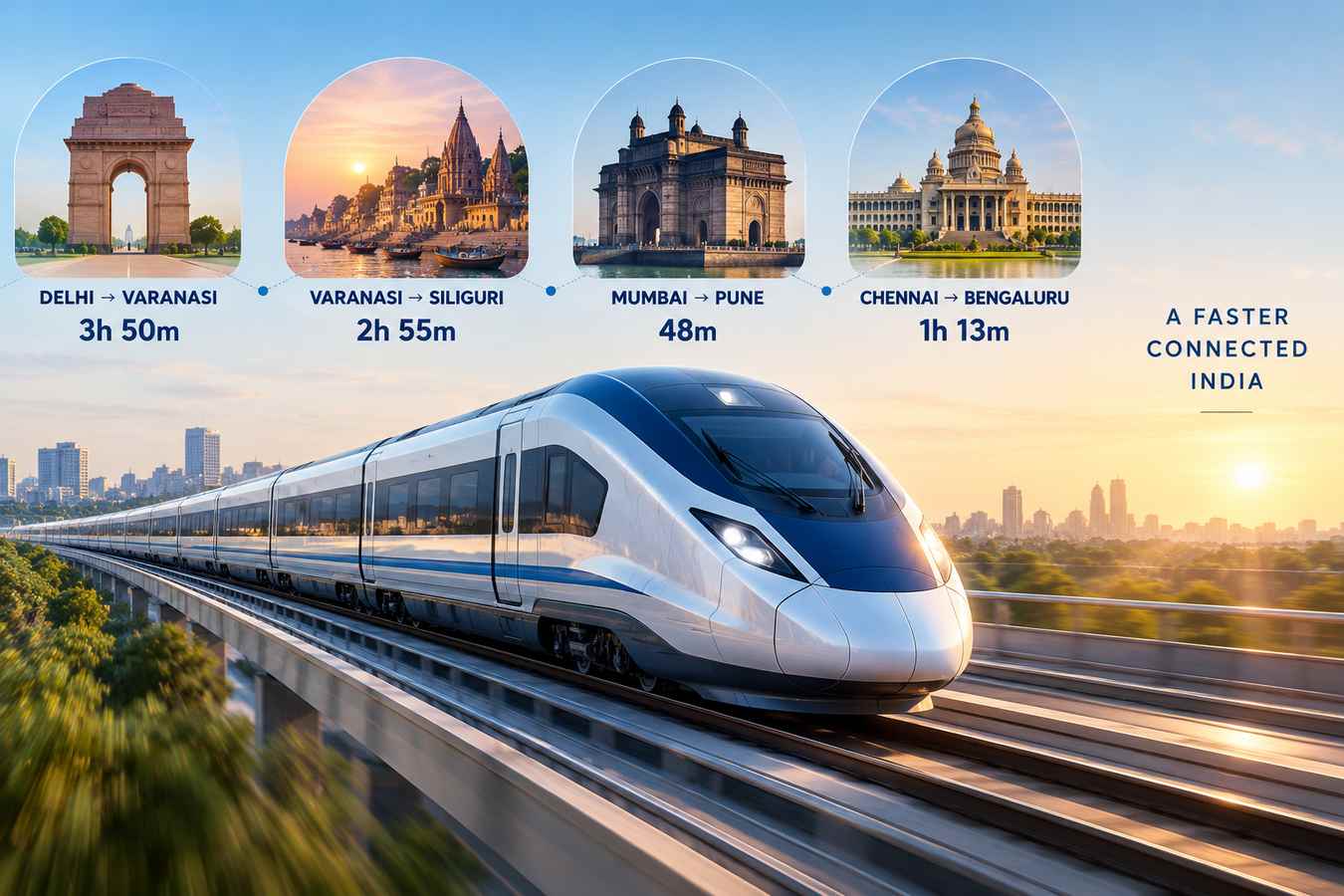
Among the proposed corridors, the Delhi-Varanasi high-speed rail link is projected to bring the journey time down to around 3 hours 50 minutes. The proposed Varanasi-Patna-Siliguri corridor could enable travel between Varanasi and Siliguri in approximately 2 hours 55 minutes.
The Railways has also proposed high-speed connectivity in western and southern India. The Mumbai-Pune corridor is projected to reduce travel time to about 48 minutes, while the proposed Pune-Hyderabad corridor could bring the journey down to approximately 1 hour 55 minutes.
Chennai-Bengaluru Journey in About 73 Minutes
The proposed southern high-speed network would connect Chennai, Bengaluru and Hyderabad. Under the projected travel times, Chennai-Bengaluru could take around 1 hour 13 minutes, while Bengaluru-Hyderabad could be covered in approximately 2 hours.
The proposed corridors are aimed at strengthening connectivity between major metropolitan centres and economic hubs while supporting tourism, business activity and regional development.
Budget Push Beyond High-Speed Rail
The Railways’ infrastructure plans extend beyond high-speed passenger corridors. The Union Budget also includes proposals for a 40-km underground rail corridor in the Northeast, four-line route expansions and the Rishikesh-Karnaprayag railway line in Uttarakhand.
Plans also include improved railway connectivity in Jammu and Kashmir, including proposed extensions towards Uri.
For freight transportation, the Railways has proposed the East-West Dedicated Freight Corridor, connecting Dankuni in West Bengal with Surat in Gujarat.
The proposed travel times are part of the Railways’ long-term infrastructure vision and do not represent currently operational train services. The implementation timeline and operational details for the proposed high-speed corridors will depend on subsequent planning, approvals and execution.
