
‘Digitalisation Steel Sector’s Survival Strategy’: Kumaraswamy
Steel Minister says AI, data and smart manufacturing will drive India's journey towards Viksit Bharat

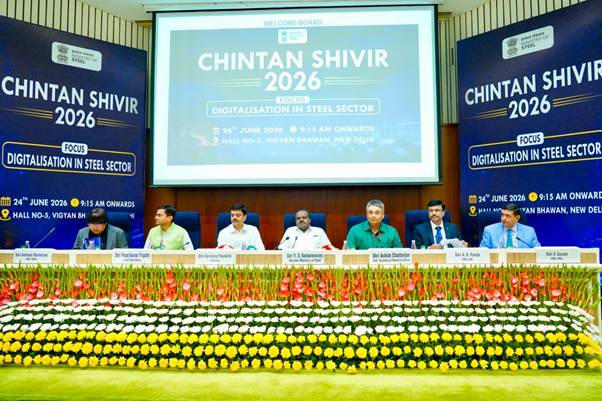
- H.D. Kumaraswamy said digitalisation is essential for the long-term competitiveness of India’s steel sector.
- The Minister highlighted AI, machine learning, robotics and smart factories as key growth drivers.
- India aims to expand steelmaking capacity to 300 million tonnes by 2030 and 400 million tonnes by 2035.
- Chintan Shivir 2026 focused on accelerating digital transformation across the steel industry.
GG News Bureau
New Delhi, 24th June: Union Steel and Heavy Industries Minister H.D. Kumaraswamy on Wednesday said digitalisation is no longer a choice but a necessity for the survival and future growth of India’s steel industry, asserting that the sector must move beyond capacity expansion towards intelligent and data-driven manufacturing.
Addressing the Chintan Shivir 2026 on Digitalisation in the Steel Sector at Vigyan Bhawan in New Delhi, Kumaraswamy said Prime Minister Narendra Modi’s vision of Viksit Bharat by 2047 would be powered by a technologically advanced and globally competitive steel industry.
Describing steel as the backbone of nation-building, the Minister said India has maintained its position as the world’s second-largest steel producer since 2018 despite sluggish demand in several advanced economies.
He highlighted the sector’s strong performance, noting that crude steel production has grown at an average annual rate of nearly eight per cent since FY 2021-22, while finished steel consumption has expanded by around 13 per cent annually, driven by rising domestic demand and rapid industrialisation.
Kumaraswamy reiterated the government’s target of increasing steelmaking capacity to 300 million tonnes by 2030 and 400 million tonnes by 2035. However, he stressed that achieving these goals would require addressing challenges related to raw material security, operational efficiency, decarbonisation, modernisation and export competitiveness.
The Minister said emerging technologies such as Artificial Intelligence (AI), Machine Learning, Industrial Internet of Things (IIoT), Digital Twins, Robotics and Advanced Data Analytics are transforming steel manufacturing globally and must be widely adopted across India.
According to him, digitalisation and automation can improve productivity, optimise energy consumption, reduce operational costs and enable predictive maintenance systems capable of identifying equipment failures before they occur. These technologies can also minimise unplanned downtime, reduce human errors and improve workplace safety.
“India’s steel future will be shaped by data, AI and smart factories,” Kumaraswamy said, emphasising that intelligent manufacturing ecosystems would define the next phase of industrial growth.
The Chintan Shivir featured discussions on AI-driven mining solutions, digital transformation of steel plants, Industry 4.0 technologies, PM Gati Shakti integration and case studies demonstrating measurable business benefits from technological adoption.
The event brought together senior officials from the Ministry of Steel, heads of major public sector enterprises including SAIL, NMDC and MOIL, as well as industry leaders, startups and technology experts.
Expressing confidence in the outcomes of the deliberations, Kumaraswamy said the recommendations emerging from the conclave would help build a smarter, greener and more efficient steel industry aligned with the goals of Atmanirbhar Bharat and Viksit Bharat 2047.
