
Europe’s Demographic Crossroads: When Migration Becomes More Than an Immigration Issue
A demographic transformation hiding behind migration statistics

By Subodh Mishra
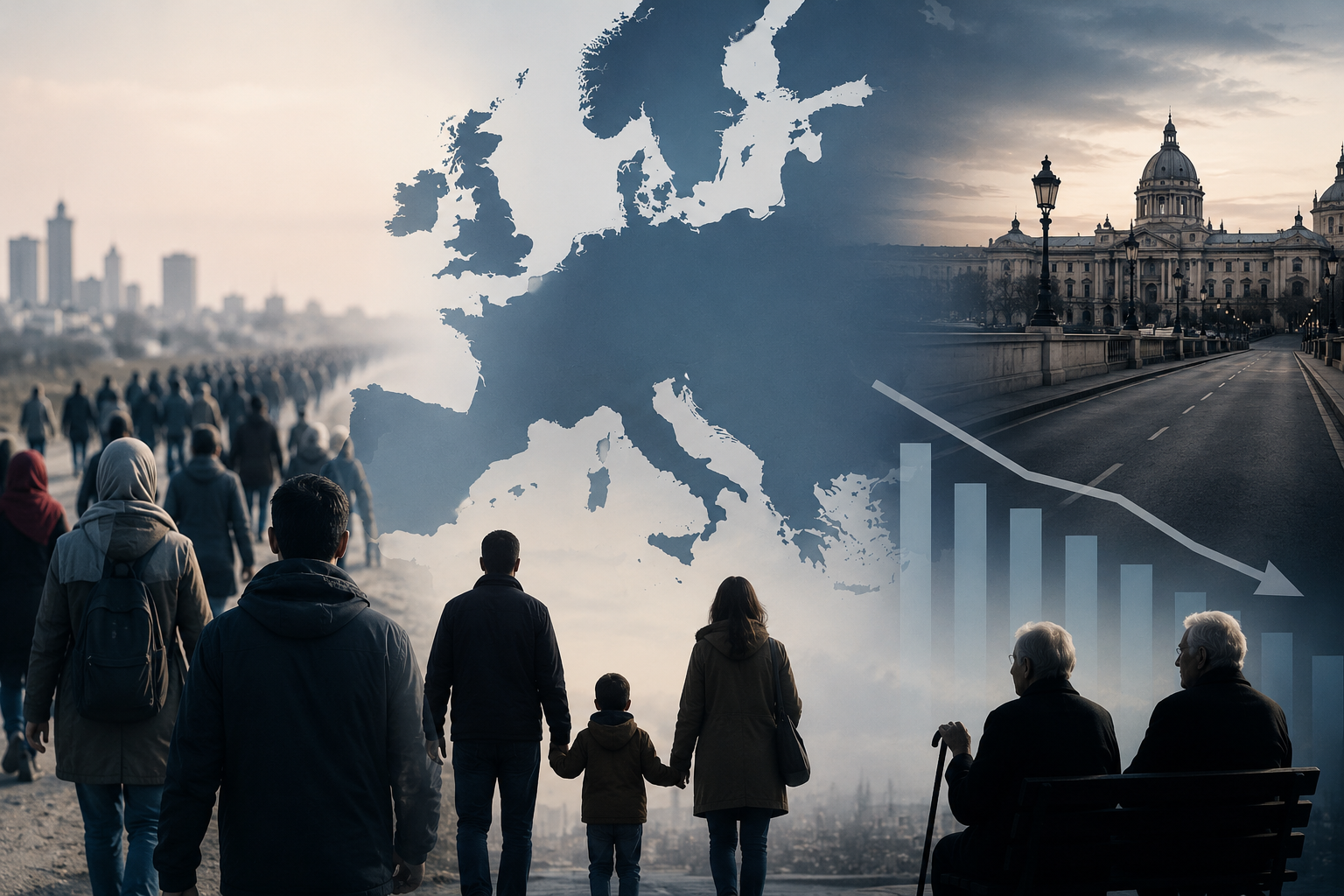
Europe is approaching a demographic crossroads that its political establishment can no longer afford to treat merely as an immigration-management problem. The real issue is the simultaneous convergence of three trends: sustained immigration, extremely low fertility among European populations, and the rapid ageing of the continent.
The European Union’s total fertility rate fell to just 1.34 children per woman in 2024—far below the replacement level of approximately 2.1. It was the lowest EU fertility rate recorded since 2001. At the same time, Europe has one of the world’s oldest populations.
This creates a demographic vacuum. If a society produces substantially fewer children than are required to replace its population, that gap must eventually be reflected either in population decline, increased immigration, or some combination of the two.
The crucial question, therefore, is not simply how many migrants Europe receives today. It is what happens when a rapidly ageing indigenous population is increasingly supplemented by younger populations originating disproportionately from regions with higher fertility.
From immigration to parallel societies
The Muslim population of Europe remains a minority. The latest comprehensive Pew estimates put it at around 6% of Europe’s population in 2020. But the distribution is highly uneven. Muslims accounted for about 8% of Sweden’s population and 7% of Germany’s, while the Muslim population had also increased significantly in several other Western European countries.
In England and Wales, the 2021 Census recorded 3.9 million Muslims, representing 6.5% of the population, up from 4.9% in 2011.
These numbers should neither be exaggerated nor dismissed.
Being Muslim does not automatically mean supporting Sharia law, rejecting democracy or refusing integration. Millions of European Muslims are ordinary citizens who participate peacefully in their societies.
The genuine concern begins when immigration produces geographically concentrated communities whose social, cultural and political identities increasingly operate independently of the national mainstream.
A functioning democracy can accommodate religious diversity. What it cannot easily sustain indefinitely is the emergence of large parallel societies in which a substantial section of citizens begins to regard religious identity as more important than common citizenship and constitutional law.
That is where today’s migration debate could become tomorrow’s much larger political problem.
Demography eventually becomes politics
Demographic change is never merely arithmetic. Once a community becomes sufficiently large and concentrated, it inevitably acquires greater political influence.
This is already visible across Europe.
In the 2024 European Parliament election campaign, immigration and asylum were among the principal concerns of voters, while Germany ranked immigration and asylum as its single most important issue in one major cross-country survey.
In Britain, the transformation has been particularly striking. By 2025, YouGov polling found immigration and asylum had overtaken the economy as the country’s leading public concern, with 58% naming immigration among their three biggest issues compared with 51% for the economy.
The political message is unmistakable: immigration has moved from being a specialist policy issue to a central electoral issue.
Parties that once regarded the subject as politically dangerous are increasingly being compelled to address border control, asylum, deportation, integration and citizenship.
The Israel-Gaza question and the politics of identity
Another development deserves careful attention: the extent to which Middle Eastern conflicts can influence European domestic politics.
The Gaza war has demonstrated that foreign-policy questions can become intensely domestic issues when substantial immigrant communities retain strong emotional, religious or familial connections with conflicts outside Europe.
A 2024 UK poll found that 21% of Muslim voters considered the Israel-Palestine conflict their single most important election issue, while 44% placed it among their five most important issues. At the same time, the same survey showed that NHS services, inflation, cost of living and the economy remained more important overall.
That distinction matters.
It would be wrong to conclude that European Muslims collectively determine European foreign policy or that every Muslim citizen places religious identity above national interest. But it would be equally naïve to pretend that the electoral weight of organised communities has no influence on political calculations.
Governments naturally listen to electorates. As particular communities grow larger and more politically cohesive, their concerns inevitably receive greater attention.
The lesson Europe should learn before the window closes
India provides an imperfect but instructive historical analogy.
Partition in 1947 was intended, among other things, to resolve the political conflict surrounding competing national identities by creating separate states. Yet a very large Muslim population remained in India, and communal tensions did not disappear with the creation of Pakistan.
The lesson is not that Europe’s Muslims will reproduce India’s history. That would be an unjustified prediction.
The lesson is more fundamental: demographic questions cannot be permanently solved merely by drawing political boundaries or assuming that communities will automatically assimilate.
Once separate demographic communities become large, geographically concentrated and politically organised, integration becomes much more difficult.
Europe therefore still has choices.
It can maintain controlled and lawful immigration; distinguish genuine asylum from economic migration; enforce its borders; demand meaningful integration; insist that constitutional law applies equally to everyone; and encourage a civic identity that transcends religious and ethnic divisions.
Or it can postpone difficult decisions until demographic and political realities make those decisions substantially harder.
The real danger is not diversity—it is fragmentation
Europe’s future does not have to be a conflict between Christians and Muslims, Europeans and immigrants, or “white” and non-white populations.
The real dividing line should be between integration and fragmentation.
A successful multicultural democracy can contain many religions, ethnicities and cultures while maintaining one legal and civic framework. A fragmented society, by contrast, can eventually become a collection of communities competing for political power, public resources and cultural influence.
That is why Europe’s demographic trajectory deserves serious attention.
The question is not whether Europe will become more diverse. That process is already underway.
The question is whether Europe will remain one integrated civic civilisation—or whether demographic change, uncontrolled migration, declining native fertility and identity-based politics will gradually transform it into a collection of increasingly separate communities.
If European governments wait until the latter process becomes irreversible, neither stricter immigration laws nor political speeches will easily restore the social cohesion that was lost.
Demography does not determine destiny. But when demography, migration, identity and electoral politics converge, ignoring the numbers can eventually mean surrendering control over the political consequences.
