
Himalayan deluge: floods in Nepal-Tibet raise questions about transparency, warnings and accountability

Poonam Sharma
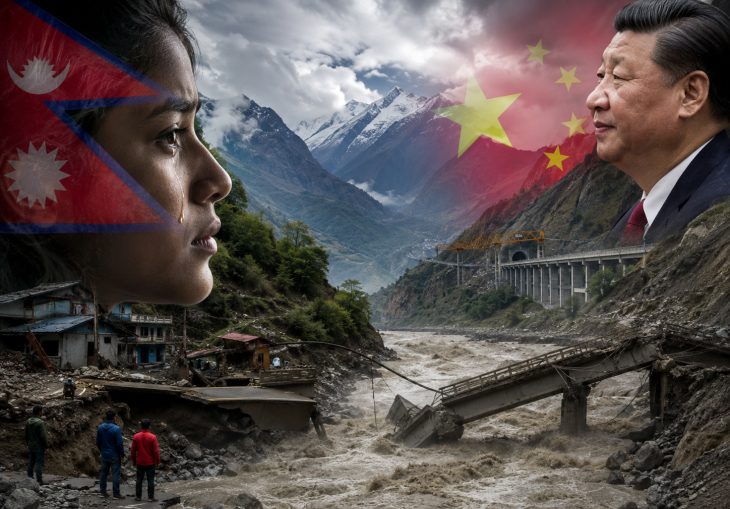
It was just another morning but a terrible cocktail of water, ice and rock came thundering down the Himalayas along the Nepal-Tibet border. Videos circulating online showed the devastation as the flood smashed into China’s Girong Port (Tirunelong Port), swallowing whole structures in seconds, before surging into Nepal, washing away roads, bridges and entire villages. Hundreds are believed dead. Perhaps more.
it was a narrow geologically fragile mountain corridor being drilled blasted and built up at enormous speed here’s the question could that amount of construction’ cause or could have that amount of construction caused the disaster we don’t know There is no evidence yet proving but after a catastrophe on this scale it’s entirely reasonable to ask whether this fragile landscape was being pushed too hard .The same corridor that makes up this disaster zone is where China and Nepal have planned, or are building, a major cross-border power transmission line, the Geelong-Rasuwa-Gadhi project. Heavy construction activity, including tunnels being drilled and machinery grinding away with little visible safety protection, had been filmed in the region days before the flood by a Western tourist. This leads to the question: Did the intense construction cause or aggravate the catastrophe? There is no evidence yet, but the scale of the catastrophe is worth looking at.
At least 800 bodies have been recovered, Nepalese authorities said, and 4000 people remained missing, including more than 500 foreign tourists. China’s official count was much lower, with only three confirmed dead. The numerical discrepancy is staggering. Eyewitnesses and local sources suggest the real toll at Gyrong Port could be much higher. The port is a major land crossing handling nearly 30% of China-Nepal trade, and is packed with tourists, workers, officials and police during the peak travel season.
The aftermath has not only been one of mourning, but also political controversy. China and Nepal soon put out conflicting narratives. Chinese state media and officials kept saying the disaster began on the Nepal side, possibly from an earthquake, while the US Geological Survey and Nepal investigators say a glacial collapse and debris flow helped cause the flood that came from Tibet into Nepal.
Much critical attention has been paid to the absence of timely warning. The flood struck Jirong Port at 10:30 a.m. Beijing time, giving Nepal about 45 minutes to react, according to Chinese media. But the authorities in Nepal say there was no warning before the flood hit. China did not formally notify Nepal until five hours after the disaster hit the port, leaving locals and officials to respond only when the river began to rise.
The issue has now reached the political leadership of Nepal, which is calling for better cross-border early warning systems, especially as a similar disaster hit the region just 14 months ago with similar complaints about late warnings. Even with the Chinese system’s advanced tracking of information, the flow of information in major crises tends to go up the bureaucracy before becoming public, perhaps constraining the ability of downstream actors to respond in a timely manner.
Transparency has also become a flashpoint. Nepal released detailed casualty figures and allowed open access to media, whereas China maintained tight control, restricted independent reporting and emphasized the disaster’s Nepalese origin in headlines. On the Chinese side, there were reports of censorship orders to limit coverage and social media discussion.
The episode brings into sharp focus the region’s geological vulnerability and the human cost of disaster, but also the need for effective early warning systems, open communication and accountability—especially when lives and livelihoods in one country are at risk in another. As families search for the missing, the world waits for answers and lessons learned.
