
‘If Hindus Awaken, World Awakens’ ‘Vishwaguru, not Mahashakti’: Mohan Bhagwat in Toronto

By Anjali Sharma
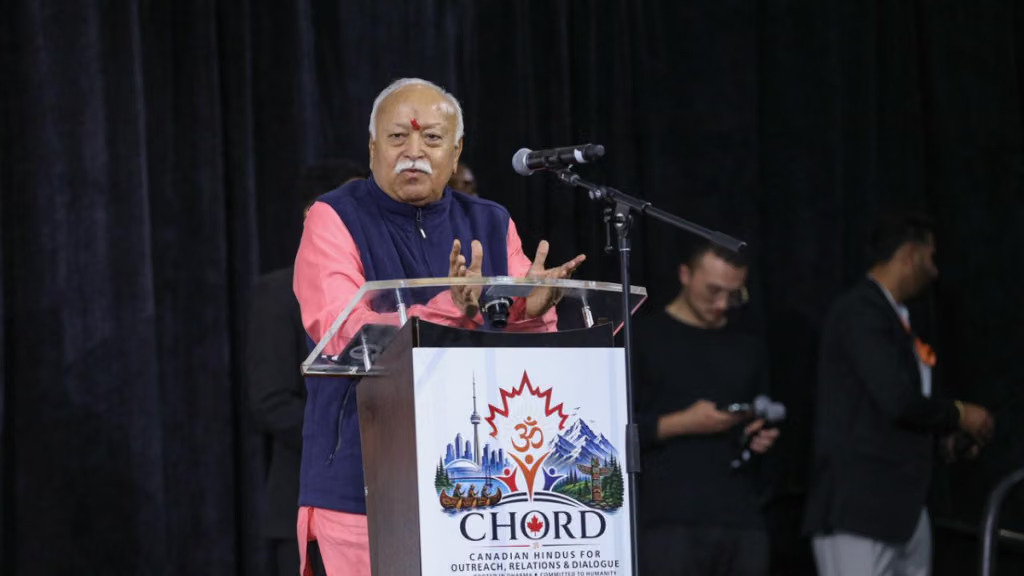
NEW YORK- RSS chief Mohan Bhagwat on Monday told a gathering in Toronto that India’s rise should be measured by the service it offers the world rather than by its ability to dominate it, argued that the country became a “Vishwaguru” through its civilisational character and not as a “Mahashakti”.
Bhagwat cited India’s history of offering refuge and humanitarian help, while Jason Kenney spoke of renewed momentum in India-Canada relations.
He was speaking at the “Hindu Vishwa Bandhu Embrace the World in Friendship” event, Bhagwat linked that idea to what he described as India’s long tradition of offering refuge, helping people in crises and accepting religious and cultural diversity.
“One may call Bharat a superpower, but it was not one. It served the world, and by its own character, it became ‘Vishwaguru’, not Mahashakti,” he said.
The gathering was organized by Canadian Hindus for Outreach, Relations and Dialogue.
Former Canadian defence minister and former Alberta premier Jason Kenney was among those who attended.
Bhagwat returned to service as the defining feature of the India he sought to describe.
“Whenever Bharat has been asked for help anywhere in the world, it has never refused, and it extends a helping hand even without even being asked. This is our tradition, the DNA of Bharat. That is why you may have heard the saying ‘If Hindus awaken, the world awakens,’” he said.
He cited the refuge given to Polish people during the Second World War by the Maharaja of Jamnagar as one example.
Bhagwat also referred to an evacuation from a Middle East conflict in which, he said, Indian military aircraft brought out citizens of seven other countries along with Indians.
“When, some years back in the Middle East war, people were trapped, the military planes of Bharat went there and rescued not only Bharatiya citizens; citizens of seven countries were rescued from there by Bharatiya,” he said.
He also said communities facing persecution had historically found refuge in India.
“Anywhere in the world, if someone was persecuted, he got asylum in Bharat only,” Bhagwat said while referring to Muslims, Christians, Jews, and Parsis.
Bhagwat contrasted his account of India’s civilisational reach with territorial or religious expansion.
He said India’s ancestors travelled across distant regions to share knowledge rather than conquer countries or convert their people.
“We did it. Long back, when there were no roads, no boats, no aeroplanes, no motor vehicles, only bullock carts and horses– our ancestors went to the regions from Mexico to Siberia, giving them all knowledge. On foot, they crossed the Himalayas, went to China, and went to Siberia and Mongolia. By small boats, they went to Southeast Asia… What did they do? They conquered no country; they converted nobody. Wherever they went, they gave knowledge – astrology and Ayurveda. They imparted the civilizational values.”
Bhagwat also used the address to explain his conception of Hindu identity, argued that it could not be confined to a particular form of worship, language or way of life.“When I say Hindu, the word Hindu cannot be defined by any specific language, through any specific worship, or through any living style,” he said.
He said Hindus “respect all” and “accept all”.
Bhagwat said that diversity should therefore not be treated as something at odds with unity.
“They have been taught to see unity in diversity. That is why diversity never poses a problem for unity in India; our tradition teaches us that not only is there unity in diversity, but diversity itself is a form of unity,” he said.
“Nature, the expression of reality, is diverse. Diversity is natural. Unity is the reality. You have to tackle with natural, keeping in mind reality. That is the ancient ethos of Bharat,” he added.
Bhagwat tied the argument to Vasudhaiva Kutumbakam, which he described as the idea that the world constitutes one family.
“Those who are open-minded and knowledgeable embrace the concept of Vasudhaiva Kutumbakam — the belief that the entire earth is one family,” he said.
He argued that physical differences between people, did not alter their essential unity.
“While individuals in the material world may differ in body, shape, and complexion, in essence, we are all one. Therefore, serving others is our duty. We have gained this wisdom, which brings us enduring happiness and lasting contentment,” Bhagwat said.
The Toronto event also carried a diplomatic undertone as Kenney spoke of what he described as renewed momentum in India-Canada relations.
Kenney said “It is so wonderful to see renewed momentum in the Canada-India relationship that will be represented by the second visit of Prime Minister Modi to Canada later this year,”.
His remarks were followed by chants of “Modi, Modi” from sections of the gathering.
Prime Minister Narendra Modi and Canadian Prime Minister Mark Carney had met on the sidelines of the G7 Summit in Évian, France, in June.
