
India Advocates Trust and Accountability at IPU Assembly
Harivansh urges parliamentarians to strengthen transparency, accountability and public trust

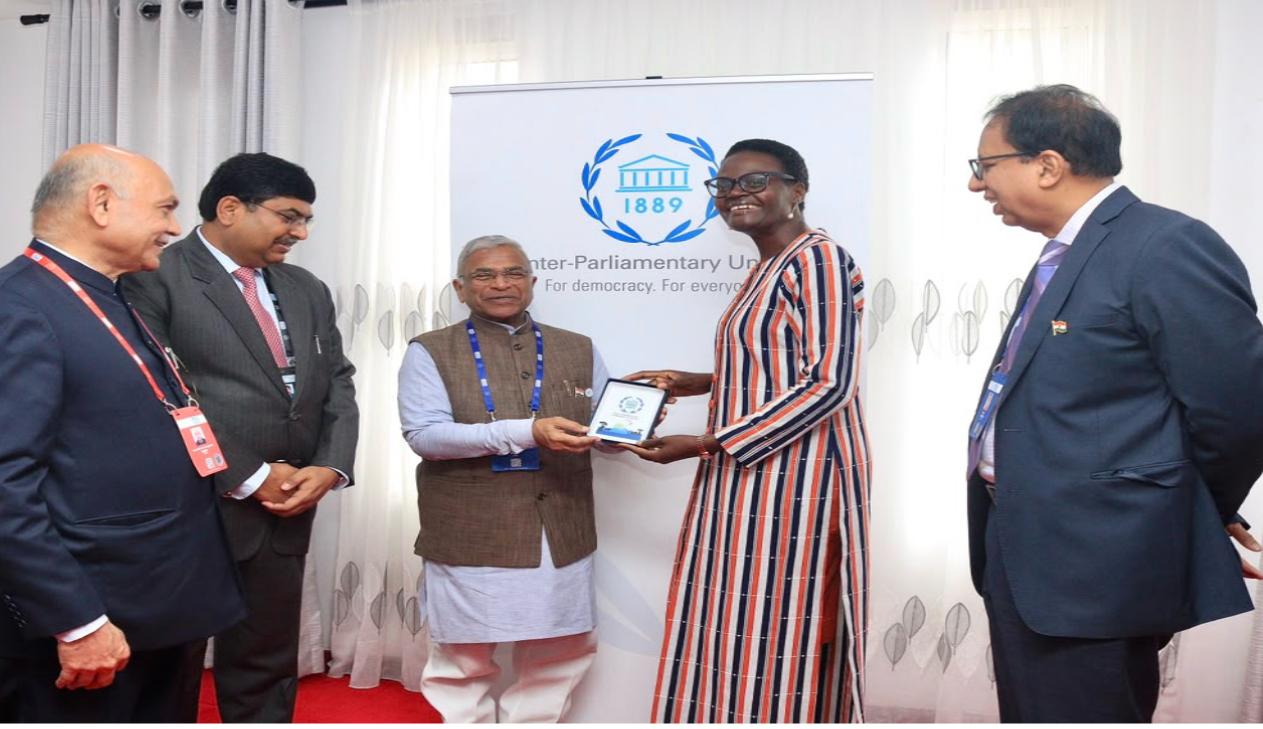
- Harivansh calls for transparency and accountability in governance.
- Indian MPs participate in discussions on peace, AI, health and climate.
- India holds bilateral talks with Russia’s Federation Council leadership.
- IPU adopts a climate-disaster resilience issue as emergency item.
GG News Bureau
Arusha, 8th Oct: The Indian Parliamentary Delegation led by Rajya Sabha Deputy Chairman Harivansh continued its participation in the 153rd Assembly of the Inter-Parliamentary Union (IPU) in Arusha on October 7, with Indian parliamentarians taking part in discussions on governance, peace, human rights, technology, sustainable development and international cooperation.
Participating in the General Debate on “Enhancing good governance and empowering communities through inclusivity, trust and opportunities for all,” Harivansh called on parliamentarians to strengthen transparency, uphold accountability and nurture public trust as essential pillars of good governance.
Members of the Indian delegation also participated in a range of thematic discussions and workshops during the third day of the Assembly.
Dr. Sanjay Jaiswal, MP, Lok Sabha, took part in a workshop on “Mental health across generations: Coping with digital overload, economic pressure and uncertainty.”
Smt. Aparajita Sarangi, MP, Lok Sabha, participated in a panel discussion on “The UN country team in the United Republic of Tanzania as the reflection of a reformed UN system” at the Standing Committee on United Nations Affairs.
Smt. Bijuli Kalita Medhi, MP, Lok Sabha, participated in the Working Group on Science and Technology. She also joined the Standing Committee on Sustainable Development’s debate on “Parliamentary leadership to protect mountain and ocean ecosystems and achieve the 30% conservation goal by 2030.”
Smt. Kamaljeet Sehrawat, MP, Lok Sabha, participated in a panel discussion on “Beyond commitments for peace: The role of parliaments in the enforcement of international humanitarian law and international human rights law.” She also attended a workshop on promoting ethical artificial intelligence serving child rights and the meeting of the Committee to Promote Respect for International Humanitarian Law.
Dr. Lata Wankhede, MP, Lok Sabha, participated in a workshop titled “What’s on our plates? Delivering healthy food in a changing climate.”
Dr. Sasmit Patra, MP, Rajya Sabha, participated in an expert hearing of the Standing Committee on Peace and International Security on “Strengthening maritime security and protecting critical infrastructure in times of conflict: The role of parliaments in safeguarding international navigation and global economic stability.”
The Indian delegation also held a bilateral meeting with Konstantin Kosachev, Deputy Chairman of the Federation Council of the Federal Assembly of Russia, where issues of mutual interest were discussed.
Harivansh separately met outgoing IPU President Tulia Ackson and appreciated her efforts to make the organisation’s functioning more inclusive and vibrant. He also commended her initiatives aimed at deepening and broadening parliamentary democracy among nations.
Secretary-General, Rajya Sabha, met Anda Filip, who was elected Secretary General of the IPU at its 152nd Assembly in Istanbul, becoming the first woman to hold the post in the organisation’s 137-year history. He conveyed Parliament of India’s full support for the IPU’s objectives of promoting democracy and peace and wished her a successful tenure.
A key development during the day was the adoption of an emergency item for the 153rd IPU Assembly. The Indian delegation participated in the voting on the proposed item.
Following the vote, the IPU President announced the adoption of “Urgent parliamentary action to address climate-related disasters and strengthen resilience in the Himalayan region and other vulnerable regions” as the emergency item of the Assembly.
The item was proposed by Nepal and supported by India, among others, highlighting the growing parliamentary focus on climate-related disasters and resilience in vulnerable regions.
