
India Launches First ‘SkyCast’ Aviation Weather System
Dr Jitendra Singh says advanced platform will cut fog-related flight disruptions and boost aviation safety

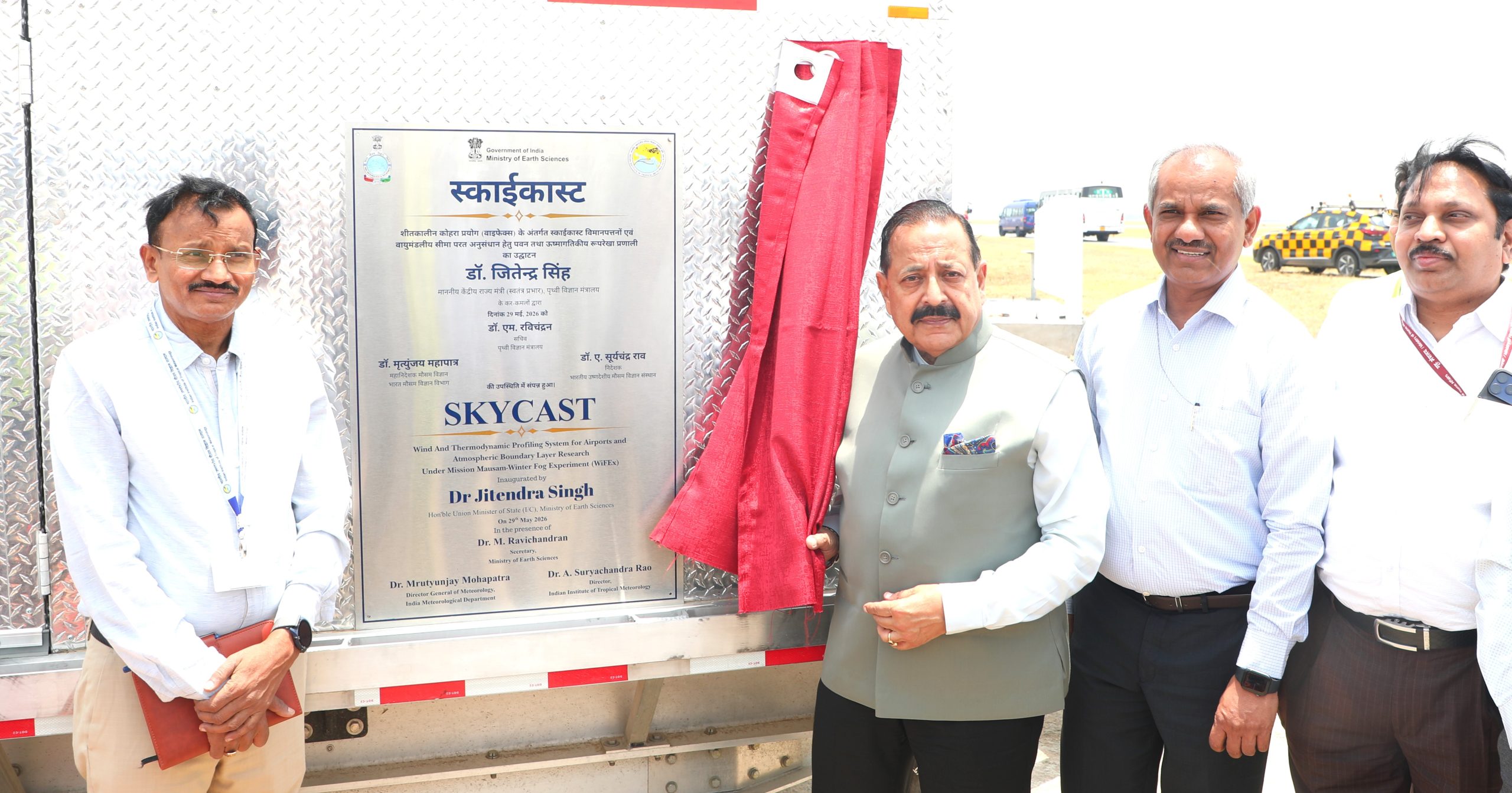
- India launches first SkyCast System at Delhi’s IGI Airport
- Country becomes 19th globally to deploy the advanced technology
- System will provide real-time weather intelligence to pilots
- Next SkyCast facility planned at Jewar Airport
GG News Bureau
New Delhi, 29th May: Union Minister Jitendra Singh on Friday inaugurated India’s first SkyCast System at Delhi’s Indira Gandhi International Airport, describing it as the beginning of a new era of fog-free and weather-smart aviation in the country.
The advanced integrated aviation weather monitoring system is designed to provide real-time weather intelligence to pilots and aviation operators, helping reduce flight delays, diversions and cancellations caused by fog, turbulence and other adverse weather conditions.
Speaking at the launch, Singh said India has become the 19th country in the world to deploy such an advanced atmospheric remote sensing system. He announced that the next SkyCast facility will be established at Jewar Airport, followed by expansion to other airports across the country.
Developed under the government’s Mission Mausam programme, SkyCast integrates multiple advanced atmospheric technologies, including Radar Wind Profiler, SODAR, Microwave Radiometer, Ground-based Fog Aerosol Spectrometer (GFAS) and CL61 Lidar-based Ceilometer.
According to the minister, the system can monitor atmospheric conditions up to nearly three kilometres above the airport and provide critical data on wind speed, wind direction, turbulence, moisture, visibility and fog formation. This information is expected to significantly improve the safety of take-offs and landings.
Singh credited Prime Minister Narendra Modi’s vision behind Mission Mausam for enabling the development of such futuristic weather infrastructure.
He said the system would provide advance alerts to pilots and aircrew, even within short windows of around three hours, allowing them to make informed operational decisions and avoid unnecessary disruptions.
The scientific foundation of SkyCast is based on the Winter Fog Experiment (WiFEX), a joint initiative launched by the Indian Institute of Tropical Meteorology and the India Meteorological Department at IGI Airport in 2015. The project generated crucial insights into fog formation, visibility reduction and atmospheric behaviour, contributing to the development of the new system.
Secretary, Ministry of Earth Sciences, M. Ravichandran said the facility would not only support aviation operations but also strengthen weather forecasting capabilities nationwide by generating high-quality atmospheric data.
Officials said SkyCast will also support advanced forecasting models, artificial intelligence-driven decision systems, urban weather forecasting, pollution management, transport advisories and disaster preparedness initiatives, marking a major step towards weather-smart infrastructure in India.
