
India to Have 100 Doppler Radars in Two Years: Dr Jitendra Singh
CM Yogi Adityanath, Union Minister Dr Jitendra Singh Inaugurate Regional Meteorological Centre in Lucknow

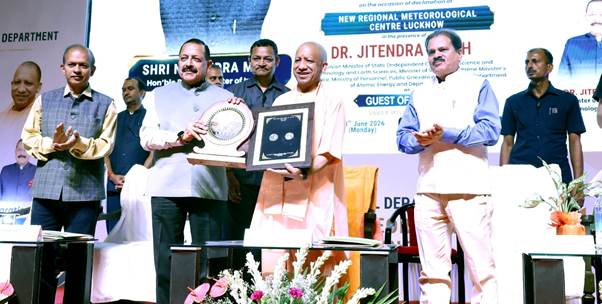
- Yogi Adityanath and Dr Jitendra Singh inaugurate Regional Meteorological Centre in Lucknow
- India to expand Doppler Weather Radar network to nearly 100 under Mission Mausam
- Uttar Pradesh’s weather infrastructure sees major growth over the last decade
- New centre to serve Uttar Pradesh, Uttarakhand and adjoining regions
GG News Bureau
Lucknow, 8th June: Union Minister of State (Independent Charge) for Science and Technology and Earth Sciences Dr Jitendra Singh and Uttar Pradesh Chief Minister Yogi Adityanath on Monday inaugurated the new Regional Meteorological Centre (RMC) in Lucknow, marking a major step in strengthening India’s weather forecasting network.
Addressing the event, Dr Singh said India’s meteorological infrastructure has expanded significantly over the last decade, enabling more accurate, localised and impact-based weather forecasts.
Highlighting the Centre’s ambitious Mission Mausam programme, the Minister said India currently has 50 Doppler Weather Radars and plans to add another 50 over the next two years, taking the national network to nearly 100 radars.
“India had only 17 Doppler Weather Radars in 2014. Several states did not have even a single radar. Today, the network has expanded to 50 radars and another 50 are proposed under Mission Mausam,” he said.
The Minister noted that forecasting capabilities have evolved from broad regional predictions to highly localised and time-specific forecasts, benefiting citizens, farmers, disaster management agencies and the aviation sector.
Focusing on Uttar Pradesh, Dr Singh said the state’s meteorological infrastructure has witnessed remarkable growth over the past decade. While Uttar Pradesh had only one Doppler Weather Radar in 2014, it now has three operational radars, with six more expected to be commissioned soon.
The number of Automatic Weather Stations in the state has increased from 59 to 107, while Automatic Rain Gauge stations have risen from 132 to 140. Lightning sensors, which were absent in 2014, have now increased to seven.
The Minister also pointed out that aviation meteorological services are currently available at 11 airports across Uttar Pradesh, reflecting the state’s growing aviation infrastructure.
Describing Uttar Pradesh as highly vulnerable to floods, droughts, heatwaves, thunderstorms and other extreme weather events, Dr Singh said the new Regional Meteorological Centre will improve monitoring, forecasting and dissemination of weather information across the region.
The newly inaugurated centre will cater to Uttar Pradesh, Uttarakhand and adjoining areas, helping strengthen disaster preparedness and public safety measures.
Dr Singh urged citizens and local administrations to take weather advisories and early warnings seriously, emphasizing that real-time weather information is now being disseminated through multiple digital platforms and should be integrated into planning and decision-making processes.
The Minister said improved forecasting systems are already contributing to disaster risk reduction by providing advance warnings for flash floods, cloudbursts, thunderstorms, lightning strikes, avalanches and other extreme weather events.
Officials said the Regional Meteorological Centre is expected to play a crucial role in supporting agriculture, aviation, disaster management and climate-related services across northern India.
