
Jaishankar flags China rise, US ‘deliberately become a lonelier power’ at Munich leaders meet

By Anjali Sharma
WASHINGTON – External Affairs Minister S Jaishankar on Sunday said the changing US approach and China’s growing power are now among the biggest forces shaping global geopolitics he world is becoming harder to read, with old partnerships being tested and new centers of power gaining influence..
The countries are increasingly balancing ties with multiple global powers, he said amid shifting alliances and sharper rivalries.
New partnerships among middle powers are also reshaping cooperation as traditional multilateral institutions face growing pressure.
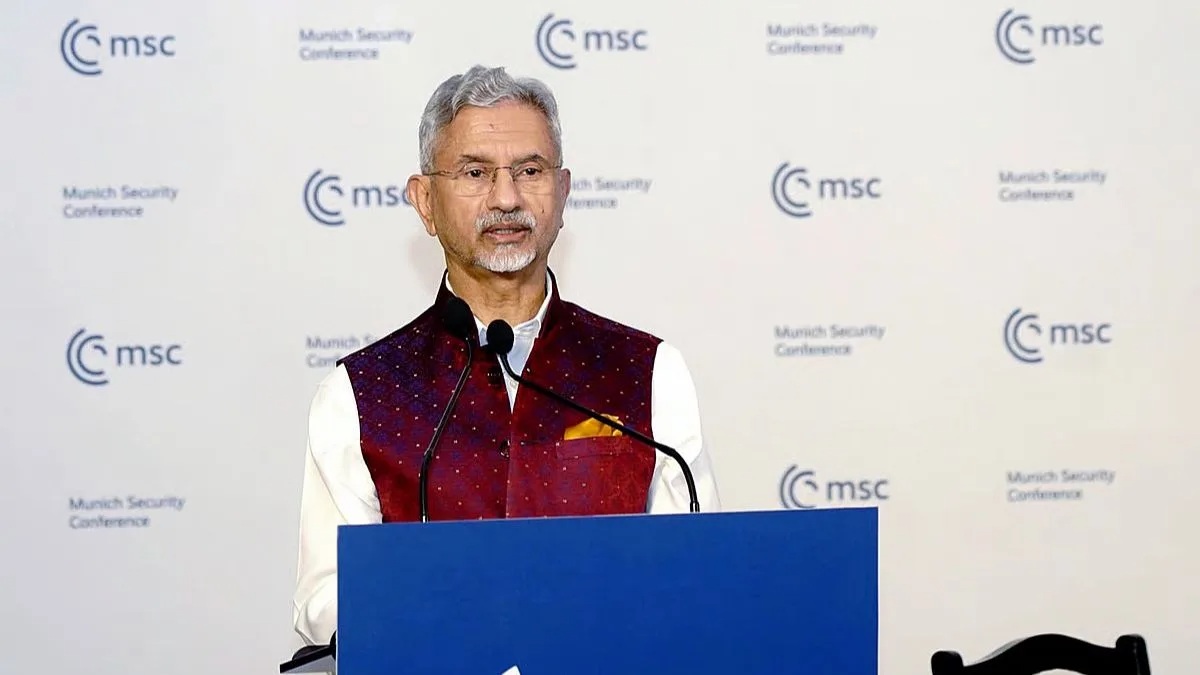
Jaishankar was speaking at the Munich Leaders meeting on Sunday said the international system is witnessing a “radical repositioning of the United States”, alongside the continued rise of China.
He described the changing American role, Jaishankar said the shift was not accidental but a “posture of choice”.
“No one in the room would disagree with the fact that the landscape today is primarily marked by a radical repositioning of the United States,” he said.
According to Jaishankar, the US has, in a way, “deliberately become a lonelier power”.
He placed this development alongside the rise of China, which he described as a country with a strong sense of its own uniqueness.
“China, sees itself as a unique country that is in a way both its self-perception, in many ways, also the reality. And we are looking at very sharp competition,” he said.
Jaishankar said the emerging global rivalry cannot simply be viewed as a contest between the US and China.
“That competition today, not limited to these two countries, has led to a weaponization of any leverage that any country has,” he said.
The countries remain deeply connected through trade, technology, transport and other forms of interdependence.
Jaishankar said the result is a complicated international system where competition and cooperation exist at the same time.
According to Jaishankar, emerging and middle powers are increasingly looking for ways to work together when their interests do not directly clash.
He said these countries would also continue to cooperate with both the US and China where their interests require it.
He pointed to the Quad as one example of such cooperation.
In connectivity, he cited the India-Middle East-Europe Economic Corridor, the International North-South Transport Corridor and the Northern Sea Route as examples of countries working together on shared interests.
Jaishankar also referred to BRICS, saying it demonstrates how countries can gain greater influence by acting collectively.
“BRICS is an example of various parties who feel that their collective voice is much stronger than the individual ones,” he said.
Jaishankar highlighted the International Solar Alliance and the Coalition for Disaster Resilient Infrastructure, both initiated by India.
He said these initiatives show how countries that are not necessarily the leading global powers can still come together around common interests.
“They come together where their interests require them to do so: they find working arrangements, develop an agenda, develop organizations, develop habits of cooperation,” he said.
He described this network of flexible partnerships as part of the “evolving global order”.
Jaishankar also pointed to the accelerated emergence of a multipolar world.
He said countries are increasingly maintaining relationships with multiple powers even when those relationships are difficult to harmonize.
EAM suggested that for many countries, this amounts to a strategy of “advancing by hedging”.
But the changing system could create further pressure on multilateral institutions, he added.
Jaishankar said multilateralism is already facing visible difficulties, with the United Nations “very visibly gridlocked”.
He argued that one consequence of the changing global order could be the growing importance of smaller groups and flexible coalitions.
