
Modi-Putin-Xi Handshake: The Picture That Tells All About India’s Diplomatic Confidence

Poonam Sharma
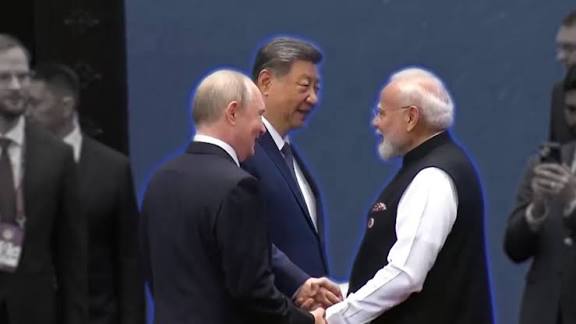
Sometimes international diplomacy is not spelled out in a long declaration but a few seconds of human interaction. This is just the kind of moment that the brief handshake between Prime Minister Narendra Modi, Russian President Vladimir Putin and Chinese President Xi Jinping at the 26th Shanghai Cooperation Organization (SCO) Summit in Bishkek has turned out to be.
The leaders of the SCO, Modi, Putin and Xi, smiled and held hands in a chain while posing for the traditional official family photograph. The video of the Kremlin pool provided a stunning visual moment of friendliness between three of the world’s most consequential powers. The caption the Kremlin gave to the image itself further politicized it: “Strategic alignment: Russia-India-China.” But the photograph is less than the meaning of the moment.
It is a mirror of something the modern world desperately needs: the ability of great powers to stay interested when their interests are not fully convergent.
The 26th SCO Summit is being held at a time when the international situation is witnessing extraordinary turbulence. The SCO has developed into an important Eurasian platform with 10 member states, but its members continue to face security challenges, economic pressures and competing strategic interests. So the fact that India, China and Russia are sitting at the same table has considerable diplomatic weight. It is a particularly crucial time for India.
India’s foreign policy has never been premised on the assumption that it must always belong to one geopolitical camp. Instead, New Delhi has increasingly demonstrated the value of strategic autonomy, forging strong partnerships with different powers, but making decisions based on India’s own national interests.
India’s simultaneous engagement with Russia, China, the United States, Europe, Iran, the Gulf and the wider Indo-Pacific should therefore not be seen as contradictory. This is the sign of a nation confident in itself, seeking maximum diplomatic elbow room in a rapidly changing world. The Bishkek image is a great example of this approach.
India and Russia have a long term strategic relationship. Meanwhile, India and China have a complex relationship where economic interests, regional security and remaining differences co-exist. The willingness of Modi and Xi to engage in public, with Putin also part of the moment, shows that diplomatic engagement still remains possible. And that is important.
Diplomacy is not about countries agreeing on everything. Indeed, diplomacy is most useful when there are differences to be resolved. If nations only talked to countries with which they were completely in agreement, there would be very little point in international diplomacy.The warmth visible in Bishkek should be welcomed therefore but not overemphasized.
This is not evidence that India, Russia and China have suddenly formed a formal political alliance. Nor does the handshake erase differences between New Delhi and Beijing or between Moscow and other great powers. Recent reporting itself describes the interaction as symbolic, not the forging of a firm new alliance.
Symbolism is important in international relations.
Handshake can be a sign of openness A smile can take the edge off. In a short conversation there is the possibility of opening the way to a longer one. And a public display of good manners can help create an environment in which difficult issues can be addressed without unnecessary confrontation. This is especially pertinent in an age in which global politics is increasingly couched in the language of confrontation.
The Bishkek summit also proved that India is not restricting its diplomacy to one or two relationships. Prime Minister Modi also held talks with Iranian President Masoud Pezeshkian, during which they exchanged views on regional issues, bilateral cooperation and peaceful approaches to crises. India too has kept up its engagement with Central Asian and other Eurasian partners.
India’s greatest strength is this broad diplomatic outreach.
The world is trending to a more multipolar order. Economic power, military capacity, technology, energy security, supply chains and connectivity are more and more dispersed across multiple centers of influence. In such a world, countries that can speak across geopolitical divides will have a big advantage. India is increasingly becoming one of those countries. The Modi-Putin-Xi moment also sends a big message to the SCO itself. The organization cannot be just a platform for competing geopolitical narratives. The real value is whether its members can use it to solve practical problems – terrorism, regional security, trade, connectivity, energy, development and stability.
Chinese President Xi Jinping has highlighted development and security as the main priorities of the organization, emphasizing cooperation instead of endless confrontation.
India has also made it clear that security cannot be divorced from the war on terrorism. At the Bishkek summit, Modi had strongly condemned the use of terrorism as a strategic tool and highlighted the need to dismantle the larger ecosystem that sustains terrorism. That’s when India’s diplomatic game becomes really interesting. New Delhi can be friendly without being naïve, cooperative without compromising its interests, and firm without closing every channel of communication.
The essence of mature diplomacy, of balance.
But the image of Modi, Putin and Xi holding hands should not be read as a statement that all three countries see the world exactly the same way. They don’t. There are a few things they see eye to eye on and a few things they clash on. The real achievement is much simpler and maybe more important. They could stand side by side. That skillset is much in demand in a world of wars, economic uncertainty, strategic competition and regional crises. India’s increasing global weight gives it a chance to be not just a player in global power politics, but a bridge between different power centers. The country can engage the West while maintaining its relationship with Russia; cooperate with China where interests permit, while strongly protecting its national security; deepen ties with Iran and Central Asia, while strengthening partnerships across the Indo-Pacific.
This is not diplomatic confusion.
It’s diplomatic assurance. The Bishkek handshake therefore merits a positive interpretation — not because it magically resolves geopolitical tensions, but because it reminds the world that dialog is still possible. The photo may live for a few seconds. Its message can live much longer than it.
Three powerful leaders from three major countries stood together before the cameras. They did not remove their differences. They just proved that differences don’t have to get in the way of dialog.That’s a powerful message when the world needs more bridges and not more walls.
And for India, it is also a moment of quiet diplomatic confidence: New Delhi need not choose between strength and friendship, between strategic autonomy and global engagement, or between defending its interests and keeping the doors of dialog open. It can do all of them, and increasingly does them all at once.
