

By Anjali Sharma
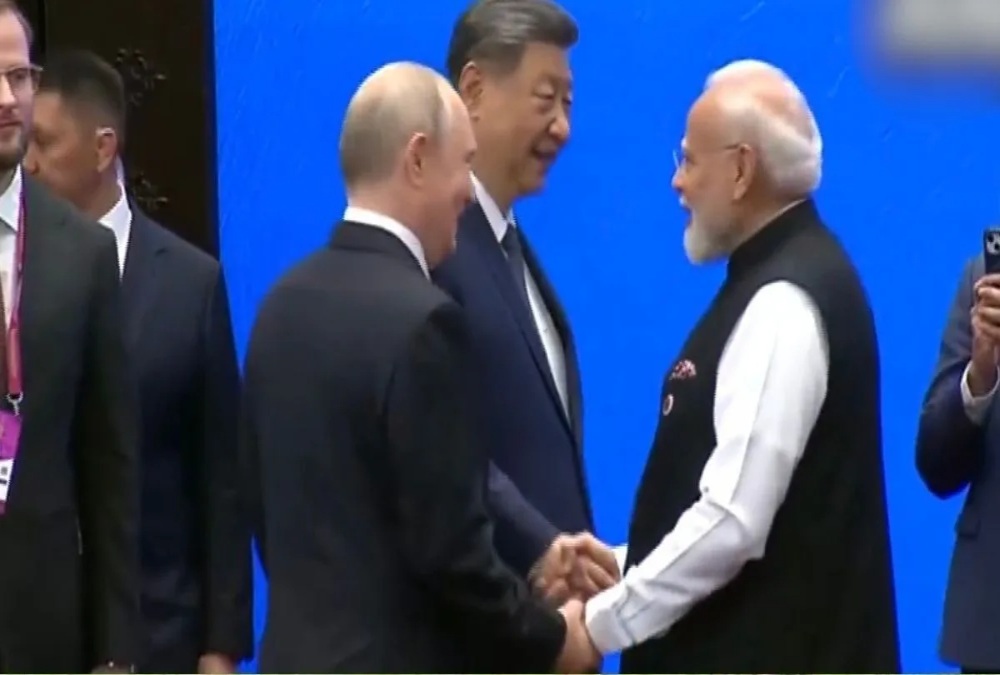
WASHINGTON – Prime Minister Narendra Modi, Chinese President Xi Jinping and Russian President Vladimir Putin on Tuesday exchanged handshakes, it was a warm and closely watched moment in Bishkek ahead of the 26th Shanghai Cooperation Organisation Summit.
The moment offered a striking image of diplomatic engagement among three major powers at a time of intense geopolitical uncertainty.
The brief exchange between Modi and Xi was significance because India-China ties have been undergoing a carefully managed reset after the deadly Galwan Valley clash of June 2020.
The interaction took place before the leaders assembled for the official family photograph and came against the backdrop of a gradual but still cautious improvement in India-China relations following the long-drawn-out military confrontation along the Line of Actual Control.
The latest visuals should not be interpreted as evidence that the strategic differences between New Delhi and Beijing have disappeared.
They underlined the return of high-level political engagement after years in which the border dispute cast a long shadow over virtually every aspect of the bilateral relationship.
The leaders were seen conversing closely and sharing a light moment before joining other SCO leaders for the family photograph.
The optics were notable because India, China and Russia occupy different positions on several major international issues, even as they remain important participants in institutions such as the SCO and BRICS.
The encounter also demonstrated the continuing importance of face-to-face diplomacy in managing competition and differences among major powers.
Modi-Xi interaction came at an consequential moment.
Senior Indian and Chinese officials have been working to consolidate the improvement in relations that followed the October 2024 agreement on patrolling arrangements in eastern Ladakh.
The agreement paved the way for disengagement from the remaining friction points and enabled the first full delegation-level meeting between Modi and Xi in 5 years at the BRICS Summit in Kazan in October 2024.
The trajectory has been one of cautious normalization rather than a complete restoration of trust.
In August 2025, Modi and Xi held talks on the sidelines of the SCO Summit in Tianjin, where both sides described themselves as development partners rather than rivals and stressed the importance of mutual respect, mutual interest and mutual sensitivity.
Modi also underlined that peace and tranquility along the border remained essential for sustained progress in bilateral relations.
The border question remains the fundamental test of the India-China relationship.
The 2020 confrontation fundamentally altered India’s approach to Beijing, with New Delhi making it clear that broader bilateral engagement could not be insulated from developments along the LAC.
The Galwan clash, in which 20 Indian soldiers were killed and at least four Chinese soldiers were reported killed triggered a prolonged military and diplomatic standoff and a sharp deterioration in political trust.
Both sides negotiated disengagement at several friction points, culminating in the 2024 patrolling agreement.
The latest diplomatic push has continued even in 2026.
National Security Adviser Ajit Doval and Chinese Foreign Minister Wang Yi held talks in Beijing on the boundary question and broader bilateral relations.
Both sides agreed to continue dialogue towards a “fair, reasonable and mutually acceptable” settlement of the boundary issue, while emphasized the importance of maintaining stability along the disputed frontier.
The engagement provides important context to Tuesday’s handshake.
The image of Modi and Xi speaking informally does not mean that the boundary dispute has been resolved; instead, it suggests that both sides increasingly see sustained political dialogue as necessary to prevent border tensions from again overwhelming the wider relationship.
The distinction is important because India continues to insist that peace and tranquility in border areas are a prerequisite for durable normalisation, while China has traditionally sought to prevent the boundary question from determining the entire bilateral relationship.
The next major test of this evolving relationship could come in New Delhi itself. Xi is expected to travel to India for the 18th BRICS Summit on September 12-13, in what would mark his first visit to India in nearly seven years.
If confirmed, the visit would be diplomatically significant because it would bring the Chinese leader to New Delhi at a time when both countries are attempting to move beyond the most difficult phase of their post-Galwan relationship.
Chinese officials are reportedly involved in preparations relating to accommodation and security, although formal confirmation from Beijing of Xi’s visit remains awaited.
A Modi-Xi meeting on Indian soil would carry significance beyond the symbolism of a presidential visit.
It would provide an opportunity for both sides to assess whether the recent stabilization along the LAC can be converted into a broader and more predictable relationship encompassing trade, investment, travel, people-to-people contacts and regional cooperation.
The economic relationship remains substantial, but India continues to be concerned about the large trade imbalance and about strategic vulnerabilities arising from excessive dependence on Chinese supply chains.
The BRICS platform could therefore provide a useful diplomatic setting for managing the complicated mix of competition and cooperation between the two Asian powers. India is hosting BRICS in 2026 at a time when the grouping has expanded considerably and is seeking a larger role in shaping the global economic and political order.
New Delhi is maintaining strategic autonomy while engaging simultaneously with the United States, Russia, China and other major powers remains central to its foreign-policy approach.
Russia occupies a distinctive position in this triangular equation.
Modi’s interaction with Putin in Bishkek demonstrated the continuing depth of the India-Russia strategic partnership.
Both leaders reviewed cooperation in political, economic, defence, energy, space and people-to-people sectors and discussed regional and global developments. Modi also said he looked forward to welcoming Putin to India for the 18th BRICS Summit on September 12-13.
Putin’s forthcoming visit would be his second trip to India in less than a year, after his December 2025 visit.
Xi and Modi presence in New Delhi would give the BRICS summit an additional strategic dimension, as India seeks to balance its longstanding partnership with Russia with its expanding engagement with Western countries and its efforts to manage competition with China.
The Modi-Xi-Putin optics in Bishkek thus carry significance at several levels.
Three countries are members of both the SCO and BRICS, but their interests are not identical.
Russia remains India’s long-standing defence and energy partner; China is simultaneously a major trading partner, strategic competitor and the country with which India has an unresolved boundary dispute.
Their interaction illustrates how multilateral platforms can create space for dialogue even when bilateral relations remain complicated.
The immediate objective is unlikely to be a dramatic breakthrough with Beijing but the creation of a stable environment in which differences can be managed without renewed confrontation.
The restoration of direct flights, visa facilitation, pilgrimage and other people-to-people contacts has already been part of the broader normalization process. India and China have also recognized the need to address their economic relationship while reducing the trade deficit and expanding balanced commercial engagement.
The larger strategic calculation is equally important. India wants the SCO to remain a platform for regional security, counter-terrorism, connectivity and economic cooperation without allowing any single power to dominate its agenda.
New Delhi’s participation in BRICS reflects its interest in a more representative and multi polar international system.
The handshake should be read less as a dramatic reconciliation and more as another visible marker in a gradual diplomatic process.
The real measure of the India-China reset will be whether the calm along the LAC is sustained, whether military tensions remain under control, whether political dialogue becomes institutionalized and whether the two countries can prevent disagreements over the border, trade and regional influence from once again spilling into the entire relationship.
Modi will have an unusually important diplomatic opportunity on home ground if Xi attend BRICS summit in New Delhi on September 12-13 and Putin joins him for the BRICS summit.
The juxtaposition of three leaders in Bishkek has already provided the optics; the forthcoming BRICS summit could determine whether optics translate into substantive progress.
India and China relations, the central question is no longer simply whether dialogue has resumed, but whether the fragile post-2020 defrost can evolve into a durable framework of coexistence based on border stability, mutual sensitivity and carefully managed strategic competition.
