

By Harshita Rai | September 17, 2026
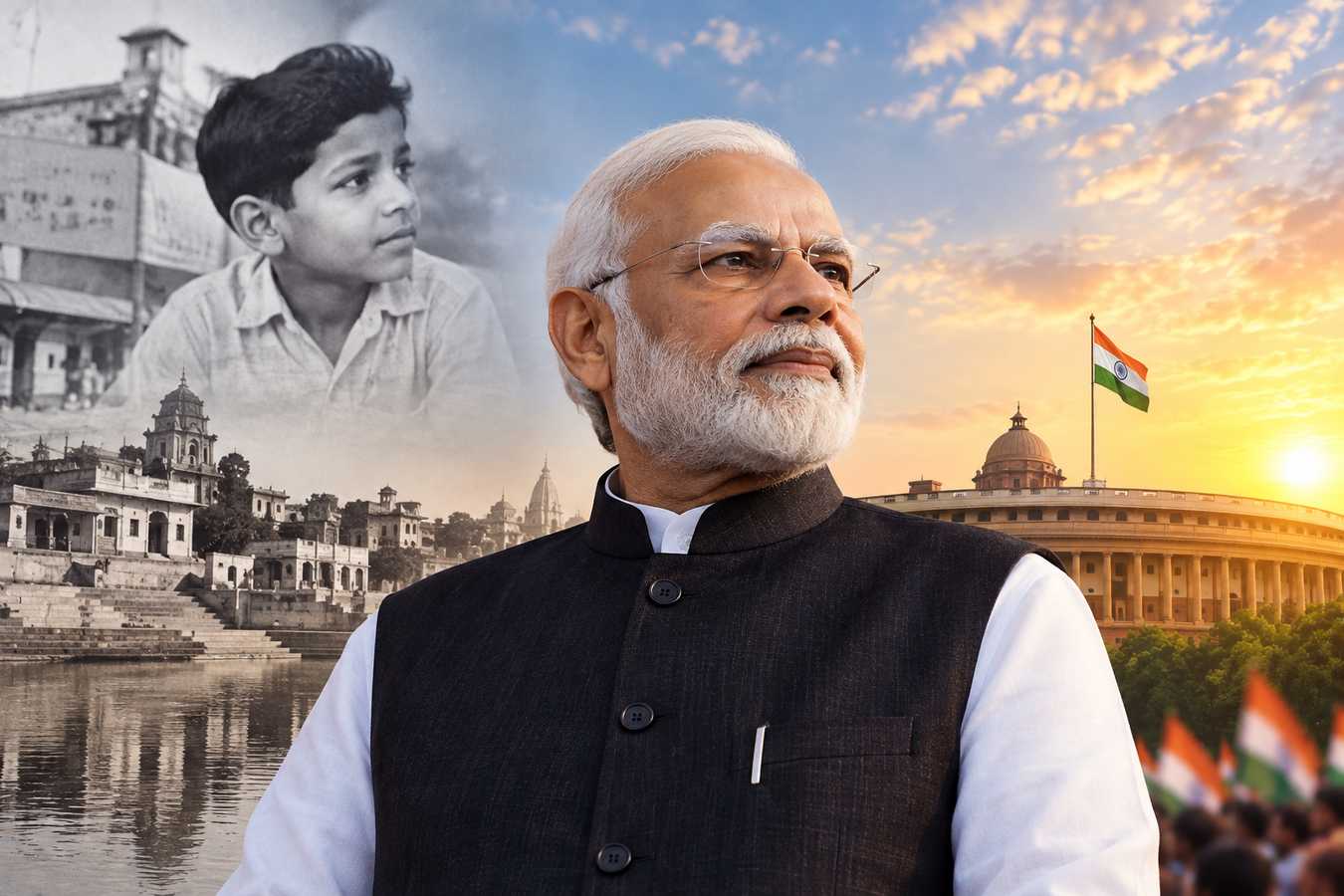
NEW DELHI: Every birthday is a moment to look back. For Prime Minister Narendra Modi, who turns 76 on September 17, 2026, the journey stretches from a small town in Gujarat to the centre of India’s political and diplomatic landscape.
But Modi’s story is not simply about the distance between Vadnagar and New Delhi. It is also a story of organisational politics, electoral victories, policy experiments, controversies, technological change and a political career that has now crossed a quarter of a century at the head of a government.
Born on September 17, 1950, in Vadnagar in present-day Gujarat, Modi is the first Indian Prime Minister born after Independence. His official biography describes a childhood in a modest family home, where he balanced schooling with helping at the family’s tea stall. It also records his interest in books, debates and swimming during his school years.
At 76, those early details have become part of a much larger political biography.
The years before power
Long before he occupied the Prime Minister’s Office, Modi worked within the organisational structure of the Rashtriya Swayamsevak Sangh (RSS) and later the Bharatiya Janata Party (BJP).
His official biography says he travelled across India as a young man and subsequently joined the RSS in Ahmedabad. He became a pracharak in 1972, beginning years of organisational work.
The Emergency period of 1975-77 was another formative chapter in the political history of the RSS and BJP ecosystem in which Modi worked. Over the following decades, he moved through organisational responsibilities within the BJP before entering government leadership.
By the late 1990s, Modi had become an important organisational figure in the BJP. In 1998, he was appointed General Secretary (Organisation) of the party, a position he held until becoming Gujarat Chief Minister in 2001.
October 7, 2001: The turning point
On October 7, 2001, Modi took oath as Gujarat’s Chief Minister.
He arrived at the post during a difficult period for the state. The Gujarat earthquake of January 2001, a severe cyclone, drought and political uncertainty had preceded his elevation. Modi later recalled those circumstances while marking 25 years of serving as head of a government.
What followed was more than a decade of state leadership.
Modi remained Gujarat Chief Minister from October 2001 until May 2014, winning assembly elections in 2002, 2007 and 2012. The Prime Minister’s Office describes him as Gujarat’s longest-serving Chief Minister.
The Gujarat years also became central to his political identity.
Supporters highlighted infrastructure, investment, industrialisation, electricity availability and administrative reforms, while critics raised questions over social outcomes and the government’s handling of contentious issues. His tenure also remained closely associated with the political and legal debates surrounding the 2002 Gujarat riots, making the period one of the most scrutinised chapters of his public career.
The political argument over the “Gujarat model” eventually travelled far beyond the state.
2014: Gujarat to New Delhi
The biggest transition came in 2014.
The BJP projected Modi as its prime ministerial candidate for the Lok Sabha election. He contested from Varanasi and Vadodara, winning both constituencies, and the BJP secured a single-party majority in the Lok Sabha.
On May 26, 2014, Modi took oath as Prime Minister.
For the first time in more than two decades, a political party had secured a clear majority on its own in the Lok Sabha. The BJP repeated that achievement in 2019.
The move from Gandhinagar to New Delhi changed the scale of Modi’s political responsibilities. Policies that had previously been associated with state administration became national programmes.
The first decade: welfare, reform and disruption
Modi’s first two terms were marked by a combination of welfare expansion, economic reforms, infrastructure development and major political decisions.
One of the earliest flagship initiatives was the Pradhan Mantri Jan Dhan Yojana, announced in August 2014 and launched later that month with the stated objective of expanding access to banking services.
Other major initiatives during the period included Swachh Bharat Mission, Make in India, Digital India, Ujjwala Yojana, Ayushman Bharat and direct benefit transfer programmes.
The period also witnessed disruptive economic decisions.
The government’s 2016 demonetisation decision withdrew high-value ₹500 and ₹1,000 currency notes from circulation. The move was presented by the government as an effort against black money, counterfeit currency and terror financing, but its economic impact and implementation became the subject of extensive political and economic debate.
In 2017, the government introduced the Goods and Services Tax (GST), replacing a range of indirect taxes with a nationwide tax framework.
The government’s second term brought another series of consequential decisions.
In 2019, Parliament passed legislation related to the government’s decision to reorganise Jammu and Kashmir and revoke the special constitutional provisions associated with Article 370. The decision was welcomed by the government and its supporters but opposed by several political parties and remains an important point of political debate.
The same period saw the passage of the Muslim Women (Protection of Rights on Marriage) Act, 2019, commonly associated with the ban on instant triple talaq.
Ayodhya and a long-running political issue
Another defining moment came through the Ayodhya Ram Janmabhoomi dispute.
In November 2019, the Supreme Court unanimously directed that the disputed site be handed to a trust for the construction of a Ram temple while ordering an alternative five-acre site to be allotted for a mosque.
The foundation stone-laying ceremony for the Ram temple took place in August 2020, and the temple’s consecration ceremony was held in January 2024.
For the BJP and its supporters, the Ram temple has been one of the most significant cultural and political issues of the party’s history. For critics, its political prominence has been part of wider debates over religion and the nature of Indian politics.
A Prime Minister through a pandemic
Then came the COVID-19 pandemic.
The nationwide lockdown announced in March 2020 brought India’s economy and everyday life to an extraordinary standstill. The government subsequently launched relief measures, expanded food support and undertook one of the world’s largest vaccination programmes.
India’s vaccination drive became another major feature of Modi’s second term, even as the government faced criticism over the handling of the devastating second wave in 2021, particularly concerning oxygen shortages, hospital capacity and the scale of deaths.
The pandemic also accelerated the use of digital systems for vaccination certificates, payments, welfare transfers and public administration.
The digital transformation
One of the more enduring features of the Modi years has been the expansion of India’s digital public infrastructure.
The Jan Dhan-Aadhaar-Mobile architecture, direct benefit transfers and the rapid expansion of the Unified Payments Interface (UPI) have changed how millions of Indians access banking and make payments.
The government has increasingly presented digital public infrastructure as an Indian model that can be shared internationally. Modi himself has repeatedly highlighted UPI and Digital India as examples of technology being used for wider financial inclusion.
The transformation has been visible in everyday life: from small shops accepting QR-code payments to welfare benefits reaching bank accounts without the need for traditional cash-based transactions.
India’s growing global footprint
Modi’s tenure has also coincided with a more visible Indian diplomatic presence.
India hosted the G20 Leaders’ Summit in New Delhi in September 2023, during its G20 presidency. The summit’s New Delhi Leaders’ Declaration was adopted unanimously by G20 members, while the African Union was welcomed as a permanent member of the grouping.
India’s presidency placed particular emphasis on the Global South, digital public infrastructure, climate finance, development and reform of international institutions.
Modi’s government has simultaneously sought closer strategic relationships with the United States, Europe, Japan, Australia and countries in West Asia, while maintaining longstanding ties with Russia.
The diplomatic balancing act has become particularly visible since Russia’s invasion of Ukraine in 2022, with India maintaining its relationship with Moscow while also deepening engagement with Western partners.
2024: A third term
The 2024 Lok Sabha election produced another milestone.
The BJP did not secure a majority on its own, but the National Democratic Alliance (NDA) won enough seats to form the government. Modi took oath for a third consecutive term on June 9, 2024.
That made him only the second Prime Minister after Jawaharlal Nehru to return to office for a third consecutive term.
His third-term agenda has increasingly been framed around the government’s Viksit Bharat 2047 objective—the stated goal of transforming India into a developed country by the centenary of Independence.
2026: Another milestone
The year 2026 has added another unusual entry to Modi’s political record.
On June 10, Modi completed 4,399 consecutive days as Prime Minister, surpassing Jawaharlal Nehru’s 4,398 days of continuous service following the first general election. The Union Cabinet subsequently passed a resolution marking the milestone.
The birthday therefore arrives in a year in which Modi has simultaneously marked his 76th birthday, more than 12 years as Prime Minister and 25 years since first becoming the head of a government.
The man behind the office
There is also a quieter side to the Modi story.
His official biography frequently refers to his interest in reading, yoga and writing. His public speeches often include references to his mother, his childhood in Vadnagar and his experiences within the RSS organisation.
In a personal account published by the Prime Minister’s Office, Modi recalled his mother’s advice when he first became Gujarat Chief Minister in 2001: to work for the poor and never take a bribe.
Such anecdotes have become part of the public image surrounding Modi, although separating personal narrative from political branding is an important part of understanding any modern political career.
76 and still at the centre of the conversation
Narendra Modi’s 76th birthday comes at a point when his political journey has already crossed several unusual milestones.
He has spent nearly 13 years as Gujarat Chief Minister, more than 12 years as Prime Minister, contested elections from Gujarat and Uttar Pradesh, led the BJP in three national campaigns and become the longest continuously serving elected Prime Minister by days in office.
His record includes initiatives that have altered everyday life for millions, as well as decisions that have generated intense political debate.
That combination is perhaps the most defining feature of the Modi era: few political figures in contemporary India have been as consistently present in both government policy and public conversation.
The story began in Vadnagar in 1950.
Twenty-five years after he first took charge of a government in Gujarat, and more than a decade after moving to New Delhi, Narendra Modi enters his 77th year with his political chapter still unfolding.
For India, the bigger question is no longer simply how the journey from Vadnagar to Delhi happened. It is how the decisions made during that journey will ultimately be measured in the country’s longer history.
About the Author
Harshita Rai is a news writer and journalist focused on Indian affairs, public policy, governance, politics and contemporary developments. Her work combines factual reporting with accessible, narrative-driven storytelling, bringing context and human perspective to current affairs.
With an interest in examining the people, policies and events shaping India, she writes news features that aim to present complex developments in a clear and engaging manner.
