
Oceanography About Protecting Humanity’s Future: VP Radhakrishnan
C.P. Radhakrishnan highlights India's maritime vision during visit to CSIR-NIO in Goa

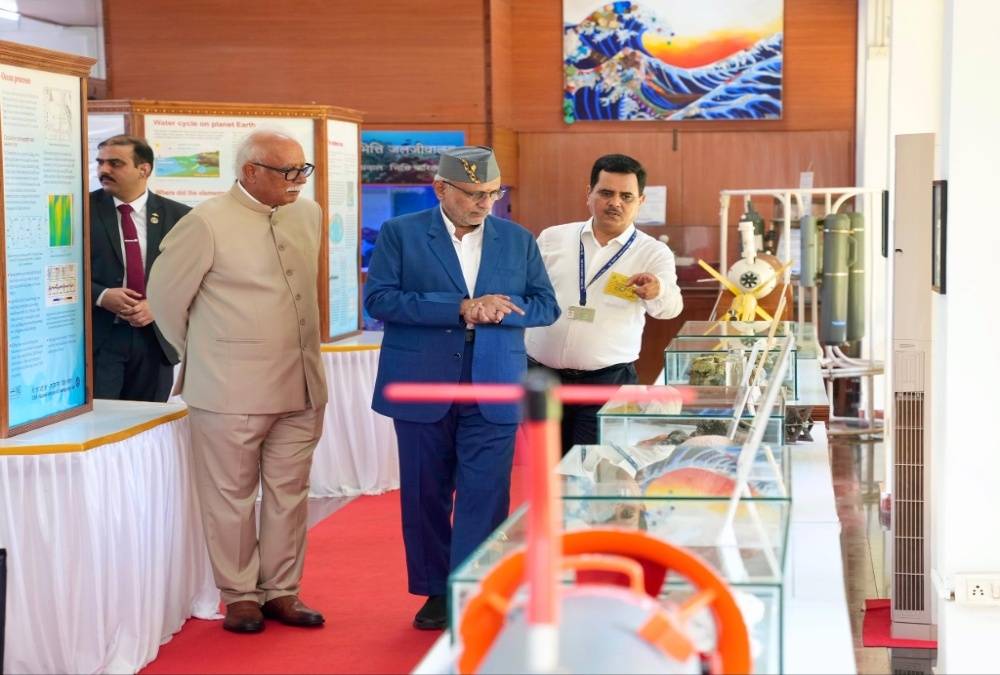
- Vice President visited CSIR-National Institute of Oceanography in Goa
- Called oceans vital for India’s economic and strategic future
- Urged young scientists to innovate boldly and dream fearlessly
- Praised India’s global scientific contributions and Deep Ocean Mission
GG News Bureau
Panaji, 30th May: Vice President C. P. Radhakrishnan on Saturday said oceanography has become essential for protecting humanity’s future, stressing that scientific progress must be guided by sustainability, responsibility and compassion.
Addressing scientists, researchers and students during a visit to the CSIR-National Institute of Oceanography (CSIR-NIO) in Panaji, the Vice President said India’s nearly 11,000-kilometre coastline makes the oceans a vital part of the country’s future rather than merely a natural resource.
“Our seas are not boundaries separating us from the world but bridges connecting India to global trade, energy security, economic prosperity and strategic strength,” he said.
Highlighting India’s rich maritime heritage, Radhakrishnan noted that the Indian Ocean has played a pivotal role in shaping the country’s civilisation through centuries of trade, cultural exchange and navigation.
He praised CSIR-NIO for its contributions over the past six decades, describing it as one of India’s premier scientific institutions helping the country become more self-reliant and future-ready through research, innovation and exploration.
The Vice President also welcomed growing international scientific cooperation, referring to the Memorandum of Understanding between the Council of Scientific and Industrial Research and Norway’s Research Council. He said such partnerships would strengthen research, technology development and capacity building.
Expressing concern over climate change, rising sea levels, biodiversity loss, marine pollution and microplastics, he said coastal communities worldwide face increasing risks and that development cannot come at the cost of nature.
Radhakrishnan highlighted national initiatives such as the Deep Ocean Mission, Blue Economy programmes, the Green Hydrogen Mission and renewable energy partnerships as examples of India’s future-oriented approach.
Referring to India’s response during the COVID-19 pandemic, he said the country chose to serve humanity rather than focus solely on patents, reflecting the spirit of “Vasudhaiva Kutumbakam”.
Addressing young researchers, the Vice President encouraged them to dream fearlessly and work tirelessly. Drawing inspiration from renowned mathematician Srinivasa Ramanujan, he said true excellence emerges from deep passion and dedication.
“The next breakthrough in climate solutions, marine biotechnology, renewable energy or ocean conservation could emerge from the young minds present here today,” he said.
During the visit, the Vice President toured various laboratories and a research exhibition showcasing the institute’s scientific projects. He also released a coffee table book titled A Diamond Legacy of Oceanographic Excellence.
The visit formed part of his ongoing engagements highlighting science, innovation and sustainable development as key pillars of India’s journey towards becoming a developed nation by 2047.
