
Rajnath Singh Calls For ‘Aatmanirbharta 2.0’ In Defence Sector
At SWAVLAMBAN 2026, the Defence Minister stresses advanced technologies, stronger research, resilient supply chains and greater participation by Indian startups and industry.

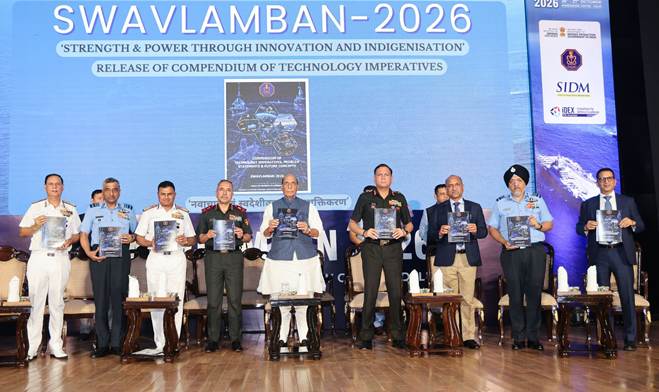
- Rajnath Singh calls for Aatmanirbharta 2.0
- Defence supply chains identified as strategic priority
- Navy receives over 4,000 iDEX proposals
- Indigenous technologies to support all three Services
GG News Bureau
New Delhi, 26th Oct: Defence Minister Rajnath Singh has called for a new phase of self-reliance, termed “Aatmanirbharta 2.0”, focusing on advanced technologies, stronger research and development, and resilient domestic supply chains to reduce import dependence and strengthen national security.
Addressing the fifth edition of SWAVLAMBAN, the Indian Navy’s Naval Innovation and Indigenisation Seminar, at the Manekshaw Centre in New Delhi on Monday, Singh said India must build on the progress achieved in defence manufacturing and pursue cost-effective, operationally superior and globally competitive technologies.
He said innovation and technological self-reliance would contribute to the vision of Viksit Bharat by 2047.
Supply Chain Resilience A Strategic Priority
Singh described supply chain management as a strategic imperative linked directly to national security. He called for a time-bound roadmap identifying critical technologies, industries, raw materials and resources needed to reduce dependence on imports.
He highlighted vulnerabilities arising from limited domestic availability of materials such as rare earth elements and the absence of certain technologies in India. He also stressed the need to assess buffer stocks and domestic production capacity in advance to prepare for possible disruptions in supply routes.
The minister identified research and development as central to addressing these challenges and urged greater private-sector participation in high-risk, high-reward projects. He also called for a shift in attitudes towards research failures, describing them as a natural part of the innovation process.
Startups And Academia Key To Defence Innovation
Singh emphasised stronger links between industry, academic institutions and young researchers to build a deeper culture of innovation. He cited the iDEX initiative as an important platform for startups and micro, small and medium enterprises (MSMEs) developing technologies previously imported by India.
More than 4,000 proposals have been submitted against 229 challenges issued by the Indian Navy, reflecting interest among Indian innovators in addressing operational requirements.
The minister said naval contracts worth more than ₹1,900 crore demonstrated progress in converting indigenous innovations into procurement outcomes. However, he called for further efforts to address remaining import dependence, particularly in Buyer Nominated Equipment.
Dual-Use Technologies And Jointness
Singh proposed a “Dual Technology Roadmap” to identify technologies suitable for both civilian and military applications. He also called for identifying products that could be used across the Army, Navy, Air Force and Indian Coast Guard.
He highlighted emerging fields such as artificial intelligence, quantum technologies, autonomous systems, advanced communications and counter-drone capabilities as areas requiring sustained research and investment.
Chief of the Naval Staff Admiral Krishna Swaminathan said Navy-specific iDEX challenges had increased from 20 in 2022 to 229. He added that 41 Acceptance of Necessity cases worth more than ₹3,500 crore had been accorded, while 25 contracts valued at over ₹1,900 crore had been signed.
The two-day seminar, being held on October 26–27 under the theme “Strength and Power through Innovation and Indigenisation”, features technology exhibitions, discussions on emerging defence capabilities and engagement with startups, MSMEs, industry and academia.
