
SC Pushes Banks to Compensate Digital Fraud Victims
Supreme Court seeks enforceable RBI rules, stronger safeguards and accountability to prevent cyber fraud losses

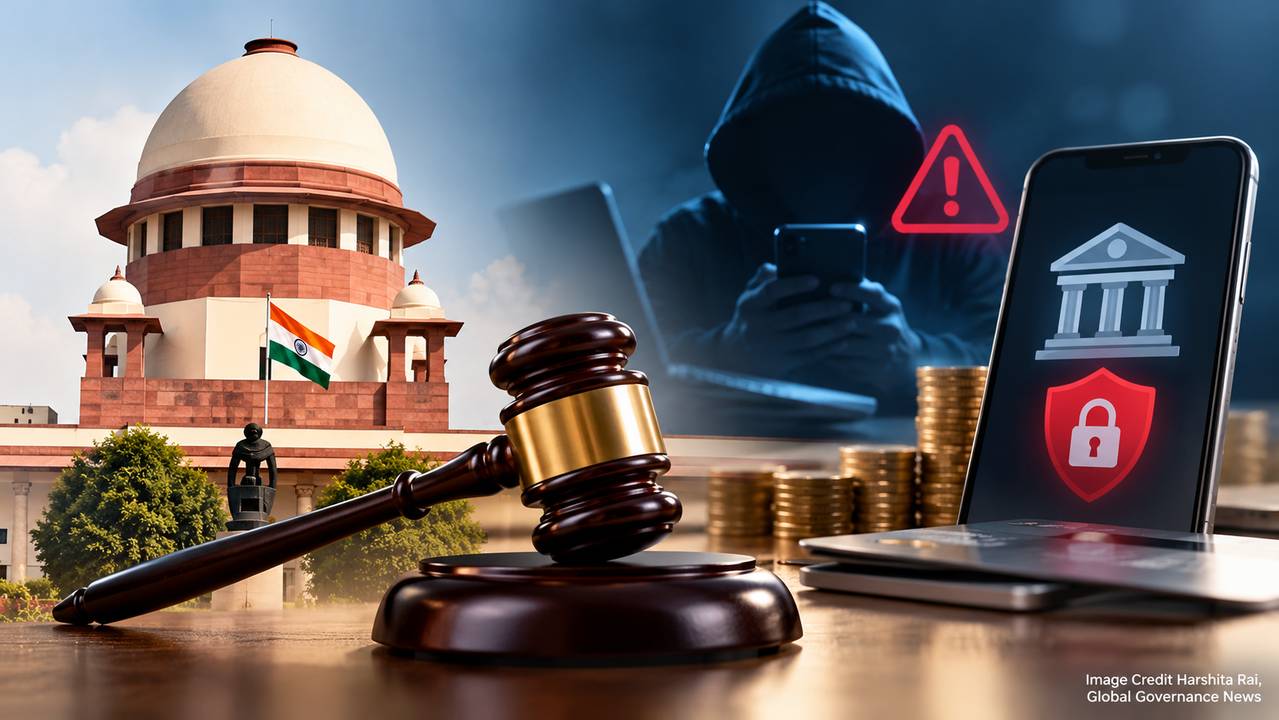
- SC seeks compensation for victims of bank-linked digital fraud.
- RBI asked to include enforceable liability provisions.
- Banks urged to flag unusual transactions and alert police.
- States and UTs directed to report digital arrest cases.
GG News Bureau
New Delhi, 30th Oct: The Supreme Court has called for stronger safeguards and financial accountability from banks, saying digital fraud victims should receive compensation of at least the amount lost if an investigation establishes that the fraud resulted from a financial institution’s failure of due diligence.
A bench headed by Chief Justice Surya Kant, along with Justices Joymalya Bagchi and V. Mohana, made the observations while hearing suo motu proceedings concerning victims of digital arrest scams and cyber-enabled financial crimes.
The court noted that despite a reported 50 per cent decline in cybercrimes, victims had lost around ₹800 crore so far this year. It said the proposed Reserve Bank of India (RBI) regulatory framework must include enforceable provisions for compensation, preventive intervention and institutional accountability.
The bench said it would first examine the proposed RBI Know Your Customer (KYC) Amendment Directions, 2026, before allowing the regulatory process to move forward. The directions are proposed to be notified by November 30 and operationalised by December 31.
Emphasising that general advisories would not be enough, the court said banks must face clear consequences for failing to exercise due diligence. Chief Justice Surya Kant observed that without penal provisions, financial institutions might not change their practices.
The bench also called for banks to temporarily suspend transactions that sharply deviate from a customer’s established banking pattern, automatically flag suspicious activity and conduct physical verification wherever necessary.
The Chief Justice questioned why banks could not intervene when an individual, particularly a retired person or ordinary saver, suddenly attempted to transfer a large amount inconsistent with their usual transactions. He suggested that banks use account histories and artificial intelligence to identify unusual activity.
The court further proposed a mechanism to alert the nearest police station about suspicious high-value transactions involving customers who may be victims of digital arrest scams. Police could then verify whether the account holder was knowingly making the transaction.
The bench stressed that preventing fraudulent transfers was more important than investigating them after the money had disappeared. It also sought stronger action against mule accounts used by cybercriminals to move stolen funds and make their recovery difficult.
Attorney General R. Venkataramani, appearing for the Centre and other authorities, told the court that steps were being examined to improve suspicious transaction detection and strengthen preventive mechanisms. He also referred to possible liability for banks and individual officials, including personal liability and criminal prosecution in cases involving collusion.
The court directed the RBI to submit a list of all authorised financial institutions by the next hearing, so that any directions issued could apply across the banking sector.
It also asked the law enforcement agencies of all states and Union territories to submit details of FIRs registered in digital arrest cases, investigations undertaken and suggestions for preventing, detecting and prosecuting such offences. The respective Directors General of Police have been asked to ensure compliance.
During the hearing, senior advocate Kapil Sibal, appearing for WhatsApp, informed the bench that the platform had taken preventive steps, including action against 9,400 accounts. He said WhatsApp would file an affidavit detailing its measures and was working on software to identify suspicious accounts and warn users.
