
SC Rejects Quota Claim After Religious Conversion
Supreme Court upholds Madras High Court ruling, saying pre-conversion social status alone cannot secure Backward Class reservation.

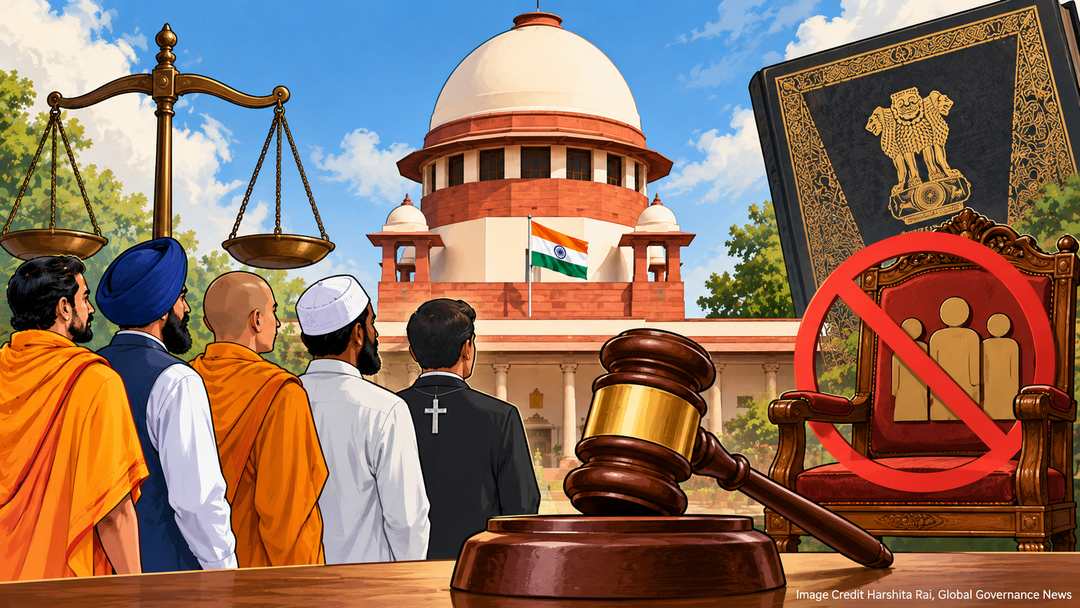
- Supreme Court upholds Madras High Court ruling
- Tamil Nadu’s reservation order struck down
- Conversion alone does not establish BC eligibility
- SC status governed by separate constitutional provisions
GG News Bureau
New Delhi, 15th Oct: The Supreme Court on Thursday ruled that converting from Hinduism to Islam does not automatically entitle a person to reservation benefits under Tamil Nadu’s Backward Class (Muslim) category, upholding the Madras High Court’s decision to strike down a state government order extending such benefits to converts.
A bench of Justices Prashant Kumar Mishra and Shree Chandrashekhar dismissed the Tamil Nadu government’s appeal, holding that a person’s social status before religious conversion does not, by itself, establish eligibility for reservation under a different religious community.
The case arose from a March 2024 government order that sought to extend Backward Class reservation benefits to certain people from Backward Class and denotified communities who had converted to Islam. The Madras High Court had struck down the order, and the Supreme Court has now upheld that decision.
The court emphasised that social backwardness associated with a person’s original caste or community cannot automatically be transferred to another social and religious group merely through conversion. Eligibility for reservation must be established under the applicable legal and community criteria.
The ruling does not mean that every person belonging to a religious minority is ineligible for reservation. Rather, it addresses claims based solely on a person’s pre-conversion status and does not eliminate eligibility that may independently arise under applicable reservation classifications.
SC Status and Religious Conversion
The latest ruling follows a separate Supreme Court judgment delivered on March 24, 2026, in the case of Chinthada Anand v. State of Andhra Pradesh. In that case, the court held that a person professing Christianity cannot claim Scheduled Caste status under Clause 3 of the Constitution (Scheduled Castes) Order, 1950.
The provision recognises Scheduled Caste status for people professing Hinduism, Sikhism or Buddhism. The March judgment held that conversion to a religion outside these categories results in the loss of Scheduled Caste status under the existing legal framework.
The court also laid down conditions for claims of reconversion, including clear proof of the person’s original caste, credible evidence of genuine reconversion and acceptance by the original community.
However, the Scheduled Caste rule should not be confused with a blanket rule covering all reservation categories. Eligibility for Other Backward Classes and Scheduled Tribes is governed by their respective legal frameworks and applicable criteria.
What the Ruling Means
The October 15 decision reinforces that religious conversion alone cannot establish eligibility for a new Backward Class category. State governments must ensure that reservation policies comply with the applicable legal framework, and applicants must satisfy the relevant eligibility requirements.
The ruling concerns the Tamil Nadu government order and the claims considered in that case. It does not, by itself, abolish reservation for all religious converts or establish a universal prohibition on reservation benefits across every category.
