
Congress’ Double Standards On Women’s Safety: Why Is Rahul Gandhi Silent?
Rahul Gandhi claims to stand for women’s rights, but allegations involving Congress leaders raise serious questions about the party’s commitment to accountability.

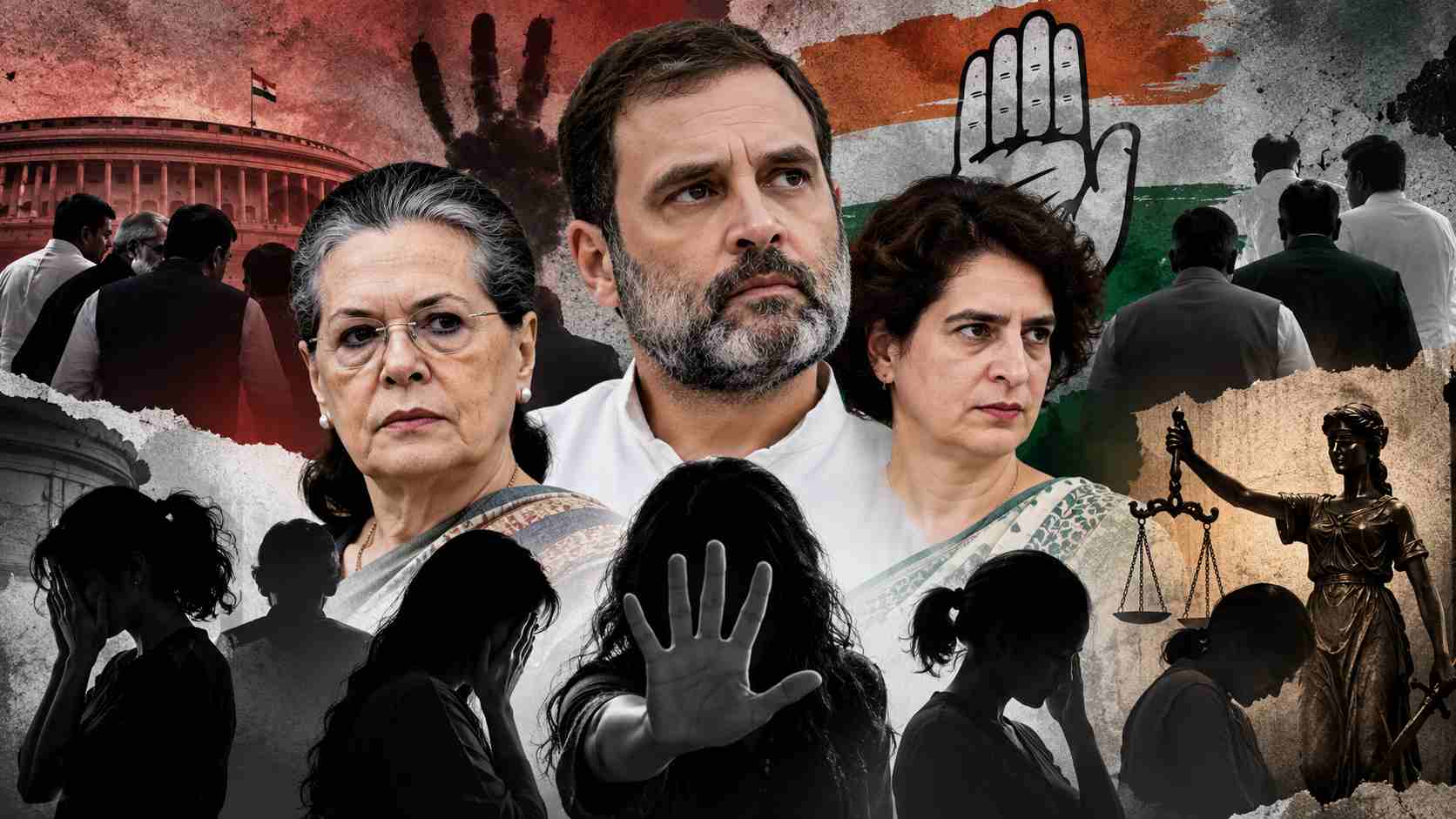
Rahul Gandhi often presents himself as a champion of women and girls in Bharat. He speaks about their safety, dignity and rights, and frequently questions political opponents over their treatment of women.
But what happens when serious allegations emerge against leaders from his own party? Does the Congress leadership show the same urgency and determination when the accused belongs to its own ranks?
This is the question Congress cannot continue to avoid.
Over the years, Congress MPs, MLAs and other party leaders have faced allegations of rape, sexual harassment and other crimes. Yet, whenever such controversies emerge, the party’s response deserves scrutiny. While allegations against opponents often become a political issue, questions about its own leaders raise doubts about the consistency of its commitment to women’s safety.
Is women’s safety a genuine principle for Congress, or does it become a convenient political weapon against its opponents?
A party that claims to stand for women’s dignity must show that commitment through its actions. Rahul Gandhi cannot expect the public to judge him only by his speeches while ignoring the questions raised by the conduct of leaders within his own party.
If Congress demands accountability from others, it must be prepared to answer questions about its own leaders.
Why Is Congress Under Scrutiny After JNU Sacked MP Bimol Akoijam?
The controversy surrounding Congress MP Dr. Angomcha Bimol Akoijam has brought the party’s position on women’s safety into sharp focus.
Akoijam, the Lok Sabha MP from Inner Manipur, was dismissed from his position as a professor at Jawaharlal Nehru University (JNU) on October 9, 2026, following an inquiry by the university’s Internal Committee into allegations of sexual harassment. A Delhi Police FIR was registered against him on October 11, 2026.
The case reportedly involves complaints from 11 to 12 female students. The allegations include inappropriate remarks, late-night messages and unwanted invitations to his residence.
JNU Vice-Chancellor Santishree D. Pandit said the university followed established procedures. The administration reportedly stated that it sent more than 300 emails to Akoijam and gave him a 90-day window to present his defence, alleging that he delayed the process.
Akoijam has rejected the allegations, calling the university’s action a politically motivated witch hunt by the BJP-led central government. The Manipur Congress unit has also defended him and criticised the proceedings.
But the bigger question is not whether Congress should support a fair legal process. Every accused person is entitled to due process. The question is why the party’s response has raised concerns about whether political loyalty is taking precedence over accountability.
When a sitting MP faces allegations involving multiple female students and is dismissed following a university inquiry, the public has every right to ask what his political party intends to do.
Will Congress explain its position clearly? Will it prove that allegations of sexual misconduct are treated seriously, regardless of the accused person’s political standing? Or will it continue to portray the controversy primarily as a political attack?
Rahul Gandhi must explain how Congress reconciles its public claims about women’s safety with its response to the allegations involving Bimol Akoijam.
The university’s disciplinary action, the police FIR and a criminal conviction are different matters. The FIR does not establish guilt, and the allegations must be assessed through the legal process. But that does not make questions about political responsibility any less legitimate.
Why Is Congress Emphasising Political Vendetta?
The Manipur Congress unit has backed Akoijam, while the MP himself has described the action against him as politically motivated. Senior Congress leaders have also stressed the importance of due process.
Congress MP Shashi Tharoor has emphasised that the proper procedure must be followed before reaching definitive conclusions about Akoijam’s position or resignation.
However, a demand for due process cannot be the only answer to every question about political accountability.
Congress leaders frequently question the government and rival parties over allegations involving their representatives. They demand explanations, transparency and action. Why should the same expectations not apply when allegations involve a Congress MP?
The party must explain whether it follows a clear and consistent policy for dealing with serious allegations against its own leaders. It must also explain what accountability measures it considers appropriate when an institutional inquiry results in disciplinary action.
The concern is not simply about whether Congress has issued a statement. It is about whether the party is willing to examine its own conduct with the same intensity it applies to its opponents.
Political parties cannot demand public accountability when it suits them and dismiss uncomfortable questions as political vendetta whenever their own representatives face scrutiny.
How Many Congress MPs And MLAs Face Cases Related To Crimes Against Women?
The controversy involving Akoijam is part of a larger debate about criminal cases against elected representatives across India.
According to the Association for Democratic Reforms (ADR), a report published in 2024 identified 151 sitting MPs and MLAs who had declared cases related to crimes against women in their election affidavits.
Among them, 23 sitting Congress MPs and MLAs had declared cases related to crimes against women. This category covers different offences, including sexual harassment, assault with intent to outrage a woman’s modesty, stalking, voyeurism and domestic abuse.
The figures also identify five sitting Congress lawmakers facing declared rape charges under Section 376 of the Indian Penal Code (IPC).
Across all political parties, the ADR report identified 16 sitting lawmakers facing declared rape cases. Congress and the BJP had five lawmakers each among those facing such charges.
Of the 16 lawmakers identified nationwide, two were MPs and 14 were MLAs. The five Congress lawmakers cited were predominantly state-level MLAs rather than Members of Parliament.
These figures raise serious questions about candidate selection, internal accountability and the standards political parties apply to their elected representatives.
When Congress speaks about protecting women, voters have every right to ask what the party is doing to address serious allegations involving its own members.
The party cannot limit its criticism to rival political organisations while expecting its own record to remain beyond public scrutiny.
Women’s safety cannot be a selective concern. If Congress demands accountability from other parties, it must demonstrate the same commitment within its own organisation.
Congress Lawmakers Named In Connection With Rape-Related Allegations
The Congress legislators identified in connection with rape-related or other sexual offence allegations include:
- Vinay Kulkarni — Karnataka MLA
Vinay Kulkarni has been named among lawmakers facing rape-related charges under Section 376 of the IPC.
- Hemant Satyadev Katare — Madhya Pradesh MLA
Katare has been mentioned in connection with reported sexual offence and rape-related allegations.
- M. Vincent — Kerala MLA
- Vincent has faced rape and harassment allegations and related legal proceedings.
- Assan Maulaana — Tamil Nadu MLA
Assan Maulaana has been cited in connection with reported criminal proceedings relating to offences against women.
- Pradeep Yadav — Jharkhand MLA
Pradeep Yadav has been mentioned in connection with reported sexual offence allegations and related proceedings.
The controversy involving Dr. Angomcha Bimol Akoijam, the sitting MP from Inner Manipur, concerns allegations of sexual harassment, JNU’s disciplinary action and a subsequent police FIR. It should not automatically be classified as a rape case.
These cases must be examined individually, and their current legal status should be verified before publication. The figures do not establish a complete list of every Congress MP or MLA who has faced rape allegations.
Nevertheless, the political question remains: what standards does Congress follow when allegations of serious offences involve its own representatives?
Voters should not have to wonder whether the party’s commitment to women’s safety changes according to the political identity of the accused.
Why Is There No Complete Record From 1950 To 2026?
There is no comprehensive, verified dataset establishing the total number of Congress MPs and MLAs accused of rape or sexual harassment between 1950 and 2026.
Before the Supreme Court’s landmark directions in 2002 and 2003, candidates were not required to disclose their criminal antecedents through the present system of mandatory self-sworn election affidavits. This makes it difficult to establish reliable party-wise figures covering the entire period.
However, the absence of complete historical data does not remove the need to examine the cases that are documented today.
Political parties must be transparent about the criminal cases declared by their candidates and explain how they respond when serious allegations emerge. Voters deserve accurate information about the allegations, the status of proceedings and the decisions taken by party leadership.
Congress cannot demand transparency from others while treating questions about its own representatives as politically inconvenient.
Rahul Gandhi Must Answer The Questions About Congress
Rahul Gandhi has repeatedly spoken about women’s safety and dignity. But a political leader’s credibility is judged not only by public speeches; it is also judged by the standards upheld within his own organisation.
The Bimol Akoijam controversy has raised serious questions about Congress’ response to allegations involving one of its MPs. The party’s defence of the MP, its criticism of the university proceedings and its emphasis on political targeting must be examined alongside the reported institutional findings and the registration of the FIR.
Why has Congress not provided a clearer explanation of the accountability standards it applies in such cases? What steps does it take when serious allegations emerge against its elected representatives? Why should the public accept different standards for political leaders who claim to champion women’s rights?
These questions do not require a declaration of guilt before a court reaches a decision. They require political honesty and a clear explanation from the party leadership.
Congress must demonstrate that it takes allegations seriously without compromising the right to a fair investigation. It must also show that political loyalty does not prevent scrutiny of its own representatives.
Women’s Safety Cannot Be Reduced To Political Slogans
Rahul Gandhi cannot repeatedly position himself as a champion of women’s rights while expecting the Congress party’s own record to escape scrutiny.
The allegations involving Bimol Akoijam, together with the figures cited in the ADR report, raise questions that the Congress leadership must address directly. The party must explain its position, clarify its accountability standards and demonstrate that its commitment to women’s safety extends beyond political speeches.
The issue is not whether Congress should be allowed to defend due process. It should. The issue is whether the party is equally willing to confront difficult questions when the allegations concern its own leaders.
If Congress demands answers from the BJP and other political parties, it must be ready to answer questions about its own representatives.
Women’s safety is too important to be reduced to a campaign slogan or a weapon against political opponents. It requires consistency, transparency and the courage to confront uncomfortable issues within one’s own organisation.
The question Rahul Gandhi must answer is simple: if Congress claims to stand firmly with women, why should its own leaders be exempt from the same public scrutiny and accountability that the party demands from others?
Congress MPs Sonia Gandhi and Priyanka Gandhi Vadra must also answer why they have not pushed for stronger internal guidelines to protect women within Congress. If women’s dignity is a priority, should they not ensure that party leaders and workers follow clear standards of conduct? The resignations of Former Congress Spokesperson Radhika Khera and Priyanka Chaturvedi after raising concerns about their treatment within the party have already raised questions about its internal culture. Recently, Mamta Choudhary, a Dalit Congress leader and former municipal corporator, accused former Varanasi Congress Chief Ajay Rai of abusing and threatening her during the confrontation. She alleged that Rai’s associates also mistreated women workers, used abusive language and physically assaulted them. Dalit Congress leader Mamta Choudhary’s allegations against Ajay Rai also demand a transparent inquiry. Is politics only about power and elections, or does it also carry a social responsibility? Why should women’s safety become a political issue only when it concerns opponents?
Until Congress addresses these questions clearly, doubts about the consistency of its commitment to women’s safety will continue.
Dr Kumar Rakesh is a Senior Journalist, writer, commentator and political analyst based in New Delhi, India. Dr Rakesh has been worked with Times of India group, Hindustan Times Group, Indian Express Group, Danik Bhaskar group & others in different Editorial Capacities. He has been also Senior member of the Core team involved in launching Nine TV News channels, with around 39 years of experience across print, television, radio, online and digital media. He has travelled and written from more than 50 countries covering issues concerning Bharat and the wider world with Presidents, VPs, PMs & many fellowships also. His works has earned him several honours and awards in Bharat & Abroad. Currently, Dr Kumar Rakesh is the Hon. Editorial Chairman of Global Governance News Group and Samagra Bharat Media Group.
