
Union Minister Scindia Calls for Inclusive, Trusted Intelligent Finance
Union Minister says connectivity, compute and trust are the foundation of India’s next phase of digital finance

- Broadband access rose from 6 crore to 103 crore in a decade
- 5G now covers 99.9% of districts and nearly 85% of the population
- UPI processed 24,162 crore transactions worth ₹314 lakh crore in FY 2025–26
- Scindia calls for a secure “Trust Grid” linking telecom, digital identity, UPI and finance
GG News Bureau
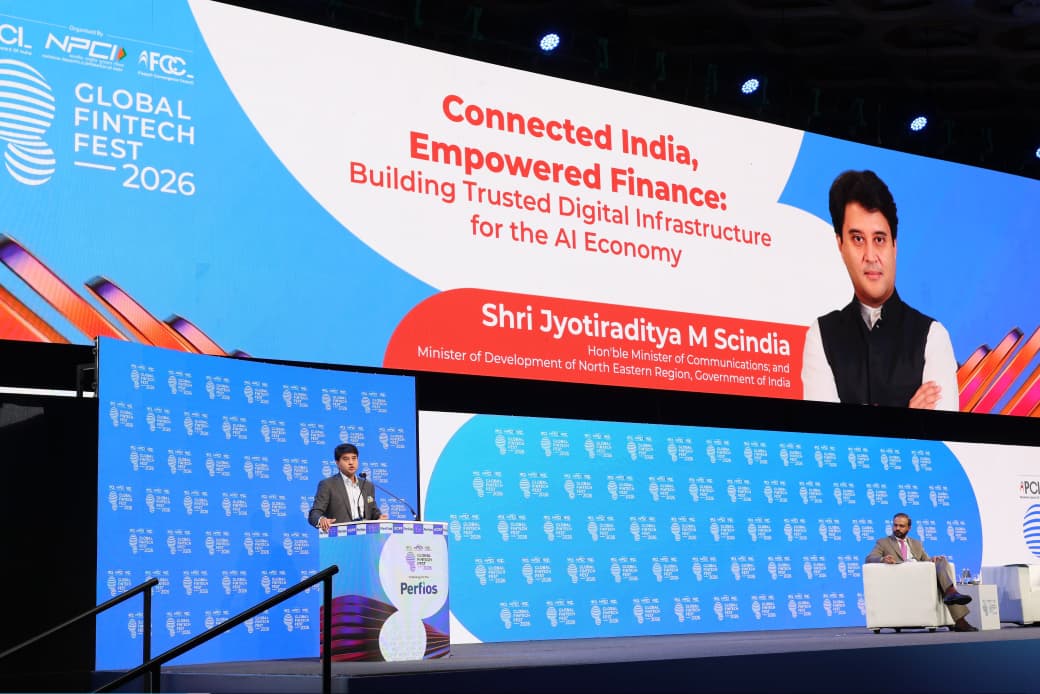
New Delhi, 10th Sept: Union Minister for Communications and Development of North Eastern Region Jyotiraditya Scindia has called for an inclusive and trusted digital financial ecosystem, saying finance must first become inclusive before it can become intelligent.
Speaking at the Global Fintech Festival 2026, Scindia said telecom connectivity forms the foundation of fintech, while compute and trust complete the digital trinity powering the next phase of financial services.
Scindia highlighted India’s rapid digital expansion, noting that broadband access has increased from 6 crore to 103 crore in the past decade. Internet access, he said, has expanded from around 25 crore people a decade ago to nearly 100 crore today.
He described smartphones as the “new bank branch”, saying they are enabling citizens to move from connectivity to credit, investment and other financial services. Around 6.5 lakh villages are now participating in the digital economy, he added.
On 5G, Scindia said India, after launching the technology in 2022, achieved coverage across 99.9% of districts and nearly 85% of the population within 26 months, supported by more than 5 lakh 5G base stations. The rollout involved capital expenditure of around ₹4.5 lakh crore.
Scindia also highlighted the affordability of digital connectivity, saying data costs have fallen to around 10 cents per GB. He credited affordable connectivity with making digital technology increasingly accessible across the country.
Highlighting UPI’s growth, Scindia said the platform has expanded from around 90,000 transactions in its first month to more than 740 participating banks. UPI processed around 24,162 crore transactions in FY 2025–26, valued at approximately ₹314 lakh crore.
He said 84% of domestic digital transactions take place on UPI, while India accounts for nearly 49% of global real-time digital payment volumes. UPI is also being taken to nine countries at no cost to them, with discussions looking towards its expansion to another 20 countries.
Scindia said India’s digital finance architecture must be based on three principles: open infrastructure to scale innovation, affordable infrastructure to expand inclusion, and secure infrastructure to build trust.
He cited around 60 crore Jan Dhan accounts and 9 billion documents on DigiLocker as examples of digital infrastructure reducing barriers to financial access.
On connectivity in the Northeast, Scindia said Digital Bharat Nidhi is supporting the establishment of around 22,000 telecom towers across 34,000 villages without telecom connectivity, with the objective of achieving 100% saturation.
He also stressed the convergence of AI and financial infrastructure, saying compute capabilities can help personalise financial advice and credit while making financial services increasingly autonomous.
At the same time, Scindia called for stronger safeguards as financial systems become more intelligent. He highlighted initiatives such as Sanchar Saathi and the AI-powered ASTR tool, which has helped disconnect more than 88 lakh suspicious mobile connections.
He also highlighted the Financial Fraud Risk Indicator, saying it can help identify suspicious transactions and prevent fraudulent payments before money leaves citizens’ accounts. Scindia called for stronger standard operating procedures across banking networks and a shift from reactive fraud detection to predictive trust.
Calling for a “Trust Grid for Finance”, Scindia proposed greater convergence between telecom, digital identity, UPI and financial systems. He said closer integration of Aadhaar and UPI could further enable citizens to participate in the digital economy.
Scindia said “Intelligent India” must democratise intelligence just as Digital India democratised access. AI, he stressed, should not remain limited to corporates and banks but become accessible to citizens.
He also highlighted India’s indigenous 4G telecom stack and ongoing work on 5G, saying the country has moved from being a technology consumer to becoming a technology maker. India’s 6G mission, he added, aims to contribute 10% of global 6G patents and play a significant role in developing 6G standards.
Scindia concluded by calling for India to “innovate in India, serve in India, serve the world and serve it securely”, with the broader ambition of moving from a connected India to intelligent and empowered finance built on trusted infrastructure.
