
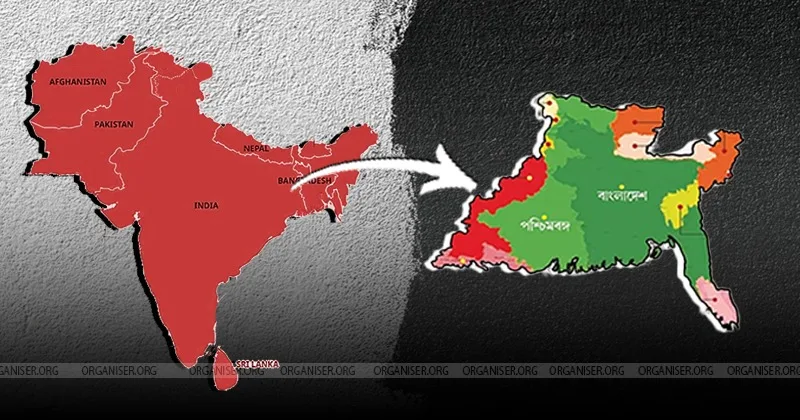
Conspiracy to merge West Bengal with a “Greater Bangladesh”

Poonam Sharma
There is an alleged conspiracy to merge West Bengal with a “Greater Bangladesh,” with accusations directed toward political leadership in the state. A structured account of these claims and the reasoning behind such beliefs, also reflecting on broader historical and geopolitical contexts involving India, Pakistan, and Bangladesh.
Historical Context: Partition and Its Aftermath
It begins with a reference to the partition of India and the creation of Pakistan—first as West and East Pakistan. According to this , global powers, particularly Western nations, allegedly supported this division to weaken India and Hindu society. However, despite these efforts, India remained united and resilient. while Pakistan was formed with the idea of religious unity under Islam, it eventually split into two nations: Pakistan and Bangladesh. This division is cited as evidence that religious unity alone could not sustain a nation.
Unity in Diversity
A key claim presented is that India’s strength lies in its diversity. Despite having multiple religions, languages, and cultural traditions, India has remained intact and continues to grow.
Hindu society, often criticized for lacking unity, is actually bound together by a deep cultural and philosophical foundation. Different traditions such as Shaivism, Vaishnavism, and Shaktism coexist within a broader identity, creating what is metaphorically described as a “threadless garland” holding the nation together.
Comparison with Islamic Nations
This narrative contrasts India with several Islamic-majority countries, arguing that internal conflicts—such as sectarian divisions between Sunni and Shia communities—have led to instability in many regions. Examples often cited include countries in the Middle East and North Africa. Despite India having one of the largest Muslim populations in the world, it has not experienced the same level of sectarian violence seen elsewhere. This is used to argue that India provides a stable and secure environment for diverse communities.
Pakistan and Geopolitical Tensions
Another major point in the argument focuses on Pakistan’s relationship with India. It is claimed that Pakistan has consistently attempted to destabilize India, particularly through issues like Kashmir. However, according to this perspective, these efforts have not succeeded in dividing India.The revocation of Article 370 is cited as a turning point, after which supporters believe Pakistan has lost strategic ground. Speculation is also expressed about potential future fragmentation within Pakistan itself.
Territorial Expansion and Integration
The narrative also highlights India’s territorial evolution, including the integration of regions like Sikkim. It suggests that India’s political system and stability have made it an attractive option for neighboring regions seeking security and development.
Regions such as Nepal, Bhutan, or parts of Myanmar and Pakistan may prefer closer ties with India. However, these may require more alignment and in the due course of time may need support by official positions of those regions.
Allegations Against West Bengal Leadership
The central focus of the article revolves around accusations against the current political leadership in West Bengal. Corruption in various sectors, including coal, cattle trade, and public welfare schemes. It is also claimed that investigations into these issues have been obstructed. But if taken care of by the center these are not of a much big matter .
More seriously, there may be covert agreements with certain groups aimed at securing political power. These claims suggest that maintaining authority is prioritized over governance and development.
Concerns Over Law and Order
The narrative raises concerns about law and order in West Bengal, citing isolated incidents and statements as examples of growing unrest. While the deployment of paramilitary forces during an election in a state is a matter of serious concern, it also demonstrates the government’s capacity to maintain control and ensure the, at least procedural, facilitation of free and fair elections. However, this unprecedented deployment of around 2.4 lakh Central Armed Police Forces (CAPF) personnel for the 2026 elections highlights the persistent challenges in maintaining a stable political environment, with the Election Commission of India (ECI) having to take a direct, active action.
Based on these concerns, stronger central intervention in required including the possibility of imposing President’s Rule if not controlled to restore stability and ensure governance aligned with national interests.
A Call for Critical Evaluation
It is important to note that many of the claims presented in this narrative are highly sensitive and may be substantiated by verified evidence. They reflect a particular viewpoint shaped by political beliefs and interpretations of history.
Conclusion
The discussion surrounding West Bengal, India’s unity, and regional geopolitics highlights the deep divisions in public opinion. While some view India’s diversity as its greatest strength, others interpret political developments through the lens of suspicion and conspiracy. Conclusion lies in terms of resistance whenever and wherever required.
