
ABISY Hosts Key Lecture on ‘Comprehensive History of Bharat’
Scholars call for integrated, nation-centric rewriting of Indian history at ABISY event

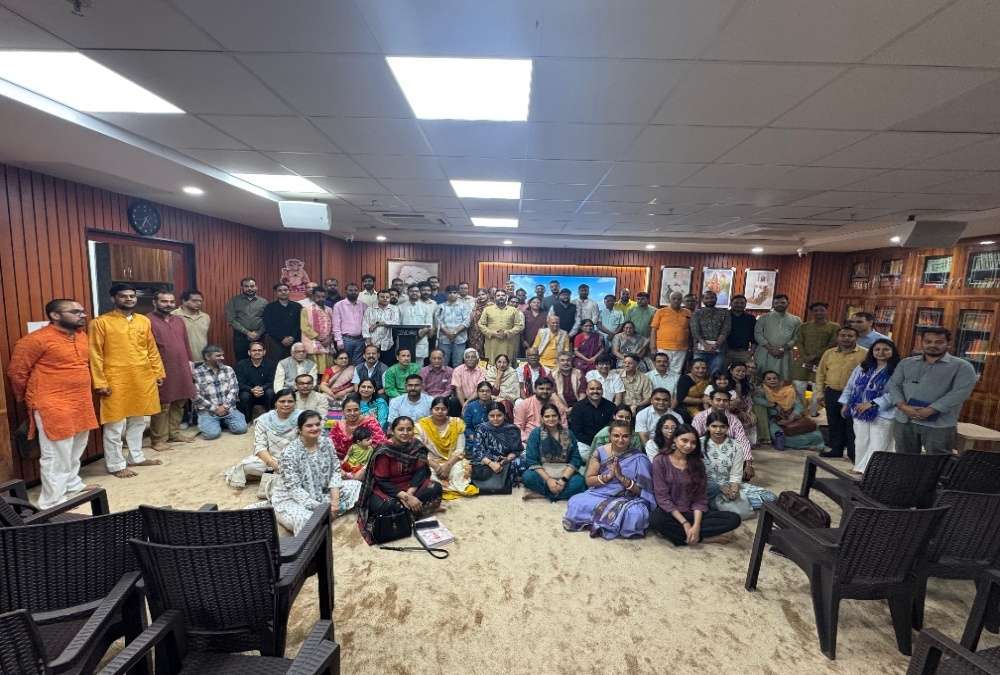
- Lecture on “Comprehensive History of Bharat” held in Delhi
- Experts stress balance between ancient traditions and modern perspectives
- Call for rewriting history rooted in Indian ethos
- Academicians, researchers and students attend in large numbers
GG News Bureau
New Delhi, 13th April: A special lecture on “Pura Navam Bhavati: Comprehensive History of Bharat – Unfolding the Geo-Cultural Tapestry” was organised at Keshav Kunj, Jhandewalan, under the “Namoolam Likhyate Kinchit” lecture series.
The programme was jointly organised by the Akhil Bharatiya Itihas Sankalan Yojana (Delhi unit) and Madhav Sanskriti Nyas at the central office of the organisation.
Focus on Geo-Cultural History
The event began with a thematic introduction, where a message by Dr Narendra Shukla was read out. He emphasised that history is a harmonious blend of antiquity and modernity, adding that Bharat’s history should be viewed from a geo-cultural rather than purely geopolitical perspective.
Key Address
Delivering the keynote lecture, Prof Sushmita Pandey highlighted that Indian history reflects a comprehensive worldview rooted in cultural continuity. She stressed that India’s civilisational ethos is built on knowledge traditions, philosophical thought, and the concept of the four Purusharthas—Dharma, Artha, Kama, and Moksha.
She noted that Indian history is not merely a record of events but a reflection of diverse ideas and perspectives shaped over centuries.
Call for Rewriting History
In his address, Dr Balmukund Pandey said that history is a continuous process requiring innovation and revision. He asserted that efforts to rewrite Indian history have begun and should be expanded at the national level.
He also alleged that past interpretations by certain historians had distorted India’s cultural and social narratives, calling for a more balanced and truth-based approach.
Chair and Participation
The session was chaired by Prof Rajneesh Kumar Shukla, who emphasised that history rooted in truth and knowledge is essential to reflect India’s civilisational identity.
The event witnessed participation from over 150 scholars, academicians, and students from various institutions, reflecting growing interest in re-examining India’s historical narratives.
