
Unlocking Lost Capacity: How AT Marts Can Empower India’s Disabled Workforce


Just think of real life circumstances where a visually impaired student may struggle to pursue higher education due to the high cost or limited availability of screen-reading software and accessible learning materials. Similarly, a person with hearing impairment may be excluded from job opportunities because hearing aids and workplace communication support are either unavailable or unaffordable. A young man with severe locomotor disability may find it difficult to travel long distances in search of appropriate assistive device. In many cases, family members are forced to reduce working hours or leave employment altogether to provide care and support.
Taken together, these individual hardships translate into broader economic and social costs. The consequences extend beyond social exclusion. Labour force participation among persons with disabilities aged 15 years and above stands at only 23.8 percent, with a worker-population ratio of 22.8 percent. Low participation is not merely an individual challenge; it represents lost productive capacity for the economy. Global evidence suggests that disability-related exclusion can result in economic losses equivalent to 3–7 percent of GDP due to lower employment, reduced productivity, and the diversion of family members into unpaid caregiving roles.
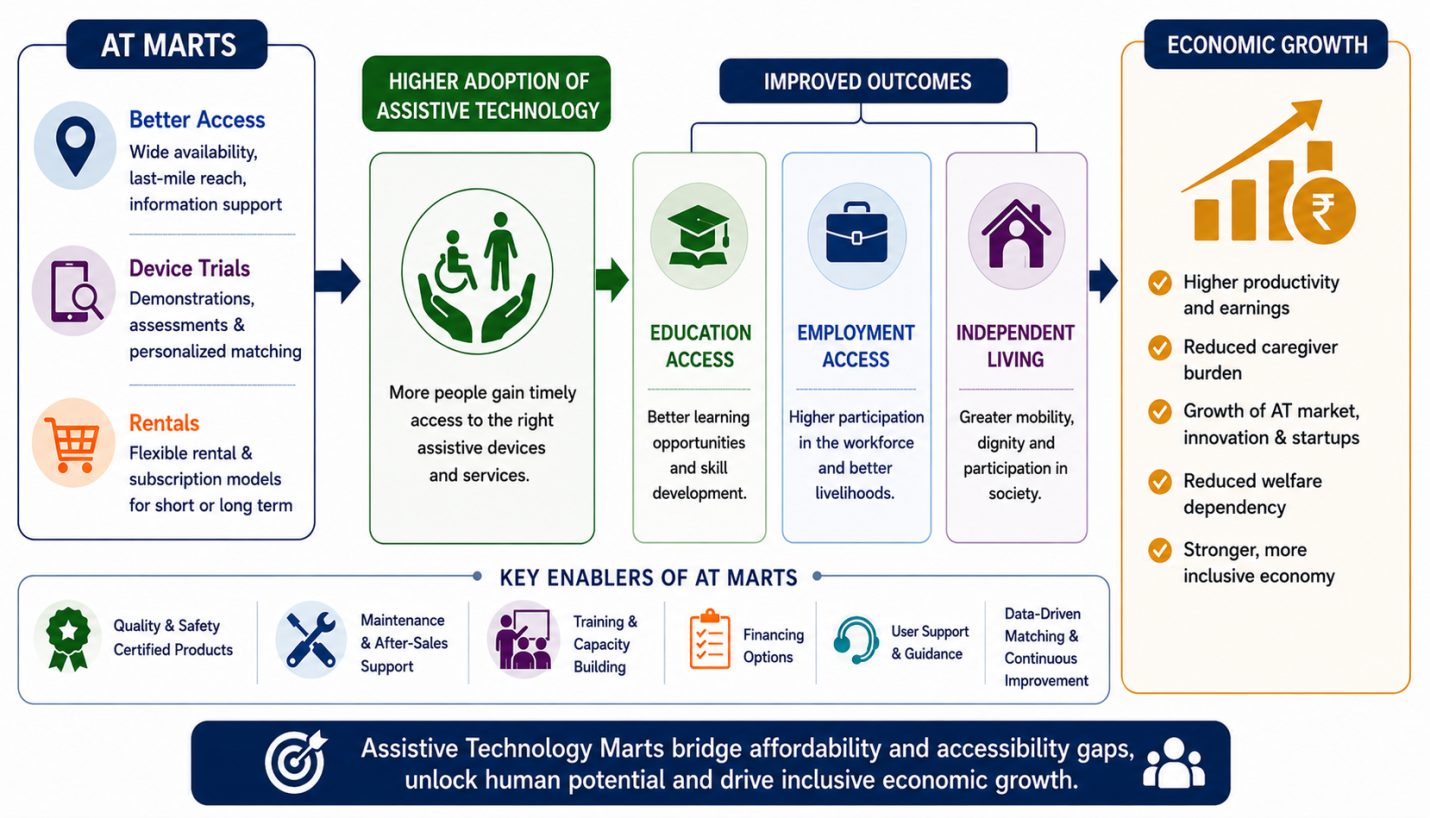
One of the most significant yet often overlooked contributors to this exclusion is the limited accessibility of assistive technology (AT). The AT market suffers from classic economic failures. Information asymmetry makes it difficult for users to identify appropriate products, while fragmented supply chains and weak service delivery networks constrain availability, particularly in smaller cities and rural areas. In addition, inadequate assessment, fitting, maintenance, and after-sales support limit the effective adoption and sustained use of assistive technologies. Moreover, because the social returns from assistive technology exceed the private returns captured by individuals and firms, the market tends to underinvest in accessibility solutions, perpetuating both social exclusion and economic inefficiency. Addressing these market failures requires innovative institutional mechanisms that strengthen market coordination, service integration, and equitable access to assistive technologies. A promising response lies in the creation of Assistive Technology (AT) Marts proposed under the Divyang Sahara Yojana, integrated service platforms that combine product availability, professional assessment, financing options, training, maintenance, and after-sales support.
Beyond improving access for persons with disabilities, AT Marts can serve as catalysts for innovation, entrepreneurship, and industrial growth. With ALIMCO (Artificial Limbs Manufacturing Corporation of India) acting as an implementing agency under the Department of Empowerment of Persons with Disabilities (DEPwD), the initiative can foster strategic partnerships among multinational corporations, original equipment manufacturers (OEMs), startups, and premier research institutions such as IITs, DRDO, and CSIR-CSIO. Such collaborations can strengthen domestic manufacturing, promote indigenous innovation, and position India as a hub for advanced assistive technologies.
Some of the global examples such as in United Kingdom, mobility retailers provide demonstration centres where users can test products before purchase, receive guidance, and access tax exemptions where applicable. In the United States, accessibility solution providers have expanded beyond product sales to include rentals, financing plans, home assessments, installation services, maintenance support, and rent-to-own models. These approaches reduce financial risk for users and encourage adoption.
Japan offers an even broader ecosystem model. The country integrates assistive technology with long-term care insurance, workplace inclusion programmes, and digital product registries. Innovations such as shoe-mounted navigation systems for persons with visual impairments and wheelchair accessibility mapping applications demonstrate how technology can improve participation while creating entirely new markets. Drawing on these international experiences, India can adapt these lessons through a Clinico-Social Model that combines public support, private innovation, and community participation. Such a model would position Assistive Technology Marts as more than retail outlets. They would become accessibility hubs that offer:
- Device demonstrations and trial programmes.
- Rental and subscription-based access models.
- Financing checks.
- User application, training resources and e-commerce platforms.
- Maintenance, repair, and after-sales support networks
- Certified products meeting quality and safety standards.
The need for flexible access models is particularly important because assistive technology requirements are not always permanent. Persons recovering from orthopedic injuries, surgeries, strokes, temporary visual or hearing impairments, pregnancy-related mobility limitations, neurological conditions, or acute illnesses may require assistive devices only during rehabilitation and recovery. Similarly, individuals with conditions such as hemophilia and sickle cell disease may require assistive devices on an intermittent or episodic basis. These diverse user needs underscore the importance of rental, subscription-based, and short-term access models within AT Marts.
Most importantly, policymakers should view assistive technology as infrastructure rather than expenditure. Just as roads connect people to economic opportunities, assistive devices connect persons with disabilities to education, employment, healthcare, and social participation.
The Sustainable Development Goals commit nations to “Leave No One Behind.” Achieving this objective requires moving beyond welfare-based approaches and embracing market-building strategies that improve access, reliability and innovation. The economic case is compelling: when persons with disabilities gain access to the tools they need, productivity rises, caregiving burdens fall, labour force participation increases, and society benefits from the talents of millions who have historically been excluded.
Investing in Assistive Technology is no longer a matter of fiscal charity, but of economic survival. Can India really afford not to unlock the potential of millions?
Aarushi Mishra is serving as a CPMU Consultant at the Ministry of Social Justice and Empowerment under the Department of Empowerment of Persons with Disabilities. She is an Economics postgraduate with a keen interest in public policy and inclusive development. Her work focuses on policy implementation, disability empowerment, and strengthening institutional support mechanisms for persons with disabilities.
