
Meta’s ‘Algorithmic Glitch’: The Tipping Point for Social Media’s Wild West Era

By Alok Lahad
NEW DELHI — To understand how a single computer glitch in Silicon Valley triggered a diplomatic crisis in New Delhi, one must first understand the invisible legal shield that built the modern internet: “Safe Harbour.”
Under Section 79 of India’s Information Technology Act, social media companies operate under a specific legal designation known as an intermediary. An intermediary is defined as a neutral digital venue—much like a telecom operator or a postal service—that merely provides the underlying infrastructure for users to post content. Because intermediaries exercise no prior editorial control over what citizens say, the law grants them “Safe Harbour,” protecting platforms like Meta, Google, and X from being sued or criminally prosecuted for user posts.
A publisher, by contrast, is an entity like a newspaper or a television network. A publisher curates, edits, selects, and approves content before it reaches the public, making it directly and legally liable for every word, libelous statement, or illegal advertisement it prints.
For two decades, Big Tech operated strictly under the intermediary banner. But over the past forty-eight hours, that foundational boundary has violently collapsed in India.
The Spark: Gen Z and the Muted Prime Minister
The crisis began at New Delhi’s Jantar Mantar, where a sprawling youth movement organized under the banner of the Cockroach Janta Party (CJP) mobilized over allegations surrounding the NEET examination paper leaks. Driven by algorithms designed to promote high-arousal, emotionally charged content, the movement quickly dominated Instagram and Facebook feeds, shifting from student grievances into aggressive anti-establishment rhetoric.
In an effort to calm the unrest, Prime Minister Narendra Modi released a direct video message assuring students of strict legislative action against paper-leak syndicates. But within hours, Meta’s automated moderation systems flagged and restricted the video, removing it across Facebook and Instagram for five crucial hours during a national crisis.
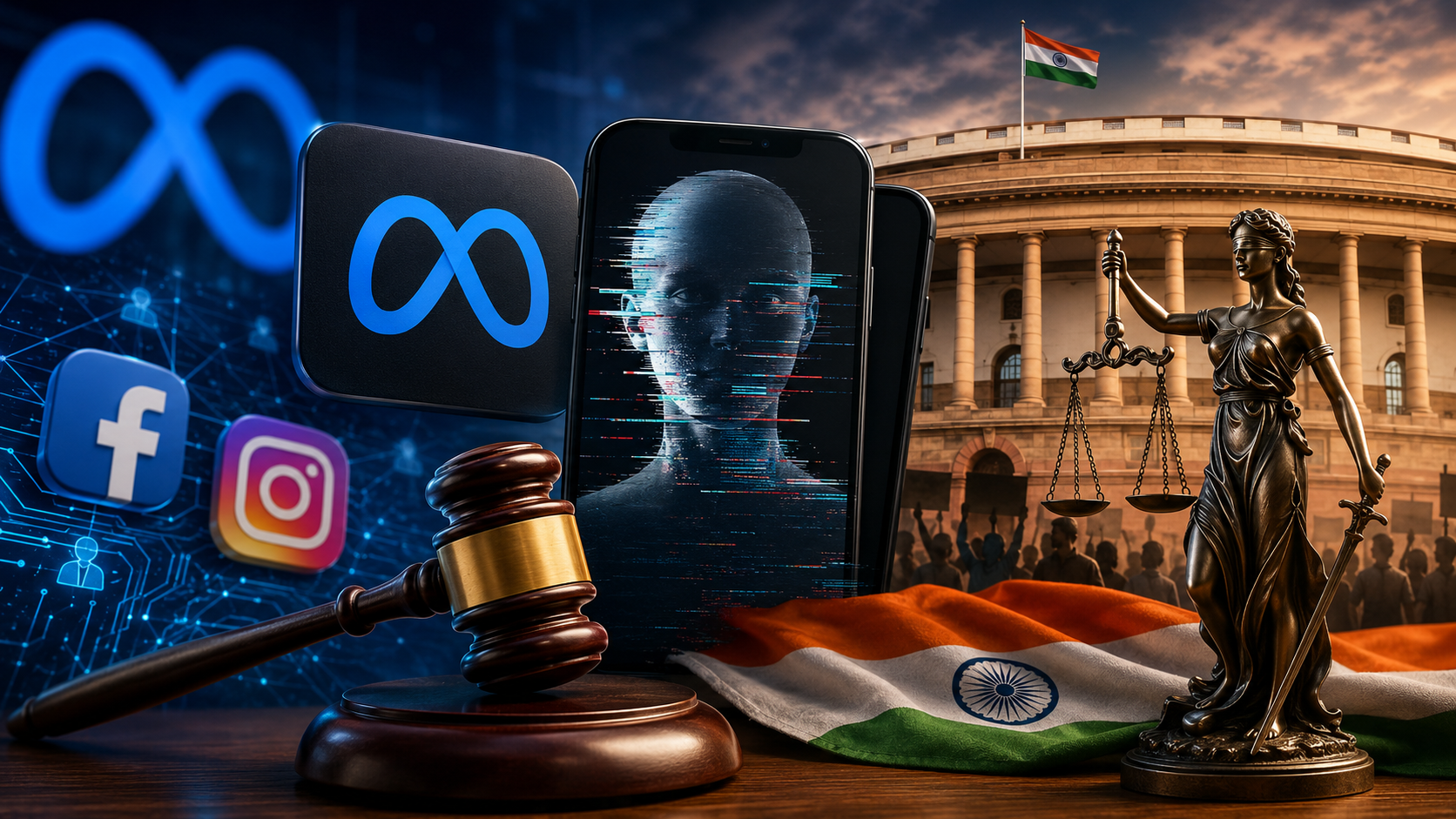
The reaction from Parliament was immediate and severe. The Parliamentary Standing Committee on IT, led by MP Nishikant Dubey, refused to accept Meta’s explanation of an “automated system error”. The panel argued that when a foreign corporation uses automated algorithms to censor a head of state while allowing offensive, digitally manipulated videos targeting public figures to stay online, it is no longer acting as a neutral pipeline. It is acting as a publisher exercising editorial veto.
The Reckoning: Money, Micro-Targeting, and the BBC Report
The parliamentary confrontation quickly moved beyond the Prime Minister’s video to expose the central contradiction of Big Tech’s business model: the monetization of reach.
During testimony, committee members confronted Meta executives with revelations—first uncovered by a BBC Eye investigation—showing that Meta’s platforms hosted paid advertisements linked to deepfakes and child sexual abuse material (CSAM). Under intense questioning, Meta representatives conceded that their platforms actively accept large sums of money to run and micro-target selected content to specific demographics.
This admission fundamentally undermined Meta’s defense. Parliamentary panel members pointed out that Big Tech cannot logically claim “Safe Harbour” as a passive, unliable pipeline while simultaneously operating a multi-billion-dollar commercial enterprise that charges money to artificially amplify specific posts over others. By taking money to dictate visibility, the platform assumes the legal mantle of a commercial publisher.
Firefighting in New Delhi
Faced with a three-day ultimatum from the Parliamentary Panel threatening to strip Section 79 immunity—a move that would instantly leave Meta executives exposed to criminal FIRs across India—Silicon Valley initiated an unprecedented diplomatic de-escalation effort.
A high-level Meta delegation led by Chief Global Affairs Officer Joel Kaplan and VP of Public Policy Neil Potts flew into New Delhi for emergency meetings at the IT Ministry. Kaplan issued a direct public apology to IT Minister Ashwini Vaishnaw for the restriction of the Prime Minister’s post. Concurrently, senior government officials confirmed that CEO Mark Zuckerberg submitted a formal apology addressing the post’s removal and promising stricter oversight regarding algorithmic bias and illicit content.
The panic is not limited to Meta. The Parliamentary Panel extended its audit to Google India, citing cyber-fraud cases originating from the Play Store where local country heads were named as co-accused, as well as X (formerly Twitter), whose subscription-based “Pay-for-Reach” algorithm explicitly prioritizes paying users over the general public.
The End of the Wild West
The standoff in New Delhi marks a historical turning point for the global internet. For years, social media giants operated under the “move fast and break things” ethos, extracting massive revenue from global markets while outsourcing content moderation to flawed automated scripts.
By threatening to revoke Safe Harbour over automated takedowns and paid amplification, India has established a new global precedent: if a platform algorithmically alters the flow of public speech or sells reach to the highest bidder, it forfeits its status as a neutral venue. The “Wild West” era of lawless digital platforms is over, replaced by a tough new reality where Silicon Valley algorithms must answer directly to sovereign law.
