

As I saw the pictures of fashion ramp walks in Raipur, Chhattisgarh, everyone was surprised. I was surprised, the country was surprised, and the world was surprised—how have former Naxalites come into the mainstream of Bharat and even gained global recognition? This transformation has been made possible by the Modi government through the determined efforts of Union Home Minister Amit Shah, his vision, and his team.
The word “Naxal” has a long history, but today that chapter has been closed by the Modi government. It was a curse for our country, never a boon. How can any anti-national movement be promoted as the pride of the nation?
How can Mr. P. Chidambaram, one of the most controversial leaders who held several important positions in the Congress government, now come forward to support the term “Naxal”? Shame on him. A Naxal is anti-national, anti-government, and anti-establishment, working only to disturb the country’s development and peace.
One important point is that Mr. Chidambaram perhaps suffers from political amnesia, as he himself initiated strong action against Naxals when he was the Union Home Minister.
Politics should be practised for peace, prosperity, and the integrated development of society and the nation—not by real “Dimagi Naxals” like P. Chidambaram, Mahua Moitra, Mamata Banerjee, Rahul Gandhi, and others who, according to this view, have always created obstacles in the path of peace and development in Bharat.
A few months ago, Union Home Minister Amit Shah announced that after 31 March 2026, no Naxals would remain in Bharat. But what about the “Dimagi Naxals”? Years ago, noted filmmaker Vivek Agnihotri had written about “Urban Naxals.”
We have to remain focused on the development of our country, beyond caste, creed, religion, and political parties. Country First should be supreme in every respect.
To understand why Prime Minister Narendra Modi used the term “Dimagi Naxals,” one must first understand what has happened on the ground over the last decade.
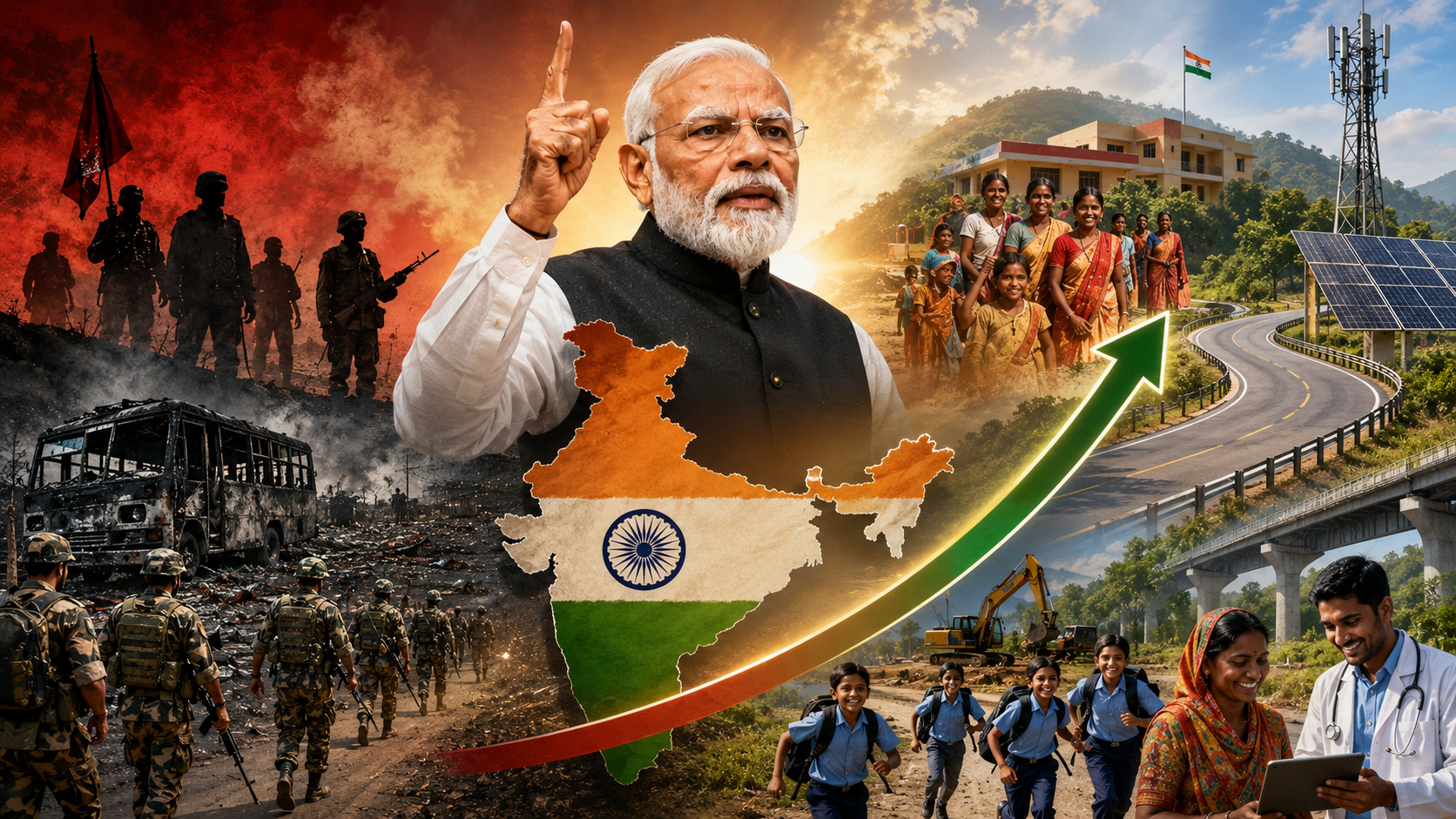
Before 2014, Left Wing Extremism (LWE) or Naxalism was considered India’s biggest internal security challenge. At its peak, the Red Corridor spread across nearly 126 districts in states including Chhattisgarh, Jharkhand, Odisha, Bihar, Maharashtra, Andhra Pradesh, Telangana, West Bengal, Madhya Pradesh and parts of Uttar Pradesh and Kerala. According to Government data, a multi-pronged strategy combining security operations, infrastructure development, road connectivity, welfare schemes and surrender policies has drastically weakened the insurgency.
According to the Government of India, the transformation began after the launch of the National Policy and Action Plan against Left Wing Extremism in 2015. Instead of relying only on security operations, the strategy combined security, infrastructure development, road connectivity, mobile networks, banking access, schools, healthcare, welfare schemes, surrender and rehabilitation policies, and tribal empowerment. This “Whole-of-Government” approach gradually dismantled the Maoist ecosystem.
The results have been unprecedented.
Naxal-affected districts reduced from 126 in 2014 to zero officially classified LWE districts by March-April 2026.
The number of most-affected districts fell from 35 to zero.
Areas once known as the Red Corridor have largely returned to normal governance and development.
The decline is equally visible in violence.
2010: 1,936 Naxal-related incidents and 1,005 deaths.
2014: 870 violent incidents and 310 deaths.
2025: Only 234 incidents and about 100 fatalities.
Thousands of Maoist cadres have either been arrested or surrendered over the past decade. Government figures show that more than 8,000 Naxalites abandoned violence, while security forces established hundreds of new camps, fortified police stations, roads, telecom towers and administrative infrastructure across former insurgency-affected regions.
The Bastar region, once regarded as the epicentre of Maoist violence, has undergone one of the most dramatic transformations. Security operations were accompanied by welfare schemes, road construction, education, healthcare, tribal festivals such as Bastar Pandum, sports initiatives like the Bastar Olympics, and improved governance, bringing large sections of the tribal population back into the mainstream.
This transformation did not happen only through encounters. It happened because the government simultaneously weakened the armed movement, disrupted financial and logistical networks, expanded the state’s presence, and encouraged thousands of cadres to surrender and return to civilian life.
For decades, security agencies and investigative agencies have alleged that the armed Maoist movement survived not only through violence but also because of a wider support ecosystem involving extortion networks, overground sympathisers, front organisations, and individuals who allegedly provided ideological, legal, logistical or financial support. Successive governments, including previous Congress-led governments, also took action against such networks. The debate over this alleged ecosystem has continued across political parties and remains politically contested.
If we look at the history of Naxalism, the movement began in May 1967 in Naxalbari village, West Bengal. It was led by Charu Majumdar, Kanu Sanyal, Jangal Santhal, and others.
The Naxalites were inspired by Mao Zedong and were therefore called Maoists, not followers of any Bharatiya philosopher or philosophy.
If we examine the ideology and objectives of Left-oriented politics and Naxalism, they had a clear agenda:
To break families,
To create confusion among religions,
To weaken the nation.
If we analyse their activities, we find repeated attempts to disturb the peace, prosperity, and development of our nation. There was nothing positive for the country—only negativity under the banner of fighting “exploitation.”
The Maoists were, in fact, Mamata Banerjee’s worst enemies. Today, Mahua Moitra claims to be a “Dimagi Naxal.”
The armed Naxalite movement was supported by a wide network of NGOs, university professors, activists, writers, Leftist student unions, bureaucrats, politicians, media personnel, and artists from various fields.
At its peak in the late 2000s, Naxal influence spread across nearly 180 districts in nine states of central, eastern, and southern India—forming what came to be known as the “Red Corridor.”
They targeted infrastructure, roads, schools, security forces, police personnel, and anyone seen as opposing them. They placed guns in the hands of youth instead of books.
When they killed police personnel and political leaders, Left groups in JNU and elsewhere allegedly celebrated those killings.
The stated goal of the Naxalite movement was to overthrow the government through armed revolution and establish the dictatorship of the proletariat.
Salwa Judum (“Purification Hunt” or “Peace March” in the Gondi language) was a state-sponsored civil militia launched in 2005 by the Chhattisgarh government.
Its objective was to combat Maoists in the Bastar region. Local tribal youth were recruited as Special Police Officers (SPOs) and armed to counter Naxalite activities.
“Civil society” challenged the initiative through the case Nandini Sundar vs. State of Chhattisgarh. On 5 July 2011, the Supreme Court declared the SPO-based Salwa Judum arrangement illegal and unconstitutional.
Today, the armed Naxalite movement stands almost neutralised across India. The “Gandhians with guns” have either surrendered or are dead. Those who remain are now walking on fashion ramps.
This has weakened the so-called “Urban Naxal” ecosystem and its support network. Their funding is drying up, and they are struggling to recruit people for armed insurgency.
As their influence on the ground has declined, they have adopted new strategies. They are now allegedly focusing on the ideological indoctrination of urban youth through teachers, coaching centres, lecturers, and professors.
These are the people whom Vivek Agnihotri described as “Urban Naxals,” and whom PM Modi later referred to as “Dimagi Naxals.”
Why did this new term trigger such an uproar in Left and Congress circles?
People like P. Chidambaram fought against Naxalites when the Congress was in power. Today, he claims to be a “Dimagi Naxal.” The reason, according to this view, is simple—Modi and Shah.
Even Congress governments arrested and acted against sections of the Urban Naxal ecosystem. However, they did not completely dismantle the ultra-Left terror networks.
The Naxalites became useful political instruments in the Congress’s larger strategy. They helped create fear and polarisation.
With the near-neutralisation of armed Naxalites, Congress has lost influence over sections of the rural vote. Today, according to this argument, Urban Naxals have become allies of Congress and other opposition parties.
The Congress-led INDIA Alliance is accused of trying to create new social fault lines and divide voters, particularly the youth, through emotionally charged issues.
That is why many people are now calling themselves “Dimagi Naxals.” A “Dimagi Naxal” does not mean a Naxal with a brain. It refers to someone whose thinking is deeply influenced by Naxalite ideology.
All those BJP critics who describe themselves as “Dimagi Naxals” are, according to this view, neither Naxals nor intellectually sound.
Their minds are said to be filled with hostility towards the BJP, the RSS, Hindu identity, nationalism, and “Vande Mataram.”
In short, Congress and other opposition parties have remained out of power for a long time. According to this perspective, they now seek to regain power by any means possible.
Amid all this controversy, the real “Dimagi Naxals” are allegedly continuing their efforts to indoctrinate the youth against the BJP, RSS, and Hindu identity.
The Modi government knows who the actual “Dimagi Naxals” are. It also knows how to deal with them.
In the meantime, enjoy the drama of the “Nut Skulls” with no “Dimag.” In short, you can call them Ghulams in Independent Bharat.
