
India Higher Education Sector Records Decade of Growth
Institutions, enrolment and women’s participation rise as India strengthens its knowledge ecosystem

- Universities increased from 760 to 1,289 between 2014–15 and 2023–24.
- Higher education enrolment rose 31.5% to 4.50 crore students.
- Female enrolment grew 42.2%, reaching 2.24 crore in 2023–24.
- STEM enrolment crossed 1 crore, while foreign student numbers rose to 58,134.
By Kumar Rakesh
New Delhi, 31st Aug: India’s higher education sector has recorded significant expansion over the past decade, with growth in institutions, student enrolment, women’s participation, faculty strength and infrastructure, according to data from the All India Survey on Higher Education (AISHE) released by the Ministry of Education.
The expansion is aligned with the objectives of the National Education Policy (NEP) 2020, which seeks to promote holistic, multidisciplinary and inclusive education while strengthening India’s knowledge ecosystem.
Universities, colleges expand
According to AISHE data, the number of universities increased from 760 in 2014–15 to 1,289 in 2023–24, registering a growth of 69.6%. The number of colleges rose from 38,498 to 48,246, while standalone institutions increased from 12,276 to 15,221 during the period.
The expansion has increased the institutional capacity of the higher education system and widened access for students across the country.
Enrolment rises, women lead participation gains
Total higher education enrolment increased by 31.5%, from 3.42 crore students in 2014–15 to 4.50 crore in 2023–24.
The Gross Enrolment Ratio (GER) also increased from 23.7% to 30% during the period. The rise contributes towards the NEP 2020 target of achieving a 50% GER by 2035.
Female enrolment recorded a sharper increase, rising 42.2% from 1.57 crore to 2.24 crore. Female GER increased from 22.9% in 2014–15 to 31.2% in 2023–24, exceeding male GER of 28.9% for the seventh consecutive year.
The Gender Parity Index improved from 0.92 to 1.08, while GPI for SC students rose from 0.91 to 1.11 and for ST students from 0.81 to 1.08.
Participation of disadvantaged groups grows
The share of SC enrolment increased from 13.44% to 15.5%, while ST enrolment rose from 4.8% to 6.4%. OBC participation increased from 32.8% to 40.1% between 2014–15 and 2023–24.
GER among SC students rose from 18.9% to 27.8%, while the ST GER increased from 13.5% to 22.8%.
The data also recorded growth in enrolment of Persons with Benchmark Disability (PwBD), which increased from 64,298 in 2014–15 to 88,816 in 2022–23.
PhD and integrated programmes see major growth
Doctoral enrolment increased from 1.17 lakh to 3.43 lakh, representing growth of 192.89%. Integrated programme enrolment recorded an even sharper increase, rising from 1.41 lakh to 5.69 lakh, a growth of 301.36%.
Postgraduate enrolment increased by 50.15%, while undergraduate enrolment rose 27.27% during the decade.
Higher education out-turn also increased from 88.28 lakh in 2014–15 to more than 1.09 crore in 2023–24, reflecting higher enrolment, retention and programme completion.
STEM enrolment crosses one crore
Enrolment in Science, Technology, Engineering and Mathematics (STEM) programmes increased from 91.5 lakh in 2014–15 to 1.02 crore in 2023–24, an overall rise of approximately 11.5%.
The increase reflects sustained student participation in STEM disciplines alongside developments in digital technology, innovation, research and employment opportunities.
Foreign students and faculty numbers rise
Foreign student enrolment increased from 42,293 to 58,134, registering approximately 37.5% growth over the decade.
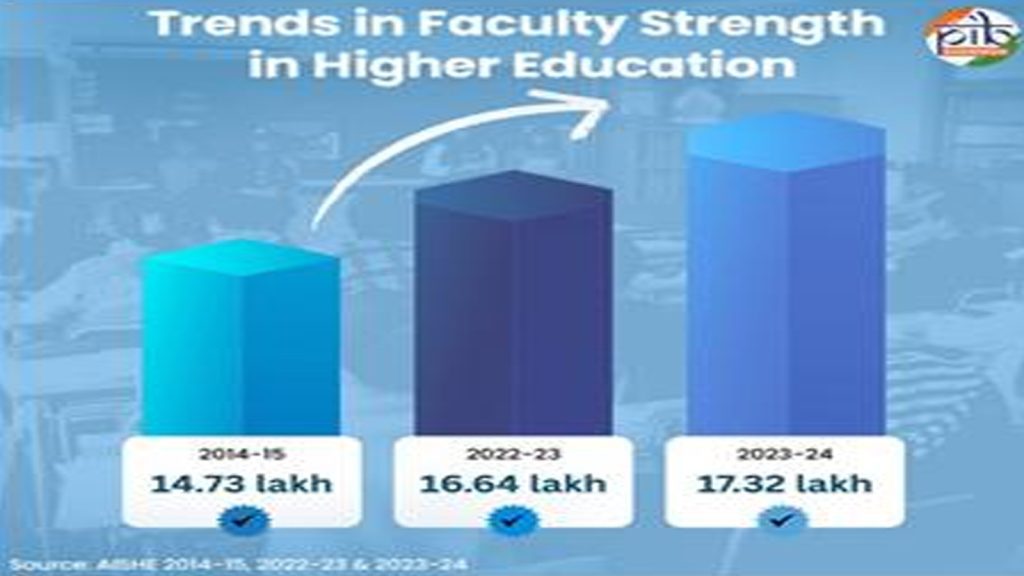
The number of teachers in higher education also increased from 14.73 lakh to 17.32 lakh, an addition of 2.59 lakh teachers. The number of female teachers grew by 36.7%, with women accounting for 44.9% of the teaching workforce in 2023–24.
Infrastructure expands
Higher education institutions have also recorded improvements in physical and digital infrastructure.
In 2023–24, playground facilities were available in 94% of universities, 95% of colleges and 91% of standalone institutions. Libraries were available in 98% of universities, colleges and standalone institutions, while laboratories were available in 89% of universities, 85% of colleges and 94% of standalone institutions.
The Ministry said the overall trends point towards an expanding and more inclusive higher education ecosystem, with improvements in access, participation, gender parity, social inclusion, STEM education and internationalisation.
