

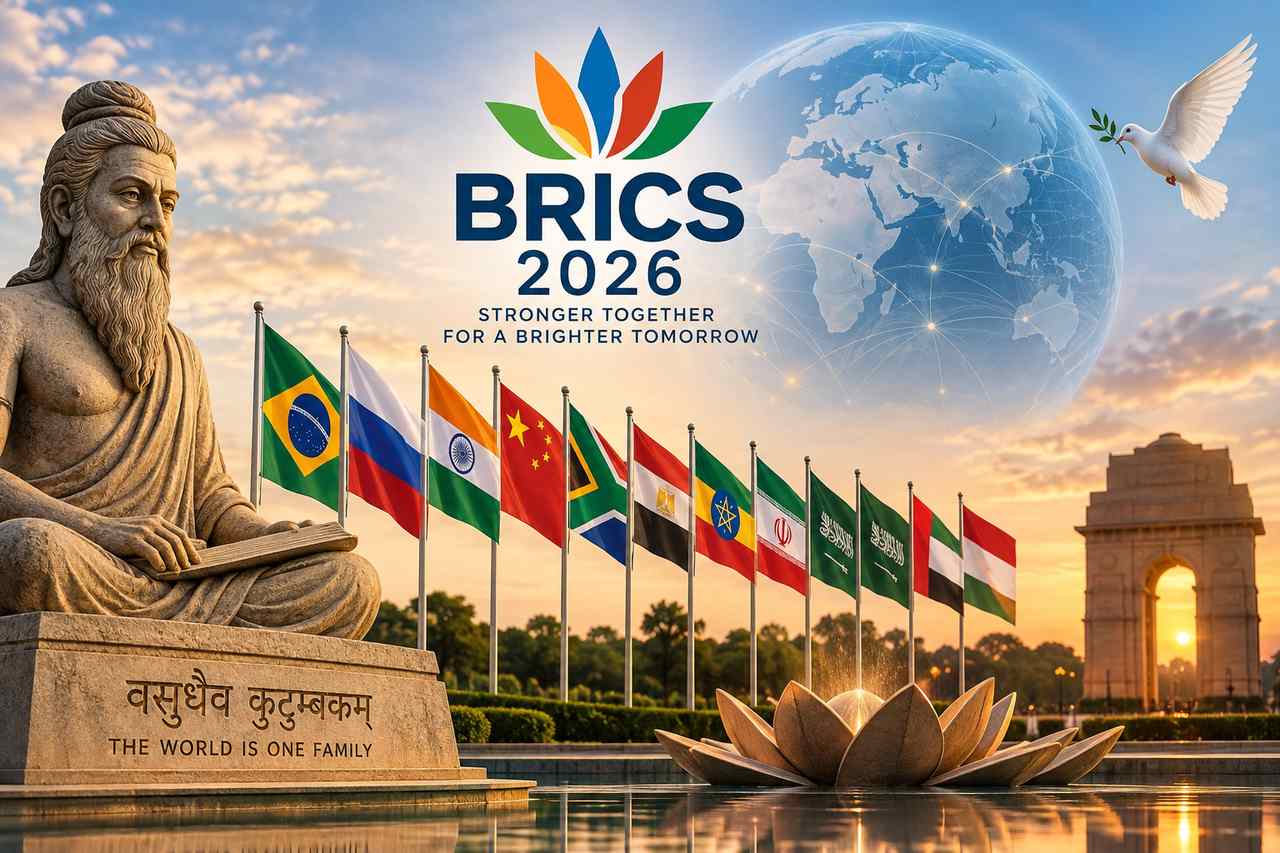

The BRICS Summit being held in New Delhi comes at a time when the world is grappling with growing geopolitical tensions, wars, and global fragmentation. In such circumstances, the message of “Building for Resilience, Innovation, Cooperation and Sustainability” under India’s chairmanship is not merely a diplomatic priority; it is also a global expression of the core ideas of Indian culture and traditions.
BRICS has emerged as an important platform in global politics and economics. Beginning as a grouping driven by the spirit of economic cooperation and sustainable development, it initially comprised four countries and has now expanded into an organisation of 11 member states. Its growing role indicates that the global order is gradually becoming more multipolar rather than remaining centred around a few developed powers. Based on purchasing power parity (PPP), the collective economies of BRICS countries account for a significant share of the world economy and highlight the growing economic potential of developing countries. Today, the success of BRICS is reflected in the fact that BRICS countries account for around 40 percent of global GDP in purchasing power parity terms, approximately 11 percentage points higher than the G7. The growth rate of BRICS member countries is around four percent, compared with only about one percent for the G7 countries.
In this changing global scenario, India’s role becomes particularly significant. India does not view BRICS merely as a platform for economic cooperation; rather, it sees it as a means of promoting dialogue, cooperation, and shared interests among developing and emerging economies. The Indian approach clearly reflects an effort to strike a balance between safeguarding national interests and promoting global cooperation.
The significance of BRICS becomes even greater at a time when the world is facing instability at multiple levels. Ongoing conflicts in different regions, growing strategic tensions, economic competition, and mutual distrust have created serious challenges for the global order. Under such circumstances, the need to prioritise dialogue and cooperation rather than considering war as a solution has become stronger than ever.
The theme of the summit under India’s chairmanship—“Building for Resilience, Innovation, Cooperation and Sustainability”—highlights precisely this need. The theme is deeply connected with the Indian cultural ethos, which has traditionally emphasised coexistence over conflict, harmony over dominance, and creation over destruction. The fundamental spirit of the Indian tradition has always been one of peace and harmony. The idea of *Vasudhaiva Kutumbakam*—the world as one family—encourages us to view humanity as an interconnected whole. At a time when nations are adopting increasingly assertive strategies to safeguard their respective interests, this perspective can offer an alternative pathway towards global peace.
Resilience: India’s Approach in a Changing World
‘Resilience’ occupies a prominent place in the theme of BRICS 2026. Indian thought has traditionally emphasised the ability to adapt to changing circumstances and remain tolerant and balanced. Giving importance to balance and dialogue rather than rigidity has been a distinctive feature of India’s social and philosophical traditions.
This approach can also be seen in India’s foreign policy. Amid changing global equations, India has given the highest priority to its national interests while keeping channels of dialogue and cooperation open with different powers. Such resilience does not signify weakness; rather, it reflects the ability to make prudent decisions in response to changing circumstances.
Innovation: A Synthesis of Tradition and Modernity
The inclusion of ‘innovation’ in the summit theme is also significant from an Indian perspective. India has a long history of innovation and scientific curiosity in its knowledge traditions. From scholars such as Charaka, Sushruta, and Aryabhata to modern Indian personalities such as Jagadish Chandra Bose, A. P. J. Abdul Kalam, and E. Sreedharan, Indian talent has demonstrated its capabilities in science, technology, and nation-building.
For India, innovation does not mean merely developing modern technologies; it also means seeking solutions to emerging challenges while remaining connected to its roots. This synthesis of tradition and modernity can give India a distinctive position in the global innovation ecosystem.
Sustainable Development: Possible Only Through Cooperation
The third important dimension of the BRICS 2026 theme is ‘cooperation’. The present global circumstances make it clear that no nation can address challenges such as climate change, food and energy security, healthcare, poverty, technological inequality, and economic instability alone. Cooperation among nations is essential for sustainable development.
Wars and conflicts obstruct the pace of development, divert resources towards destruction, and adversely affect human well-being. In contrast, cooperation, dialogue, and shared responsibility can provide development with a broader and more sustainable foundation. The spirit of cooperation and harmony in Indian civilisation is reflected in the idea of *Vasudhaiva Kutumbakam*. The thoughts of Swami Vivekananda, Gautama Buddha, and Lord Mahavira also emphasise the broader ideals of humanity, coexistence, compassion, and peace. The relevance of these ideas has become even greater in contemporary global politics.
Sustainability
The final important dimension of BRICS 2026 is ‘sustainability’. Development can be meaningful only when it progresses alongside peace, social justice, and environmental balance. If economic progress generates instability and conflict, it cannot ensure long-term human well-being.
Therefore, under India’s chairmanship, the BRICS agenda should not remain confined to the economic interests of its member states. It should move towards building a global order in which the voices of developing countries receive greater recognition, equal opportunities to access technology and resources are ensured, and greater representation and balance are established within global institutions.
The theme of BRICS 2026 is significant because it reflects a natural convergence between India’s civilisational heritage and its modern diplomatic outlook. Resilience teaches us to move forward in a balanced manner in response to changing circumstances; innovation opens new pathways for addressing future challenges; cooperation lays the foundation for shared development; and sustainability provides long-term strength to that development.
Today, the world needs partnership rather than demonstrations of power, dialogue rather than conflict, and cooperation rather than confrontation. If India advances BRICS by maintaining a balance between its cultural heritage and modern capabilities, the platform can not only strengthen the voice of the Global South but also play an important role in building a more balanced and multipolar world order.
Ultimately, the message of BRICS 2026 is that development and peace cannot be viewed separately from one another. The fundamental principle of Indian civilisation has also been that the welfare of humanity can be achieved only through collective efforts. At a time when the world appears to be moving towards division, the spirit of ‘Vasudhaiva Kutumbakam’ and the path of “cooperation for sustainability” can help humanity move away from destruction towards shared prosperity.
Dr. Priyadarshini Purohit is a Faculty of Political Science in Banasthali Vidyapith since last 18 years. She has strong academic background with publication on International Relations, Gender Issues and Indian Knowledge System.
