
India World’s Largest Vaccine Producer by Volume: Jitendra Singh
Minister highlights India’s growing vaccine capabilities, bioeconomy and partnership with CEPI on global health security

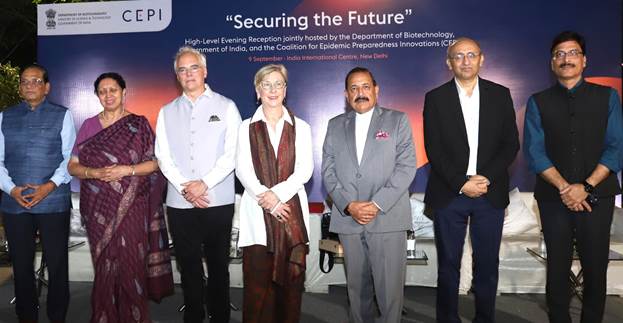
- India supplies vaccines to more than 100 countries and accounts for nearly 60% of global vaccine production, Singh said.
- India’s bioeconomy reached $195.3 billion in 2025, growing 18% year-on-year.
- The India-CEPI partnership is advancing next-generation vaccines and epidemic preparedness.
- The collaboration has supported vaccine development, research infrastructure and capacity building across countries.
GG News Bureau
New Delhi, 14th Sept: India has emerged as the world’s largest vaccine producer and global vaccine supplier by volume, Union Minister of State for Science and Technology Dr Jitendra Singh said on Sunday, highlighting the country’s expanding capabilities in vaccine research, biotechnology and epidemic preparedness.
Singh was speaking at a high-level reception for the Coalition for Epidemic Preparedness Innovations (CEPI) Board and Investors Council, jointly hosted by the Department of Biotechnology (DBT), Government of India, and CEPI at the India International Centre in New Delhi.
The Minister said India had moved significantly beyond the limitations of a decade ago and had developed a strong bioeconomy, vaccine development capabilities and scientific ecosystem capable of contributing to global preparedness for future epidemics and pandemics.
According to Singh, India supplies vaccines to more than 100 countries, accounts for nearly 60 per cent of global vaccine production and meets more than 65 per cent of the World Health Organization’s routine immunisation requirements.
He said India’s capabilities now extend beyond affordable vaccine manufacturing to research, innovation, advanced biologics, clinical development and large-scale manufacturing.
India’s bioeconomy reached $195.3 billion in 2025, recording 18 per cent year-on-year growth, while the country’s biotechnology startup ecosystem expanded to 11,855 startups, including 1,780 new startups added during 2025. The biopharma sector accounts for nearly 30 per cent of India’s bioeconomy.
Recalling the COVID-19 pandemic, Singh said India developed vaccines within a short period and supplied them to other countries and partners. He said this experience contributed to a change in the global perception of India’s scientific and technological capabilities.
Singh also highlighted India’s diverse disease landscape as an advantage for vaccine research and epidemic preparedness. He said the country’s exposure to a wide range of communicable diseases alongside increasing non-communicable and metabolic disorders provides opportunities to study pathogens, disease patterns and interactions between infectious and metabolic conditions.
The Minister said India could contribute to a global repository of biomedical knowledge and solutions for emerging health threats by combining its disease diversity with its scientific capabilities.
The DBT-BIRAC-CEPI partnership is being used to advance vaccine research and strengthen preparedness for future epidemics and pandemics. The engagement, first established in October 2019, was renewed in September 2025 for another five years.
The India-centric Ind-CEPI Mission, implemented by BRIC-THSTI and BIRAC, has supported the development of India’s first mRNA COVID-19 vaccine, GEMCOVAC-19, an inactivated Chikungunya vaccine candidate undergoing Phase II/III trials, and multivalent self-assembled nanocage-based vaccine candidates for Monkeypox and pan-sarbecoviruses.
The BRIC-THSTI Bioassay Laboratory has also been recognised as one of CEPI’s 17 centralised network laboratories. The laboratory has supported eight vaccine candidates at different development stages and tested more than one lakh samples for vaccine development.
Singh said the next phase of India-CEPI cooperation should focus on universal and pan-pathogen vaccine development, advanced biomanufacturing and wider national and international collaborative networks.
He emphasised greater cooperation among government, academia, industry and international partners to translate scientific capabilities into deployable solutions for emerging health threats.
The CEPI Board and Investors Council meetings in New Delhi, held a decade after the organisation’s previous governance meeting in India, marked a significant phase in the India-CEPI partnership and highlighted India’s growing role in vaccine innovation, epidemic preparedness and global health security.
