
Talaq Economy: The secret loophole draining Karnataka’s welfare schemes
How gaps in welfare monitoring, alimony rules and beneficiary verification may expose Karnataka’s support schemes to misuse

By Poonam Sharma
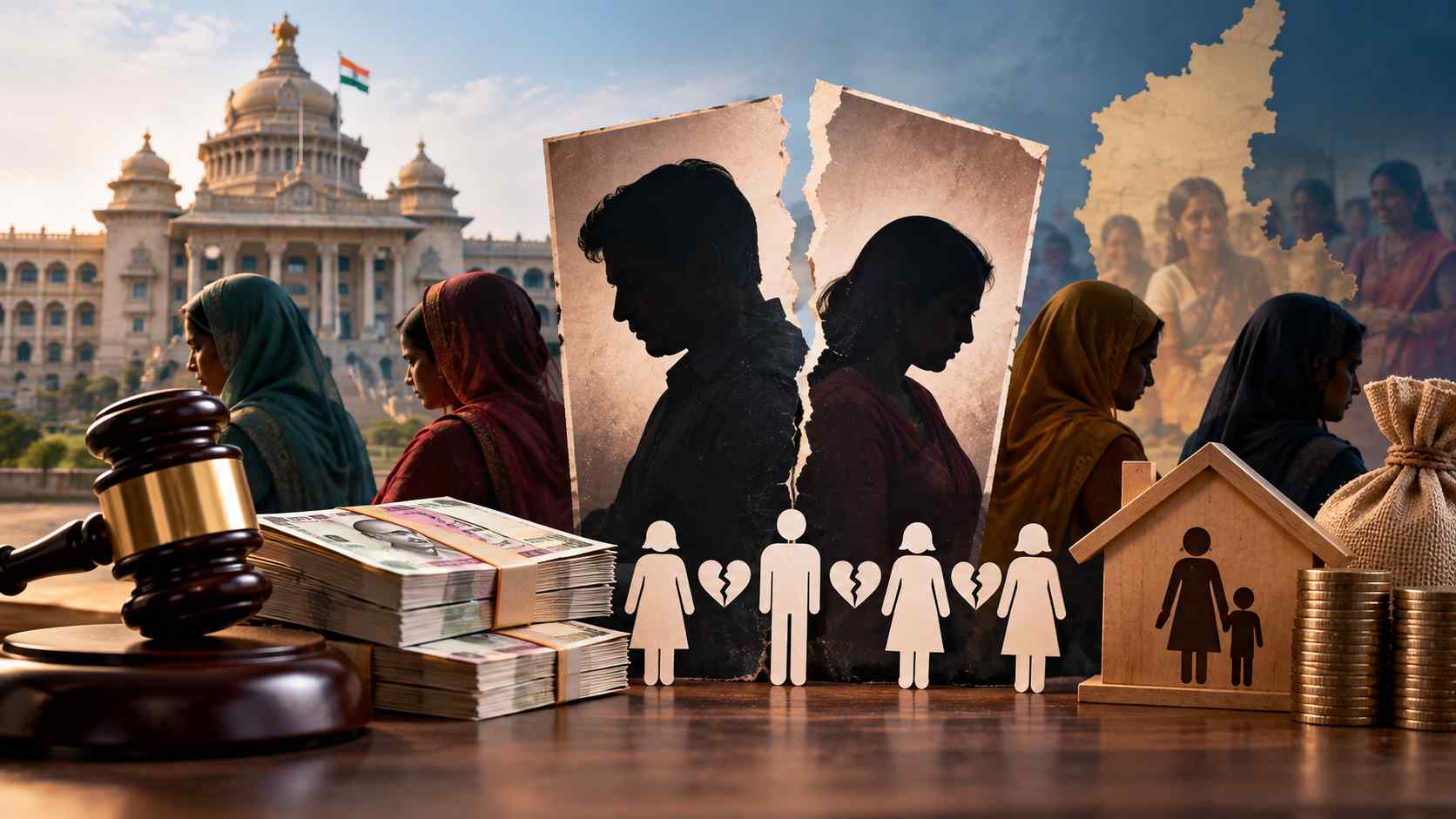
Stories often emerge from the labyrinth of India’s welfare structure of not only human ingenuity but also deep flaws in governance. Karim’s recent story, a man who has to pay alimony to multiple ex-wives, while his current household survives on the alimony his wife gets from her former husbands and government welfare, is not just an anecdote – it is a microcosm of a growing concern in states like Karnataka.
Gruha Lakshmi & Welfare Web
The Gruha Lakshmi scheme has been launched by the Karnataka government to empower women by giving a monthly cash incentive to eligible housewives. The intention is good. It is a social safety net especially for those who come from economically challenged backgrounds. But like many government programs, how well this one works depends entirely on how strongly it is implemented and overseen.Karim’s story is ironic, but it also shows a hard truth. Some personal laws permit multiple marriage, and there is a complicated web of alimony obligations and government welfare. Such schemes are more likely to be abused by those who exploit legal and bureaucratic loopholes than to help those who really need help.The phenomenon of “Talaq Economy”The term “Talaq Economy” is a succinct way of describing a system where the practice of frequent divorces and the resultant alimony claims become a means of financial sustenance, not just for the women but even for the men involved. In Karim’s case, his entire income is consumed by court-ordered alimony to multiple ex-wives. But the circularity is obvious when his current wife, too, is on alimony from her former spouses, on top of government assistance.This ‘exchange offer’ system is an abuse of statutory provisions meant for protection and welfare. It is, rather, a mechanism of economic survival. Each party therefore strategically uses divorce laws and welfare schemes. While these practices are technically legal, they undermine the spirit of public welfare and threaten the sustainability of social support systems.
Government Indifference and Policy Oversights
Gruha Lakshmi and other such schemes have been milestones of social justice for the Congress-led Karnataka government. But the absence of stringent checks and monitoring has made these schemes vulnerable to abuse. The fact is that the state authorities could not manage to create a flawless system of tracking the beneficiaries, especially when there were multiple marriages and divorces.There is no way to verify that a beneficiary does not receive alimony from several sources, or that overlapping benefits are not paid to the same household. The administrative laxity not only leads to financial leakage but also breeds resentment among genuinely needy families who are left out or given far less than intended.
The Cultural Environment: Several Marriages and Loopholes in the Law
It must be borne in mind that the problem is not confined to any one community but it is especially acute where personal laws sanction and normalize multiple marriages and easy dissolution through talaq. The space between freedoms of personal law and universal welfare schemes is a rich field of exploitation.The government’s unwillingness to tackle this sensitive issue – perhaps due to political calculation or fear of social backlash – means the cycle goes on unabated. The lack of a common civil code and the unwillingness to reform alimony and rules for determining beneficiary eligibility only deepen the problem.
Who Pays the Price?
And in the end it’s the taxpayer who pays the price for that inefficiency. While the state resources meant for empowerment and upliftment are siphoned off through loopholes, the vulnerable continue to be vulnerable. The system is not only losing money but also its credibility, promoting a culture of dependence and entitlement, not progress.
What has to change?
Tighter Monitoring: It should be linked and cross checked by beneficiary data bases to avoid double dipping and fraud.
Eligibility reforms: Welfare schemes should consider all income sources, including alimony, before sanctioning benefits.
Legal Reform: There is a pressing need to discuss the interface of personal laws and public welfare, and perhaps move toward a common civil code.
Political will: The government has to be brave enough to close these loopholes even if it means being asked questions it doesn’t want to hear.
Conclusion: A New Look at the Welfare ParadigmThe “Talaq Economy” is a painful lesson on how well-intentioned schemes can go wrong without careful policy design and vigilant execution. Like many others, Karnataka’s Gruha Lakshmi scheme is a case study in how welfare can be misused in the absence of accountability.If the Congress government really wants to seek justice, it needs to look beyond the optics and address the structural issues that make such exploitation possible. Welfare should allow, not entrench, a culture of “exchange offers” and circular dependency. Only then will public money really translate into real, transformative change for the most vulnerable in India.
