
SEMICON India 2026 Concludes With 56 Key Announcements
Three-day event draws over 51,000 registrations, 40,000 footfall and participation from 52 countries

GG News Bureau
New Delhi, 20th Sept: SEMICON India 2026, the country’s flagship semiconductor conference, concluded at Yashobhoomi, New Delhi, on Saturday, marking another step in India’s efforts to expand its semiconductor ecosystem.
Held from September 17 to 19 under the theme “Silicon to Systems: Building the Ecosystem,” the fifth edition brought together more than 600 exhibitors, including around 300 international companies. Representatives from 52 countries and more than 150 speakers participated in the event.
The conference recorded 51,656 registrations and a cumulative footfall of around 40,000. Six country pavilions representing Japan, South Korea, Malaysia, the Netherlands, Singapore and Sweden, along with 12 state pavilions, a startup pavilion and workforce development and innovation zones, highlighted different segments of the semiconductor value chain.
Prime Minister Narendra Modi inaugurated the event and highlighted India’s shift from policy formulation and project planning towards commercial semiconductor production. He also virtually inaugurated commercial production lines at CDIL Semiconductor, Mohali, and Suchi Semicon, Surat, taking the number of operational commercial semiconductor units among the 12 projects approved under Semicon 1.0 to five.
The Prime Minister also outlined Semicon 2.0, which has an outlay of ₹1,27,500 crore and focuses on six areas: design, machines and materials, new fabs, advanced packaging, research and talent development.
Across the three-day event, 56 MoUs, announcements and strategic initiatives were announced across semiconductor design, fabrication, advanced packaging, equipment and materials, power electronics, AI, high-performance computing, R&D, logistics, skilling and workforce development.
Union Minister Ashwini Vaishnaw outlined the implementation approach for Semicon 2.0, with discussions focusing on resilient supply chains, AI-enabled chip design and manufacturing, advanced packaging, indigenous R&D, power electronics, display technologies and workforce development.
The concluding day also focused on sustainability, ease of doing business, deep-tech startups, indigenous innovation and industry-academia partnerships. The Digital India RISC-V Grand Challenge under the Chips to Startup Programme attracted 1,236 teams and 5,045 participants.
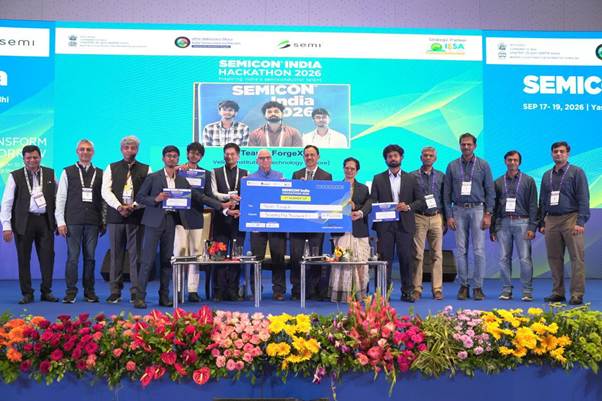
Three industry hackathons organised by KLA, Synopsys and Lam Research in partnership with CeNSE-IISc received more than 3,800 team registrations from over 900 colleges.
International cooperation remained a key component of the conference, with country roundtables involving the United States, Japan, Singapore, Europe, South Korea and Malaysia. Discussions covered investment, technology partnerships, manufacturing, advanced packaging, equipment, materials, supply chains, R&D and talent.
The conference brought together stakeholders across the semiconductor value chain, including chip design and intellectual property, materials and equipment, fabrication, advanced packaging, electronics manufacturing, research, startups, sustainability and talent development.
The 2026 edition represented an expansion over SEMICON India 2025, with the government highlighting the increased participation as a platform for investment, technology partnerships, research commercialisation, skilling and international cooperation.
