
Congress’s Gandhi Family’s Silence on Our World Hero Captain Smit Machchhar Is a Missed Post or Muslim Votes Politics??
When an Sanatani Hindu Bhartiya pilot captain Smit risked his life to protect 174 people, Congress’s Rahul Gandhi and his family had a simple opportunity to put the Nation before Politics, But They chose merely SILENCE. Why?

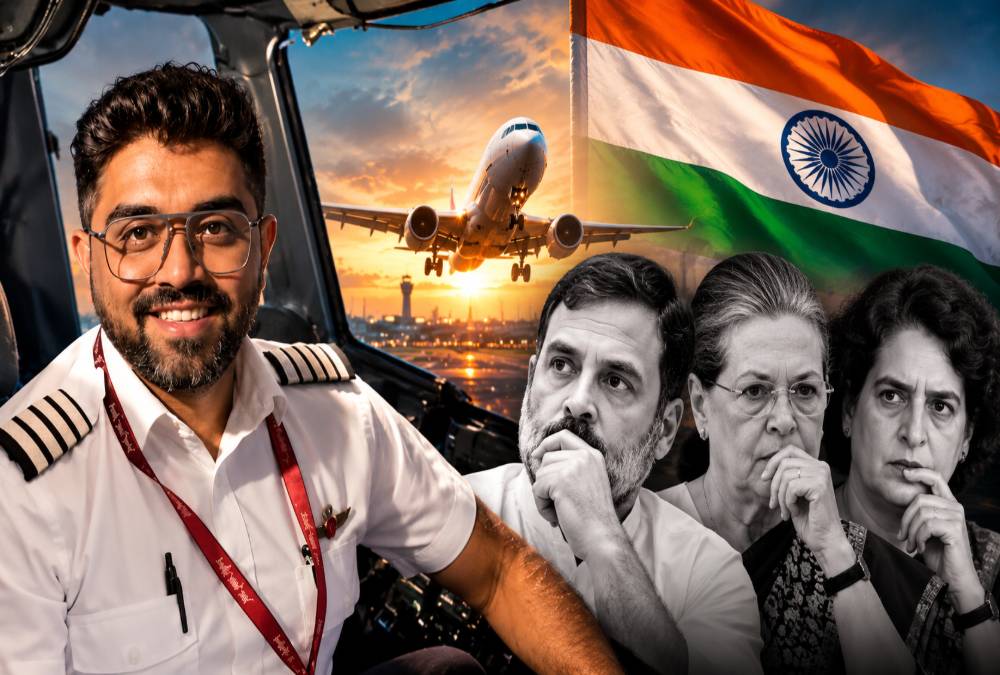
There are moments in public life when a politician’s silence becomes more revealing than a hundred speeches. The controversy surrounding Captain Smit Machchhar is one such moment. An Bhartiya pilot found himself in an extraordinary cockpit emergency on a Flydubai flight no FZ1073 from Dubai to Tel Aviv on September 30, 2026. According to reports, Machchhar was attacked by his co-pilot a Muslim youth Hamami al Hamami (29) Omani citizen, while the aircraft was carrying 174 people. Despite being seriously injured, he managed to open the cockpit door, creating an opportunity for others to intervene and preventing what could have become a catastrophe. His courage with other 4 passengers has subsequently received recognition from Prime Minister Narendra Modi and Israeli Prime Minister Benjamin Netanyahu. Captain Smit also thanked to our PM Shri Modi, people of Bharat with Israel PM H.E. Benjamin Netanyahu for their blessings & courageous support.
According to insiders of Congress, Muslim votes politics may be one big reason to not speak about Captain Smit, as he is a Hindu Bhartiya, as Rahul is a very systematic & calculative person in his life. So, it may be one important reason to not speak for the great contribution of Captain Smit for Humanity.
In between, while the country was talking about the pilot’s courage, an uncomfortable question emerged in Bharat — where were the Leader of Opposition in Lok Sabha & Congress Leader Rahul Gandhi, Sonia Gandhi and Priyanka Gandhi Vadra? As all are members of Parliament also.
The question is no longer merely a social-media talking point. The BJP has openly challenged the congress ‘s Gandhi family over what it describes as its silence, and the issue has now become part of the political conversation. BJP leaders Dr Sudhanshu Trivedi, Sambit Patra & others have specifically asked why Sonia Gandhi, Rahul Gandhi and Priyanka Gandhi Vadra did not personally acknowledge Machchhar’s bravery. What is the reason behind it?
Sambit Patra has raised a troubling set of questions about Rahul Gandhi’s reported Oman visit and the subsequent Flydubai incident. Was Rahul Gandhi in Oman around May 3? Who hosted the visit? Who financed it? And why was the co-pilot reportedly linked to Oman? Coincidence or something that deserves investigation?
No one should declare a conspiracy without evidence. But neither should Rahul Gandhi be allowed to hide behind silence. If the Oman visit was routine, explain it. If the funding was legitimate, disclose it. If there is no connection with the aviation incident, establish that clearly.
And then comes the more uncomfortable question: Is the Gandhi family’s silence on Captain Smit Machchhar another example of the Muslim-appeasement politics that the BJP has repeatedly accused the Congress of practising?
The answer should come from Rahul Gandhi himself—not from political spokespersons, rumours or speculation.
Questions do not become illegitimate merely because they are inconvenient.
The Congress cannot honestly claim that the party as a whole ignored Machchhar. That would be factually incorrect. Congress president Mallikarjun Kharge praised the pilot, while Congress MP Jairam Ramesh said Machchhar’s courage, quick thinking and resolute action would remain inspirational and that the entire nation was in awe of what he had done.The comment of another congress MP Imran Masood about Captain Smit was so disgraceful.He should shame himself about those comments.
But that defense actually makes the Gandhi family’s silence more difficult to understand.
If Congress leaders could recognise Machchhar’s courage, what prevented the Gandhi family’s most prominent members from doing the same? Why??
Rahul Gandhi is the Leader of the Opposition in the Lok Sabha. His political statements are routinely presented as an alternative national narrative to that of the government. Sonia Gandhi also MP in Rajya Sabha a, upper house of parliament, remains a central figure in the Congress establishment, while Priyanka Gandhi Vadra, MP, is also one of the party’s most recognisable national leaders. These are not obscure politicians whose public statements nobody notices. Their words carry political weight. Consequently, their silence on a matter of such extraordinary public interest also carries meaning.
No one is suggesting that a politician must comment on every accident, every achievement or every news event. That would be absurd. But this was not an ordinary incident. It involved the safety of 174 people, an attack inside an aircraft cockpit, a badly injured Bhartiya pilot and an act of courage that attracted international attention. Prime Minister Shri Modi personally spoke to Mr Machchhar. Mr Netanyahu publicly praised him. US President Mr Donald Trump praised the courage of Captain Smit .The pilot’s story became a matter of national pride with international recognition for him & our Bharat.But Congress’ Gandhi family choose to be SILENT? Why ??
At that point, a message from the Leader of the Opposition should not have required political calculation.
It required only basic human decency and recognition of courage.
That is precisely why the Gandhi family’s silence is politically embarrassing.
The uncomfortable truth for the Congress is that Rahul Gandhi did not need to praise Narendra Modi to praise Captain Machchhar. Priyanka Gandhi Vadra did not need to endorse the government’s policies to wish the injured pilot a speedy recovery. Sonia Gandhi did not need to make a political speech to recognise an Bhartiya citizen who had displayed extraordinary courage.
A simple acknowledgement would have been enough.
Instead, the political space was left open for the BJP to ask the question that the Congress now has to confront.
The BJP’s attack has been sharp. Its leaders have accused the Gandhi family of selective sensitivity and have questioned whether political considerations were responsible for the absence of a personal response. Some BJP leaders have specifically raised comparisons with the Gandhi family’s positions on earlier controversial security-related cases.
The Congress may dismiss these attacks as political opportunism. That is predictable. The BJP obviously has an interest in embarrassing the opposition. But dismissing the messenger does not eliminate the question.
The question remains: why did the Gandhi family not personally acknowledge Captain Machchhar?
And there is a second question that is even more uncomfortable: would the response have been different if the circumstances had fitted the Congress’s preferred political narrative more comfortably?
That is the issue of selective sensitivity.
Bhartiya politics has become accustomed to parties deciding which tragedies deserve outrage, which individuals deserve praise, which victims deserve immediate political solidarity and which incidents can be quietly allowed to pass. Every party is guilty of this to some degree. But the Congress, which constantly presents itself as the defender of constitutional values, pluralism, justice and the rights of ordinary citizens, should be especially careful about appearing selective in its empathy.
Captain Machchhar’s case should have been impossible to politicise from the Congress side because his courage was so straightforward. He was not a politician. He was not a government spokesperson. He was not campaigning against Rahul Gandhi. He was not campaigning for Narendra Bhai Modi. He was a professional pilot confronted with an emergency and apparently acted to protect the people under his responsibility.
There was no ideological trap.
There was no political price for praising him.
There was no reason to remain silent.
And yet the Gandhi family’s personal response was conspicuous by its absence.
That is why the controversy deserves more than a dismissive response from Congress supporters.
There is another lesson here for Rahul Gandhi personally. A Leader of the Opposition is expected to challenge the government. He is expected to ask uncomfortable questions. He is expected to demand accountability. But leadership is not simply the ability to criticise those in power. It also involves knowing when an issue is bigger than the government of the day for our country .
Captain Machchhar’s courage was bigger than the BJP.
It was bigger than Narendra Bhai Modi.
It was bigger than Rahul Gandhi.
It was bigger than the Congress.
It was a Bhartiya citizen demonstrating courage in a life-threatening situation.
A confident opposition leader should have been able to recognise that without worrying about whether the government would receive political credit.
If Rahul Gandhi believes that praising a Bhartiya Hero would somehow benefit Narendra Bhai Modi, that would itself reveal an unhealthy understanding of opposition politics. National recognition should not be treated as a zero-sum political game.
Unfortunately, Indian politics has increasingly reached a point where even appreciation can become partisan. It should not be for any political parties .
The Gandhi family’s silence has fed exactly that perception.
There is also a larger problem with the politics of the Gandhi family. For decades, the family has occupied an extraordinary position within the Congress & in this country .Sonia Gandhi ,Rahul Gandhi and Priyanka Gandhi Vadra remain among the party’s most influential public faces. With that prominence comes scrutiny. The family cannot reasonably expect its statements to be treated as nationally significant when it speaks while demanding that its silence be treated as meaningless when it does not.
Leadership comes with accountability in both directions.
If Rahul Gandhi wants to be taken seriously as a national alternative to Narendra Bhai Modi, then his political conduct must be judged by a national standard. That includes what he says about government policy, what he says about national security and, equally, whether he can recognise courage when it comes from outside his political ecosystem.
The Gandhi family should therefore stop treating every criticism from the BJP as something that can be dismissed simply because the BJP made it.
Some questions deserve answers regardless of who asks them.
This is one of them.
The Congress’s own response makes the matter particularly difficult to explain. Kharge praised Machchhar. Jairam Ramesh praised him. The party’s communications machinery recognised the pilot’s courage.
So why did the party’s most prominent political family not make the same gesture personally?
If the answer is that senior Congress leaders had already spoken, then say so.
If the answer is that Rahul Gandhi did not want to comment on the incident, explain why?
If the answer is simply that the matter was overlooked, admit it.
Any of these explanations would be preferable to allowing speculation to define the story.
What is unacceptable is the political habit of demanding transparency from everyone else while treating one’s own choices as beyond questioning.
But the existence of political opportunism does not erase legitimate criticism.
The Gandhi family had a chance to demonstrate that there are still issues in Bharat that transcend partisan politics.
It missed that chance.
And the irony is difficult to ignore. Rahul Gandhi has recently been speaking forcefully about democracy, accountability and the importance of questioning those in authority. He has argued that questions cannot be suppressed and that political power must remain accountable.
Fine.
Then the same principle must apply to him.
If citizens have questions about his conduct, he should answer them.
If there are questions about his silence, he should explain it.
Accountability cannot be a principle reserved exclusively for one’s political opponents.
The question of Rahul Gandhi’s public conduct cannot, however, be separated entirely from the wider controversies that have surrounded him for years. His nationality, alleged British citizenship, overseas associations, business dealings and aspects of his personal life have repeatedly generated political debates, media reports and public speculations.Some of these matters have reached courts or official forums, while others have remained the subject of competing claims and counterclaims. The point is not to pronounce every circulating story as fact; the point is to ask why a politician who seeks the highest public office in the country should not be expected to provide clear answers whenever credible questions concerning his public record arise.
The controversy surrounding his alleged British citizenship is one such example. Questions over his nationality and documents have persisted for years, and the matter has repeatedly entered political and legal discourse. Whatever the final legal position on individual claims, the persistence of the controversy itself raises a legitimate question about transparency. If the documents and facts are clear, why should there be hesitation in placing them before the public and putting the matter to rest?
The same questions arise regarding the various reports and speculation concerning Rahul Gandhi’s overseas relationships, business connections and associations with individuals and organisations outside India. Some accounts have been aggressively promoted by partisan publications and political opponents; others have been disputed or remain unverified. But a public figure of Rahul Gandhi’s stature cannot reasonably expect every uncomfortable question to disappear simply by dismissing it as propaganda. If there is nothing behind a particular controversy, the strongest response is not outrage but evidence.
This is where the Gandhi family’s political philosophy deserves examination. Rahul Gandhi has built much of his political identity around questioning institutions, demanding transparency and challenging those in authority to provide answers. That standard cannot logically apply only to his political opponents. The same demand for transparency must apply to him.
If questions concerning his nationality are baseless, answer them conclusively. If speculation about his business associations is false, establish the facts. If reports concerning his personal associations are fabricated, expose them. If political opponents have distorted the truth, provide the documentary record and end the controversy. A national leader should not fear scrutiny; he should welcome the opportunity to establish the facts.
And this is precisely why the Captain Smit Machchhar episode becomes so politically revealing. The issue is not that Rahul Gandhi has been accused of something in this particular incident. The issue is that his political record has repeatedly been surrounded by questions, while his response to a straightforward opportunity to recognise an Indian hero has itself generated another question: why the silence?
There is a pattern here that deserves examination—not a pattern of proven wrongdoing, but a pattern in which difficult questions surrounding the Gandhi family repeatedly become political battles over who has the right to ask them. That is not good enough for a family that has exercised such enormous influence over India’s political life.
The Gandhi family cannot simultaneously demand that every institution, every government and every political opponent answer difficult questions while suggesting that questions directed towards them are inherently motivated or illegitimate. Democratic accountability is not selective. It cannot be a weapon to be used against opponents and a shield to be used for oneself.
Rahul Gandhi may ultimately have perfectly satisfactory answers to every one of these questions. If so, he should provide them. The public is capable of distinguishing between fact and fiction when evidence is placed before it.
What the public should not be asked to accept is silence as an answer.
And that brings us back to Captain Smit Machchhar. The question confronting Rahul Gandhi today is considerably simpler than the controversies that have surrounded his political career. Nobody is asking him to defend a complicated business transaction, explain an overseas association or settle a decades-long political dispute.
The country is asking why he did not personally salute an Bhartiya pilot who displayed extraordinary courage while hundreds of lives were at risk.
That should have been the easiest question for Rahul Gandhi to answer.
Instead, it has become another question about Rahul Gandhi that the public is waiting to have answered. Is Rahul listening??
About the Author
Dr Kumar Rakesh is a senior journalist, writer, commentator and political analyst based in New Delhi, India. With around 35 years of experience in journalism and writing, he has worked with several prestigious media institutions across the country.
He has also served as a producer-presenter for nine TV news channels in India and has travelled to and written from more than 50 countries, covering issues concerning India and the wider world. His work has earned him several honours and awards.
Currently, Dr Kumar Rakesh is the Editorial Chairman of Global Governance News Group and Samagra Bharat Media Group.
Contact: krakesh8@gmail.com
