

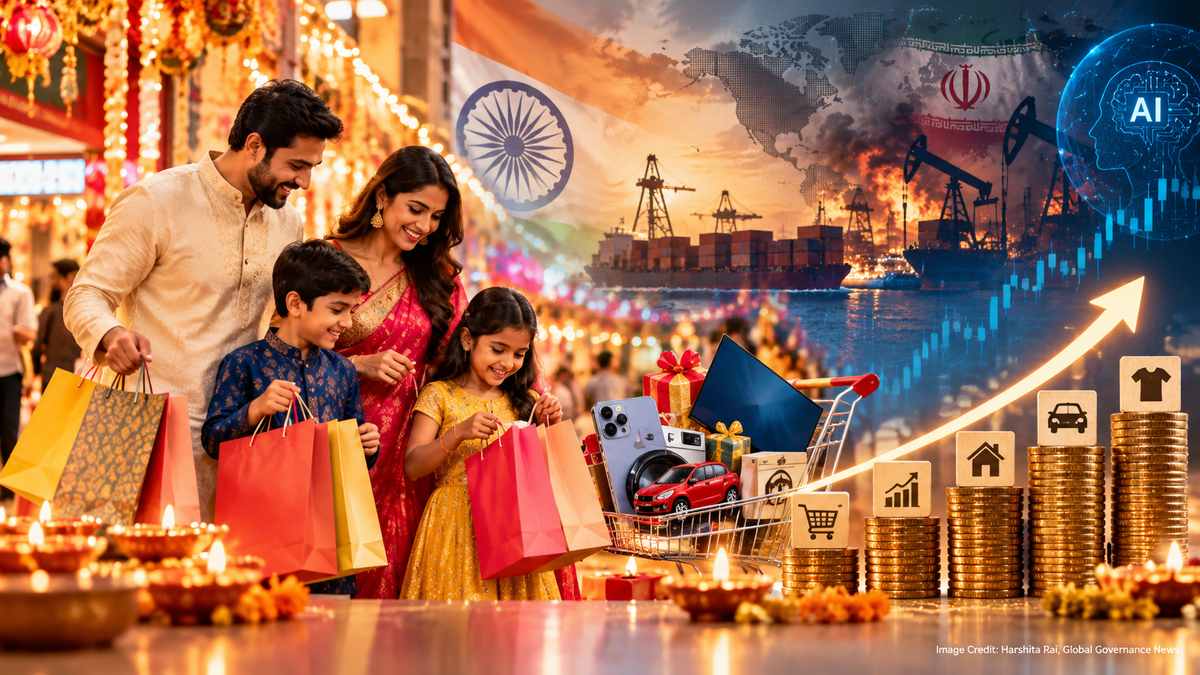

India, a nation of festivities, enters the festival season of 2026 with a significant economic challenge: how to sustain consumer demand while protecting household purchasing power amid rising costs. Festivals should be occasions of happiness, togetherness and responsible consumption—not sources of financial stress. The ongoing Iran war, higher energy costs, supply-chain disruptions, currency movements and the resource-intensive expansion of artificial intelligence (AI) are creating cost pressures across several sectors. These pressures can dilute the benefits expected from GST rationalization and place additional strain on household budgets.
The Needonomics School of Thought (NST) calls for a shift from Greedonomics to Needonomics: need over greed, value over volume, and affordability over extravagance.
1. Festival Consumption: The Engine of Domestic Demand
The festival season is among India’s important drivers of consumer demand. Spending on food, garments, smartphones, consumer durables, automobiles and household goods supports businesses, employment and economic activity.
With household consumption contributing around 60% of GDP, consumer purchasing power and confidence have a significant bearing on domestic economic momentum.
The challenge, however, is to keep festive demand ticking without encouraging excessive borrowing or unnecessary consumption. Needonomics advocates Needo-Consumption—
2. GST Rationalisation: Protecting the Consumer Benefit
The 2025 festival season was marked by expectations that GST rationalisation would improve affordability and stimulate consumption. However, the benefit of lower indirect taxation can be weakened when input costs, freight rates, currency movements and shipping delays push up the final price of products.
A reduction in tax does not automatically translate into an equivalent reduction in the retail price. The actual benefit reaching consumers depends on the interaction between taxation, production costs, supply chains, margins and market competition.
Needonomics calls for greater attention to this entire chain so that the intended benefits of tax rationalisation genuinely reach the consumer.
3. Iran War and AI Boom: A New Cost Equation
The economic impact of the Iran war extends beyond energy markets. Higher energy and transportation costs can increase the cost of producing and distributing goods.
At the same time, the AI boom is creating strong demand for advanced chips, computing infrastructure, data centres and other technology resources. The resulting pressure on components and critical inputs can influence costs across technology and other manufacturing sectors.
From food and garments to air conditioners, smartphones and automobiles, the extent of cost pressure varies across products and supply chains. Businesses therefore need to build resilience rather than simply transfer every additional cost to consumers.
4. Smartphones and Consumer Durables: Innovation versus Affordability
Smartphones provide a useful example of the affordability challenge. Consumers naturally seek better cameras, performance, connectivity, design and AI-enabled features. Yet every additional feature can add to production and retail costs.
A reported 21% rise in smartphone prices, where applicable to particular product categories and periods, would put additional pressure on household budgets.
Manufacturers need to ask a fundamental Needonomics question: Does every new feature create sufficient value to justify its additional cost?
Non-essential features should be reconsidered or removed wherever possible, without compromising safety, reliability, durability or essential functionality.
The objective should be affordable innovation—technology that solves genuine consumer problems rather than creating an endless race for increasingly expensive features.
5. NAW Marketing: Keeping Festive Demand Ticking
The festival season requires businesses to rethink marketing. The NAW approach to marketing should place genuine consumer needs, affordability and value creation at the centre of festive sales.
The objective should not merely be to sell more, but to create sustainable demand by offering meaningful value at prices consumers can afford.
NAW marketing should focus on:
- Need: Understanding genuine consumer requirements.
- Affordability: Offering suitable products across different budgets.
- Value: Emphasising usefulness, durability and functionality.
- Trust: Ensuring transparent pricing and honest communication.
- Responsibility: Discouraging unnecessary consumption and excessive borrowing.
Festive marketing should create happiness without creating financial hardship.
6. Rethinking Design, Sourcing, Manufacturing and Selling
The present cost pressures constitute a mini crisis that deserves a structural response. Businesses need to rethink the entire value chain—not merely promotional strategies during the festival season.
Design: Remove unnecessary features that increase costs without adding corresponding consumer value.
Sourcing: Diversify suppliers and strengthen domestic sourcing where economically viable.
Manufacturing: Improve productivity, minimise waste and adopt energy-efficient processes.
Packaging: Reduce unnecessary packaging while maintaining product safety and protection.
Distribution: Improve logistics and reduce avoidable transportation and handling costs.
Selling: Offer transparent pricing and affordable product variants suited to different consumer needs.
Such changes should become a long-term business strategy rather than a temporary festival-season exercise.
7. Government and RBI: Enabling Stability and Purchasing Power
The government and the Reserve Bank of India (RBI) have distinct but complementary roles in maintaining economic stability.
The government can strengthen supply chains, improve logistics, encourage competition, support efficient domestic manufacturing and ensure that policy benefits are transmitted effectively to consumers.
The RBI must remain attentive to inflation, inflation expectations, financial stability and external energy shocks. Monetary policy should respond to prevailing economic conditions rather than follow an automatic prescription.
Interest-rate increases can help contain inflationary pressures under certain circumstances, but they can also raise borrowing costs for households and businesses. The broader objective should therefore be a balanced combination of price stability, responsible credit, productive investment and consumer welfare.
This is consistent with the mandate of Needonomics.
8. Household Financial Prudence: Celebrate Within Your Means
Consumers are equally important stakeholders in the festival economy. Needonomics does not oppose consumption; it promotes responsible consumption.
Households should:
- Prepare a realistic festival budget.
- Prioritise needs over avoidable wants.
- Compare prices, quality and after-sales service.
- Avoid excessive dependence on credit and buy-now-pay-later schemes.
- Prefer durable and energy-efficient products.
- Preserve adequate savings for emergencies and future needs.
The purpose is not to reduce the joy of festivals but to ensure that today’s celebration does not become tomorrow’s financial burden.
Conclusion:
Festival season 2026 presents a significant challenge of affordability, consumer confidence and cost management. Geopolitical uncertainty, energy pressures, supply-chain disruptions, currency movements and rapid technological change require businesses, government, financial institutions and households to rethink their economic choices. The answer lies not in suppressing consumption but in making consumption need-based, affordable and value-oriented. Businesses must rethink design, sourcing, manufacturing, packaging, distribution and selling. Government must create conditions for efficient production and competitive markets. The RBI must remain vigilant about inflation and financial stability. Consumers must exercise financial prudence. The guiding principle for Festival Season 2026 should be: “Need over Greed, Affordability over Extravagance, and Value over Volume.” India can sustain festive demand and protect household welfare when the celebration of prosperity is accompanied by prudence, responsibility and consumer trust. That is the Needonomics way to sustain consumer demand during Festival Season 2026.
