
Supreme Court Orders Relief on Delhi Protest Restrictions
The court directs authorities to review barricades, allow normal metro services and protect peaceful assembly while maintaining public order.

GG News Bureau
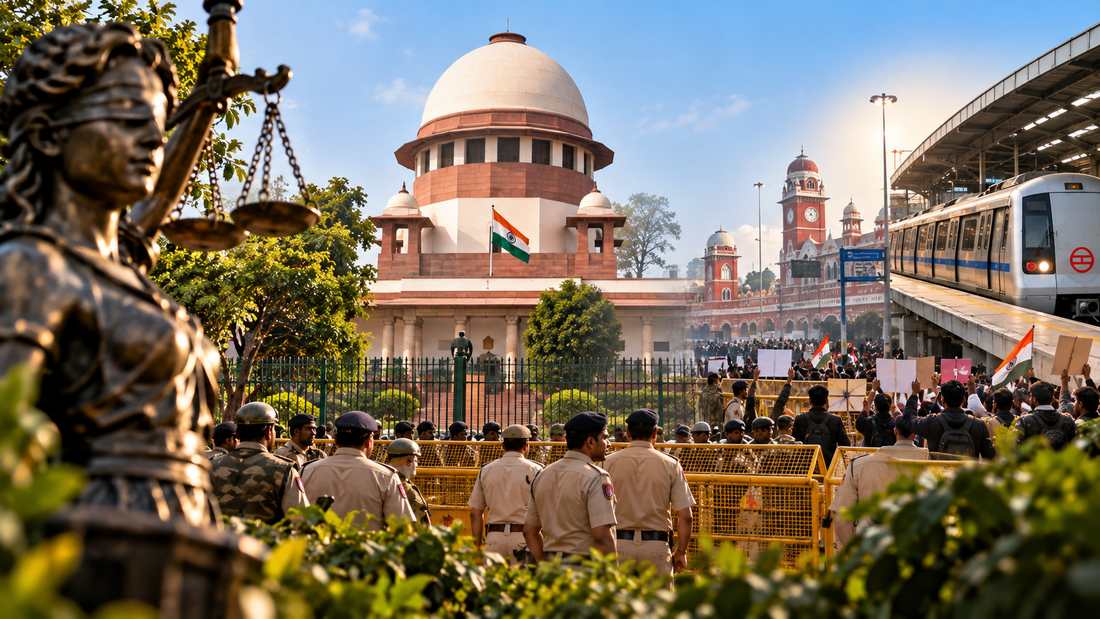
New Delhi, 11th Oct: The Supreme Court on Sunday held a special hearing on petitions challenging restrictions imposed in Delhi during Saturday’s Cockroach Janta Party (CJP) protest against Chief Election Commissioner Gyanesh Kumar. The petitions raised concerns over metro station closures, restrictions on train services, road diversions and the detention of protesters.
A bench comprising Justices Joymalya Bagchi and V. Mohana heard arguments on the restrictions imposed in central Delhi and around the Supreme Court. The petitioners alleged that the measures had disrupted public movement and access to justice, while large numbers of people had faced harassment and detention.
The court issued directions emphasising that metro services should function normally unless restrictions were necessary to address a threat to public order. It also said people’s movement across the city should be permitted, subject to lawful traffic regulation.
The bench directed authorities to review barricades immediately in light of the prevailing public-order and traffic situation. It further said internet services should remain undisturbed, in accordance with law, and that there should be no unlawful detention of people participating in peaceful, unarmed assemblies, particularly outside areas covered by prohibitory orders under Section 163 of the Bharatiya Nagarik Suraksha Sanhita (BNSS).
The court was informed that Section 163 restrictions had been imposed in and around the Supreme Court. It directed the authorities to remove the restriction to ensure there was no apprehension about access to justice.
Addressing lawyers, the bench urged them to ensure that protests remained peaceful and that no one was instigated to create disorder. It stressed that while the court remained a neutral arbiter, it was duty-bound to protect fundamental rights under Article 32 of the Constitution.
The petitioners alleged that earlier judicial directions had been violated, claiming that metro services were disrupted, New Delhi and Hazrat Nizamuddin railway stations remained closed, traffic advisories were not issued and people were detained beyond the area covered by prohibitory orders.
According to the account presented during the hearing, 45 metro stations had been closed to passengers, while train services at New Delhi and Hazrat Nizamuddin stations were affected between 4 am and 2 pm on Saturday. Authorities had also curtailed internet services in the area.
The hearing followed a Friday order by a bench comprising Chief Justice Surya Kant and Justices Bagchi and Mohana, which directed the Centre to ensure there was no “complete prohibition” on the movement of metro services and trains arriving in Delhi on October 10.
