

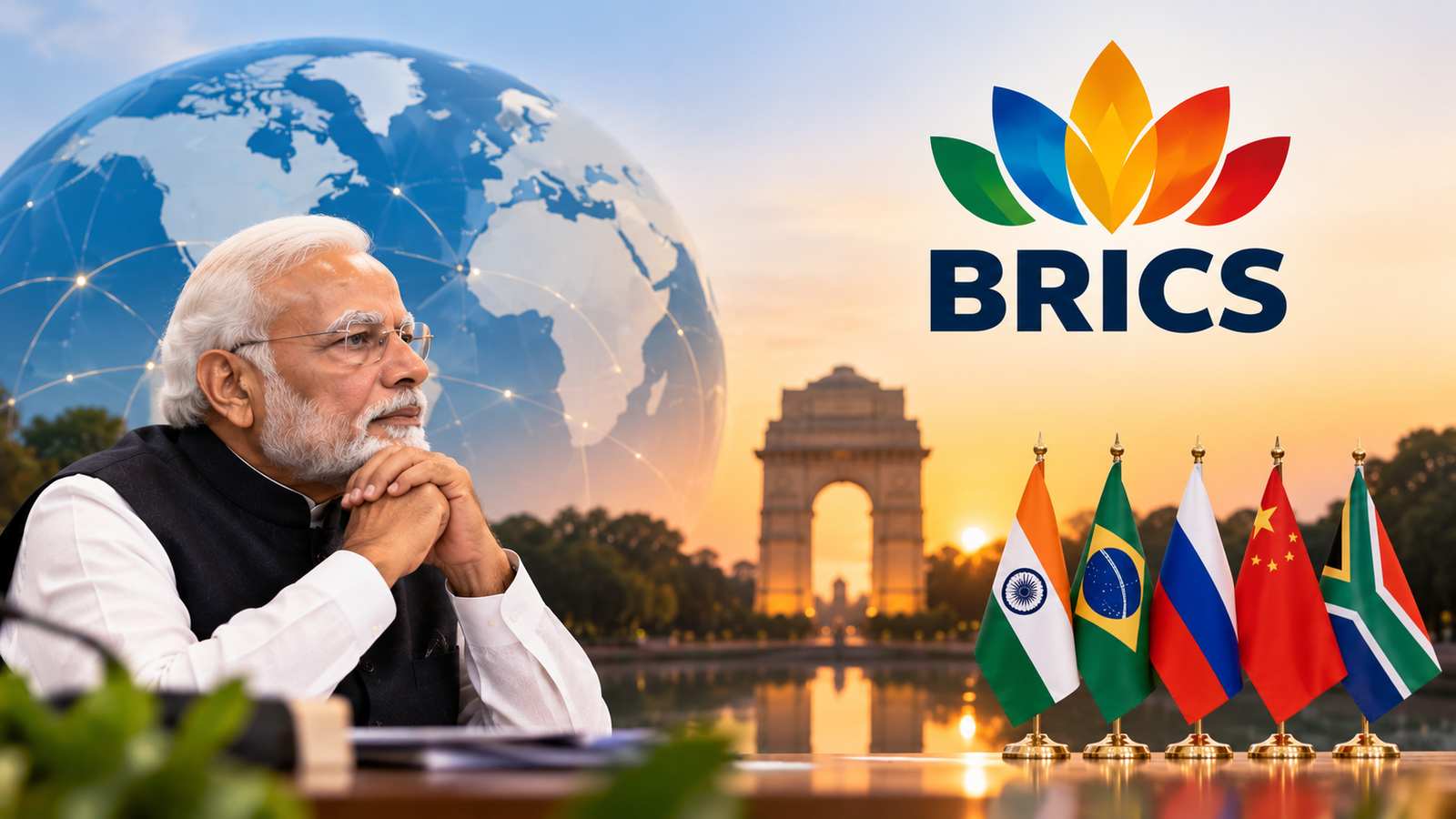

The 18th BRICS Summit in New Delhi has presented an opportunity to look beyond the traditional vocabulary of geopolitics and ask a more fundamental question: what kind of global order can respond to the challenges of an increasingly interconnected world?
Prime Minister Narendra Modi’s opening remarks at the session on “Resilience, Innovation, Cooperation and Sustainability: Shaping the Future for Inclusive Global Growth” offered a clear answer. India’s BRICS Chairship has sought to place these four pillars at the centre of cooperation, with the larger objective of ensuring that growth and technological progress reach societies beyond the traditional centres of global power.
The emphasis on resilience is particularly relevant. Pandemics, climate disasters and supply-chain disruptions have demonstrated that no crisis remains geographically isolated. A disruption in one part of the world can rapidly affect food, energy, health, trade and livelihoods elsewhere. The proposed BRICS Integrated Early Warning System for infectious diseases, disaster-management data guidelines and the Logistics Supply Chain Cooperation Framework therefore represent more than institutional initiatives. They reflect a recognition that preparedness must become a collective responsibility.
The second pillar, innovation, is equally important. The BRICS Incubator Network and proposed Startup Innovation Fund seek to connect entrepreneurial ecosystems across member countries. More significant is the proposed BRICS Network on Digital Agriculture, which aims to bring artificial intelligence, geospatial technology and digital public infrastructure closer to the everyday needs of farmers.
This approach carries an important message: technology should not become an exclusive instrument of a few advanced economies. Nor should critical technologies and minerals become tools of geopolitical pressure. Innovation must remain inclusive, accessible and directed towards solving real human problems.
The third pillar, cooperation, takes BRICS beyond government-to-government diplomacy. India’s approach has attempted to involve entrepreneurs, farmers, researchers, women, youth and ordinary citizens in the broader BRICS framework.
Initiatives such as BRICS CONNECT, the BRICS MSME Cooperation Portal and the BRICS Urban Mobility Hub reflect this people-centred approach. Their significance lies not merely in creating new platforms but in building networks through which knowledge, skills, finance and experience can move across borders.
This is particularly important for small and medium enterprises. In many developing economies, MSMEs are major sources of employment and innovation but often face barriers in accessing capital, technology and international markets. Greater BRICS cooperation in these areas could convert collective economic strength into more inclusive growth.
The fourth pillar, sustainability, may ultimately determine whether today’s development can be sustained by tomorrow’s generations. India’s civilisational understanding of nature as a mother provides a distinctive philosophical foundation for this approach.
The challenge, however, is to translate philosophy into practical action. The BRICS Digital Centre of Excellence for Smart Grids and Energy Storage, along with the Centres of Excellence for Agro-Ecology and Regenerative Agriculture, can help bridge traditional knowledge and modern science. Community-based climate adaptation can similarly ensure that indigenous knowledge becomes part of contemporary climate solutions rather than being left outside mainstream policy.
Yet the most consequential idea in the Prime Minister’s remarks may be the vision of inclusive global growth.
The Global South has increasingly become central to the world’s economic and demographic future, but its influence over global decision-making has not always kept pace. The argument that solutions developed within BRICS should be adaptable and accessible to the wider Global South is therefore significant.
The strength of BRICS is not uniformity. Its strength lies in its diversity. Different histories, economic systems, cultures and development experiences can make cooperation more difficult, but they can also make it more valuable. A successful BRICS model cannot simply reproduce one country’s development experience for another. It must create space for countries to learn from one another while developing solutions suited to their own realities.
India’s message is consequently not that the Global South needs solutions designed for it, but that it should participate in developing solutions with the world.
That distinction matters.
The future of multilateralism will depend increasingly on whether international institutions can accommodate a wider range of voices and experiences. BRICS can contribute to that transformation if it succeeds in turning dialogue into practical cooperation.
Prime Minister Modi’s closing formulation captures the larger ambition: from voice to impact, from privilege to partnership.
That transition will not happen through declarations alone. It will require institutions, financing, technology, political commitment and sustained cooperation. But the New Delhi summit has articulated an important direction.
A world facing simultaneous conflicts, climate pressures, technological disruption and economic uncertainty cannot afford fragmented responses. Resilience requires preparation. Innovation requires openness. Cooperation requires trust. Sustainability requires responsibility.
And inclusive growth requires that those who have historically had a voice but limited influence are given a meaningful role in shaping the future.
The real test of India’s BRICS vision will therefore begin after the summit—when these four pillars move from conference halls into communities, businesses, laboratories, farms and institutions across the Global South.
