
CR Patil Urges Grassroots Tech for Rural Water, Sanitation
Jal Shakti Minister says affordable, community-friendly innovations are key to safe drinking water and plastic waste management

By Kumar Rakesh
New Delhi, 30th June: Union Jal Shakti Minister C.R. Patil on Tuesday said technology can be considered truly successful only when it reaches people and is simple enough for communities to use, urging innovators to develop affordable and scalable solutions for safe drinking water and plastic waste management in rural India.
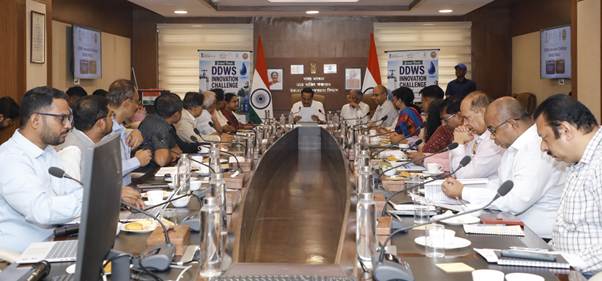
Addressing the Grand Finale of the Department of Drinking Water and Sanitation (DDWS) Innovation Challenge in New Delhi, Patil said the Jal Jeevan Mission has transformed the lives of millions of rural households by providing tap water connections, and the next phase must focus on ensuring that every household receives safe drinking water.
He called upon startups, researchers and innovators to develop low-cost, sustainable and easy-to-deploy technologies suited to village conditions, enabling Gram Panchayats, Village Water and Sanitation Committees (VWSCs), Self Help Groups and local youth to manage water quality effectively.
Highlighting water quality as a key government priority, the minister said timely testing of drinking water remains a challenge in many remote villages, making portable and user-friendly testing technologies essential for strengthening rural water safety.
Patil also drew attention to the growing challenge of plastic waste in villages due to increased use of packaged consumer products. He said transporting multi-layered plastic waste to distant recycling facilities is often expensive and impractical, underscoring the need for village- and block-level processing technologies that support a circular economy by converting waste into useful resources.
He added that innovation should not only solve local problems but also generate livelihood opportunities for rural youth and entrepreneurs, contributing to the vision of Aatmanirbhar Bharat and Viksit Bharat.
The Innovation Challenge, organised by the DDWS in collaboration with IIT Madras, sought practical and scalable technologies for two national priorities—safe drinking water under the Jal Jeevan Mission (JJM) and small-scale plastic waste management under the Swachh Bharat Mission (Grameen).
The challenge received 348 registrations, including 90 complete entries under the Water Innovation Challenge and 66 complete applications for plastic waste management solutions.
A selection committee chaired by Prof. Ligy Philip of IIT Madras chose three winning technologies under each category.
Under the Jal Jeevan Mission category, Chembiosens Pvt. Ltd., Jaljyoti Process Pvt. Ltd. and Plastic Surge Industries Pvt. Ltd. were selected for innovations in portable water quality testing, chemical and bacteriological analysis, and field-testing kits designed to make village-level water testing faster and more reliable.
In the Swachh Bharat Mission (Grameen) category, Crosslinx Pvt. Ltd., BiGlyso Pvt. Ltd. and Vigya Crafts Pvt. Ltd. were recognised for developing affordable and sustainable technologies for decentralised plastic waste management.
Patil presented awards to the winning startups and said their technologies would undergo further evaluation for safety, scalability and suitability before being considered for pilot implementation in selected rural areas.
DDWS Secretary Ashok K.K. Meena said the next phase of rural drinking water and sanitation programmes must focus on technology-driven service delivery. He stressed that innovations for rural India should be affordable, durable, easy to maintain and capable of improving transparency through digital tools such as mobile applications, geo-tagging and real-time data capture.
He also advocated decentralised plastic waste management models that promote recycling, reuse and resource recovery while creating employment opportunities in rural areas.
The event was attended by Union Minister of State for Jal Shakti and Railways V. Somanna, DDWS officials, representatives from IIT Madras, startup founders and members of the evaluation jury.
