
HM Amit Shah Pushes AI-Driven Crime Control System
Home Minister launches NCRB applications, says justice within three years is key reform goal

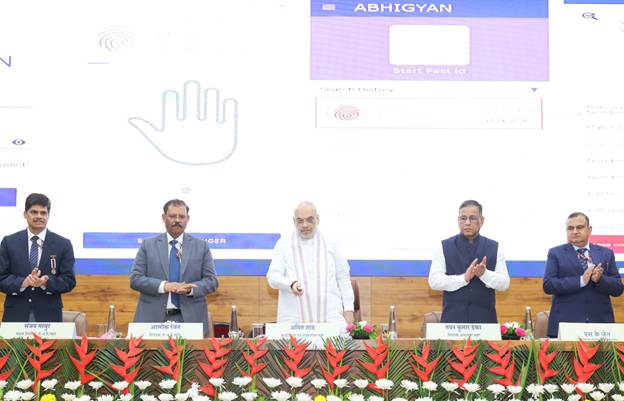
- Amit Shah launches four new NCRB applications.
- AI and data analytics to strengthen crime prevention.
- Government aims for justice within three years.
- CCTNS now connected to 17,840 police stations.
GG News Bureau
New Delhi, 19th June: Union Home Minister Amit Shah on Friday said India is moving towards a technology-driven criminal justice system, where artificial intelligence, scientific evidence and integrated databases will play a key role in preventing crimes and ensuring faster delivery of justice.
Addressing the inaugural session of the 26th All India Fingerprint Conference 2026, Shah launched the National Crime Records Bureau (NCRB) applications — Abhigyan, CrPI, e-Prosecution 2.0 and e-Forensics 2.0 — aimed at speeding up the disposal of pending cases and strengthening the criminal justice chain.
Shah said ensuring justice within three years from the registration of an FIR to conviction remains a key objective of the Modi government’s criminal justice reforms. He added that the Ministry of Home Affairs is working with the Supreme Court and High Courts to prepare a roadmap for reducing pendency of criminal cases.
Emphasising the role of science in investigations, the Home Minister said no criminal, irrespective of how intelligent or organised, should be able to escape the combined strength of law and technology. He highlighted that systems such as NAFIS, CrPI, e-Prosecution and e-Forensics have transformed data into a powerful tool for investigation and prosecution.
Shah said the government is developing a framework based on artificial intelligence, machine learning and pattern analysis to identify repeat offenders, interstate criminal networks and potential crime trends before offences take place. He said the focus is shifting from a system that only reacts after crimes to a predictive policing model.
Highlighting the scale of digital integration, Shah said CCTNS has been implemented in all 17,840 police stations across the country, with more than 37.68 crore digital records available for AI-based analysis. The criminal databases also include around 1.29 crore fingerprint records, nearly 9 lakh narcotics offenders’ records and 3.65 lakh human trafficking records.
The Home Minister said NCRB and the Bureau of Police Research and Development are evolving from record-keeping institutions into intelligence-driven organisations and called for greater use of modern technologies to improve crime detection, prosecution and prevention.
