

Poonam Sharma
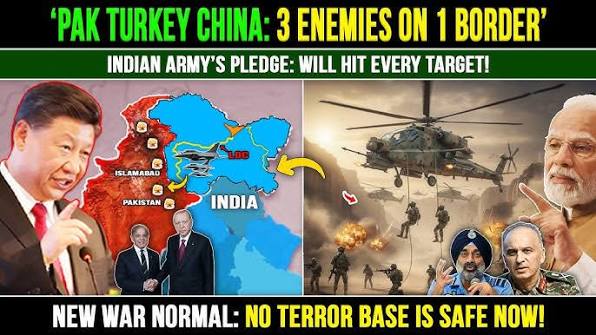
Why Caution ? Is India’s Most Powerful Weapon India’s security establishment is alarmed at Turkish and Chinese fighter jets conducting joint military exercises at several air bases in Pakistan . These jets flew sorties for nearly 60 hours and this was a lot more than just an exercise. How did this sudden alliance come about? What does it mean for India? These are the questions on the minds of every Indian.
The Global Chessboard: New Alliances, Old Rivalries
The answer is to be found in the shifting sands of global geopolitics – a world that is increasingly bipolar, unpredictable and, at times, menacing in its volatility. New Alliances, Old Rivalries in the Global Chessboard To understand the present, one must remember the recent past. When Russia invaded Ukraine, the world split into camps. On each side a country, inspired by history, geography, or self-interest, was chosen. The specter of global war loomed large, and nations scrambled to prepare for an era in which old equations no longer applied” India, with its complex history of non-alignment and a pragmatic foreign policy, was arguably facing its toughest diplomatic test in decades. India had to walk on a tightrope, surrounded by the world’s most populous and sometimes unfriendly neighbors – supporting its people, protecting its interests, but avoiding the quick sands of direct confrontation. Unlike many, India’s government consciously chose to avoid war knowing that every war sets humanity back by decades. In a world in which progress is fragile and the world’s neighborhoods burn with unrest, wisdom is restraint. But in geopolitics, restraint is often confused with weakness. The world hates a vacuum; negativity, like a contagious virus, spreads fast. The Ukraine war was a test for everyone: America and Russia were fighting, while China, the eternal opportunist, played all sides — supplying drones, technology and tacit support, as and when it suited its agenda.
India’s quiet power
While global powers may posture and provoke, India has quietly gone about its business – evacuating citizens from war zones, focusing on development and refusing to be baited by internal or external provocateurs. This stoicism has kept India out of unwarranted entanglements, like the silent Nandi. But this very attitude is now being challenged on several fronts. The implosion of Iran, the turmoil in the Middle East and the growing Chinese footprint in regional conflicts have all created a theater of uncertainty. Cheap Chinese tech—drones, missiles, kamikaze tactics—has become the currency of modern hybrid warfare, from Ukraine to Israel, from Iran to the subcontinent.
The Turkey Factor The Old Wily Fox
But one player’s moves amid the global turmoil warrant a closer look: Turkey. Turkey is often eclipsed by China or Russia, but it is a crossroads of Europe and Asia: a historic caliphate, a NATO member, and now, a seller of cheap weapons and strategic mischief. From supporting Iran to stoking proxy wars to keeping its options open with the West and with the East, Turkey’s fingerprints are all over many of the world’s flashpoints, while seeming passive. The current alignment of Turkey with China and Pakistan sends a clear message: it has ambitions beyond its borders and is prepared to stir the fires of India’s neighborhood to serve those ambitions. Pakistan: The Forever Wild Card Pakistan’s role as the perennial irritant is well established. But this new axis, buoyed by Turkish and Chinese support, is escalation.
The Real War: Beyond Borders
The threat to India is not just of conventional war but of a multi-pronged, hybrid attack – cyber, informational, internal destabilization and direct military provocations. From Shaheen Bagh protests to engineered riots, from Naxal movements to ‘fake farmer’ agitations, these external forces are going after every fissure in India’s social fabric. The objective is clear, to weaken India from within, to keep it busy with internal turmoil and to prevent it from becoming a stable rising power in the region.”The Indian Response: Resilience, Not Reaction What the world didn’t expect was the muted, methodical resilience of India’s response India did not overreact, contrary to expectations, did not fall into the trap of indiscriminately deploying its military or fueling chaos at home. Instead, India’s leadership demonstrated both patience and precision – knowing when to move, and when to hold. This restraint frustrated global adversaries who are used to seeing nations blunder into traps. Unable now to provoke India into self-damaging actions, these forces are regrouping, plotting new strategies and redoubling their efforts at internal sabotage.
The Real War: Across the Border
The lesson for editors here is stark: India’s biggest threat is not from tanks on its borders, but from insidious, slow-burn attempts to corrode it from within. The hybrid war—financing dissent, magnifying divisions, twisting social narratives—is as real and as dangerous as any missile strike. India’s security agencies are rightfully on high alert. The military is one of the best equipped in the world, its human capital is extremely competitive and its technological capabilities are on the rise. But the fight for India’s future will not just be fought on the front lines. It will be fought in the minds of its citizens, in whether they can see through the fog of disinformation and refuse to be manipulated into becoming pawns in someone else’s game. A Call for Awareness and Unity With the world getting more complicated, India needs to focus more on unity, vigilance and informed citizenship.
The enemy’s obvious goal: divide, distract, destabilize. India’s response must be no less clear: alert, unprovoked and unwavering in its desire for progress and stability. Let the world play its part. India has its own way. One that respects peace, but is ready for any challenge. The Turkish-Chinese-Pakistani axis may rattle its sabers, but the lesson of the past year is that India’s greatest strength lies in its ability to stay calm, prepared and above all united regardless of the circumstances.
