
The Republic That Refused to Kneel: India’s Democratic Journey
How Rummel's "Power Kills," a forgotten 1975 midnight order, and a 1,100-year-old ballot pot in a Tamil village reveal the world's most misunderstood democracy

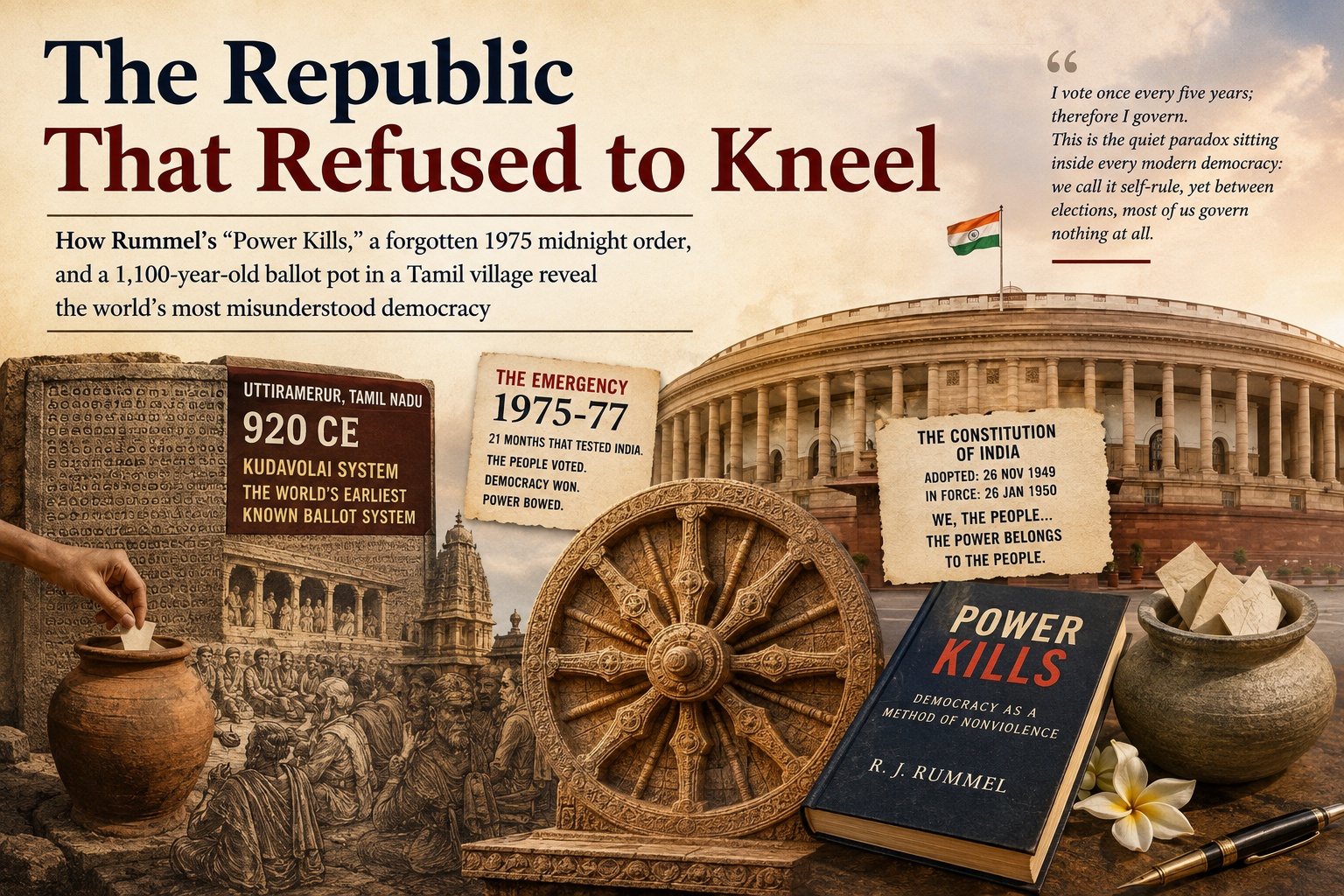
“I vote once every five years; therefore I govern.”
It sounds reasonable — until you examine it closely. After the ballot is cast, an ordinary citizen decides nothing about the budget, taxation, education policy, or the thousand daily choices that actually run a nation. We elect someone else to decide them. This is the quiet paradox sitting inside every modern democracy: we call it self-rule, yet between elections, most of us govern nothing at all.
The most rigorous scholar to examine what happens when this gap between “voting” and “governing” widens too far was the American political scientist R.J. Rummel. His life’s work, distilled into the book Power Kills, delivered one of the most sobering statistics of the twentieth century: concentrated, unaccountable political power — not war, not poverty, not even famine — was the single largest killer of human beings in the modern era.
Rummel coined a word for it: democide, death by government. His calculation was roughly 262 million people killed by their own governments in the 20th century alone, dwarfing the death toll of all that century’s wars combined. His conclusion was that democracies rarely do this to their own people because power, once dispersed, cannot easily turn its full weight against any single group. Freedom, in Rummel’s formulation, is not merely a right but a safety mechanism.
The Nation Built on Paper, Tested by Fire
America’s founding motto, e pluribus unum — “out of many, one” — was presented as an aspiration: the idea that a shared political contract could create civilizational unity.
The American Civil War in 1861 nearly destroyed that proposition. The war killed an estimated 620,000 to 750,000 Americans and remains the deadliest war in American history. The document argues that the conflict demonstrated that a political and legal contract is not necessarily the same as shared civilizational consciousness.
The Nation That Was Never Built — Because It Was Already There
The document then turns to India, arguing that a shared cultural and sacred-geographical consciousness existed long before political unification.
It highlights the Uttiramerur inscriptions, near modern Kanchipuram, dated to around 920 CE during the reign of Chola king Parantaka I. According to the document, the inscriptions describe a codified village constitution, including eligibility rules, disqualifications, fixed terms and the Kudavolai electoral system.
Under the system, eligible candidates’ names were written on palm leaves, placed in a pot and drawn publicly. The document describes this as an early example of decentralised, accountable and rule-bound local self-governance.
It also acknowledges that the system was not universal suffrage, as eligibility was linked to land ownership and community status.
When Absolute Power Actually Came Knocking
The document identifies the Emergency declared on June 25, 1975, as India’s major modern test of concentrated political power.
It notes that civil liberties were suspended, opposition leaders jailed and press censorship imposed. After 21 months, the Emergency ended through the 1977 general election, when the ruling party lost power.
The document presents this as an example of India’s electoral system acting as a mechanism for restoring dispersed political authority.
A Republic, Not Merely a Democracy
The document distinguishes between a republic and a democracy, arguing that a republic concerns who owns political power, while democracy concerns how that power is exercised.
It says India’s Constituent Assembly had 389 members and deliberated for 2 years, 11 months and 18 days while framing the Constitution. India adopted representative government and granted universal adult franchise from its first election in 1951–52.
It also discusses the 1956 linguistic reorganisation of states, arguing that India’s experience showed that unity did not require uniformity.
The Civilizational Teacher Behind the Ballot
The final section connects India’s political culture with the Bhagavad Gita’s concept of loka-sangraha, describing leadership as being directed towards the welfare and cohesion of society.
The document argues that technological tools can give citizens greater political voice through votes, hashtags and livestreams, but cannot by themselves create self-restraint, tolerance or the ability to disagree peacefully.
It concludes by contrasting the historical trajectories of America and India: America built a nation and continued searching for its civilizational identity, while India inherited a civilizational identity and built a modern nation around it.
Written by: Swami Srirama Charana Aravinda Dasa — former International Banker, currently a mendicant, serving @ ISKCON.
