

Poonam Sharma
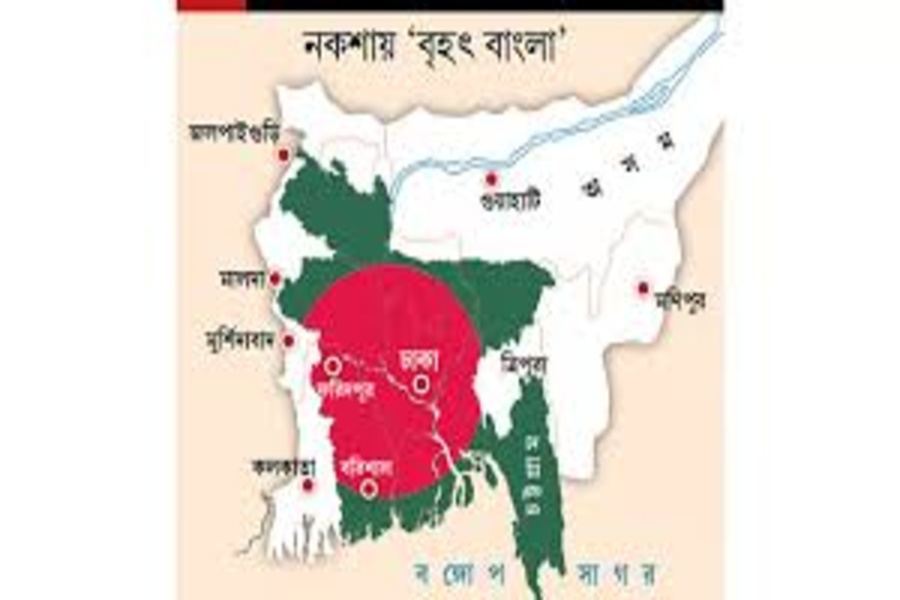
A new political controversy has broken out in India after former diplomat Deepak Vohra made sensational allegations of a purported secret understanding between Mamata Banerjee and Muhammad Yunus over the idea of a so-called “Greater Bangladesh.”
The allegations, have triggered a fierce debate as they relate to not only domestic politics but also India’s national security, border stability and demographic issues in the eastern and north-eastern regions.
What are the charges ?
Deepak Vohra alleged that after the change of guard in Bangladesh, there was a clandestine meeting between Mamata Banerjee and Muhammad Yunus. He said the discussions revolved around the idea of merging Bangladesh and West Bengal into a larger political entity called “Greater Bangladesh.”
Vohra also alleged that the proposal envisioned Mamata Banerjee as prime minister with Yunus as president. These claims were soon a talking point, especially after political changes in West Bengal and Bangladesh.
Why should India care
For India’s security perspective, any discussion on territorial integrity or cross-border political restructuring is immediately sensitive. India shares a long porous border with Bangladesh, particularly with the states of West Bengal, Assam, Meghalaya, Tripura and Mizoram.
For decades, eastern India has been politically sensitive about illegal migration, demographic changes, border incursions and radical networks. Security agencies have warned repeatedly that extremist groups are trying to exploit weak spots in border security.
In this context, even speculative talk of a ‘Greater Bangladesh’ is bound to induce anxiety among many Indians, especially in the Northeast.
The Jamaat-e-Islami Factor
Political commentators have revived discussions around the alleged influence of Jamaat-e-Islami and other Islamist groups in Bangladesh as well. Radical organizations have been historically proponents of increasing Islamic political influence in the region.
BJP Attacks
The issue has been aggressively targeted by Bharatiya Janata Party leaders against the All India Trinamool Congress. Newly elected West Bengal Chief Minister Suvendu Adhikari said the allegations, if proved true, would be a “historic betrayal” against India and West Bengal.
The BJP has sought a detailed probe by the central intelligence agencies. Several nationalist commentators have also called for increased surveillance along the India-Bangladesh border.
Trinamool Denies the Charges
The Trinamool Congress has outrightly denied the allegations, terming them as politically motivated propaganda to malign Mamata Banerjee.
Party leaders say there is no evidence and opponents are spreading conspiracy theories after electoral setbacks. The party says the controversy is being blown out of proportion to create fear and polarisation ahead of future political battles.
Bangladesh and China Perspectives
The debate has been further fueled by reports that Muhammad Yunus made strategic comments on the economic significance of eastern India and the Northeast during a visit to China.
Some analysts in India saw the comments as an attempt to emphasize regional geopolitical leverage. Others say the statements are being taken out of context for political reasons.
India is acutely sensitive to Chinese influence in South Asia, especially in countries adjacent to its frontiers. Any discussion on Bangladesh, China and India’s Northeast is, thus, inevitably caught up in a larger security debate.
Politics, Perception, Proof
The controversy seems to be about allegations and political narratives rather than verified facts at the moment. Indian intelligence agencies and the Government of India have not officially acknowledged the existence of such a conspiracy.
But the debate demonstrates how questions of borders, demography, regional identity and national security continue to be the core issues of politics in eastern India.
Deepak Vohra’s claims end up in the footnote of political speculation, the controversy has already managed to ignite a fierce debate on nationalism, regional security and India’s strategic future in the eastern corridor.
