
NCERT Adds EC, SIR to Class 9 Textbook
New Class 9 social science book praises Election Commission; Opposition criticism expected

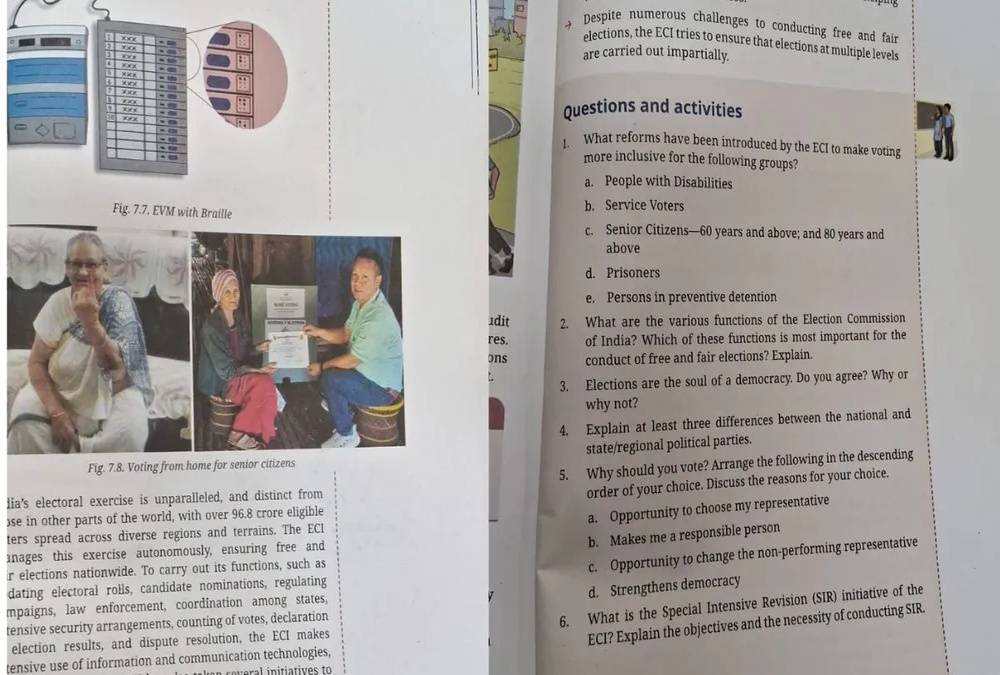
- NCERT’s new Class 9 textbook highlights the Election Commission’s role in ensuring free and fair elections.
- The book explains the Special Intensive Revision (SIR) process for updating electoral rolls.
- It also discusses EVMs, VVPATs, the Model Code of Conduct and voter awareness campaigns.
- The new content is likely to trigger fresh political debate amid Opposition objections.
GG News Bureau
New Delhi, 26th June: The National Council of Educational Research and Training (NCERT) has highlighted the role of the Election Commission (EC) in ensuring free and fair elections in its new Class 9 social science textbook, a move that is expected to fuel fresh political debate.
The textbook, Understanding Society: India and Beyond, describes the Election Commission as an autonomous constitutional body responsible for conducting elections, maintaining electoral rolls and ensuring that no eligible voter is left out of the democratic process.
The book also explains the Special Intensive Revision (SIR) of electoral rolls, describing it as an exercise to update, verify and correct voter lists by adding eligible voters and removing duplicate, deceased or shifted voters. The inclusion comes amid political controversy over the SIR exercise, with the Congress alleging it could be misused for voter manipulation.
Apart from the voter roll revision process, the textbook outlines safeguards such as Electronic Voting Machines (EVMs), Voter Verifiable Paper Audit Trail (VVPAT), the Model Code of Conduct and voter awareness campaigns aimed at strengthening electoral transparency and participation.
Students are also encouraged to study coalition politics by examining alliances that formed governments after Lok Sabha elections over the past few decades.
The latest revisions come a day after reports that NCERT introduced a detailed section on the Emergency in another textbook. While the government defended the inclusion as essential for educating future generations about one of the darkest periods in India’s democratic history, Opposition leaders criticised what they described as the politicisation of school education.
Earlier, NCERT had also drawn criticism over changes to the depiction of the Indus Valley Civilisation’s iconic “Dancing Girl” sculpture in an arts education textbook, where the figure was illustrated with clothing unlike its traditional representation.
