
PM Modi Calls for Global Governance Reform at BRICS
Prime Minister urges BRICS to move from “privilege to partnership” and give the Global South a greater role in shaping global rules

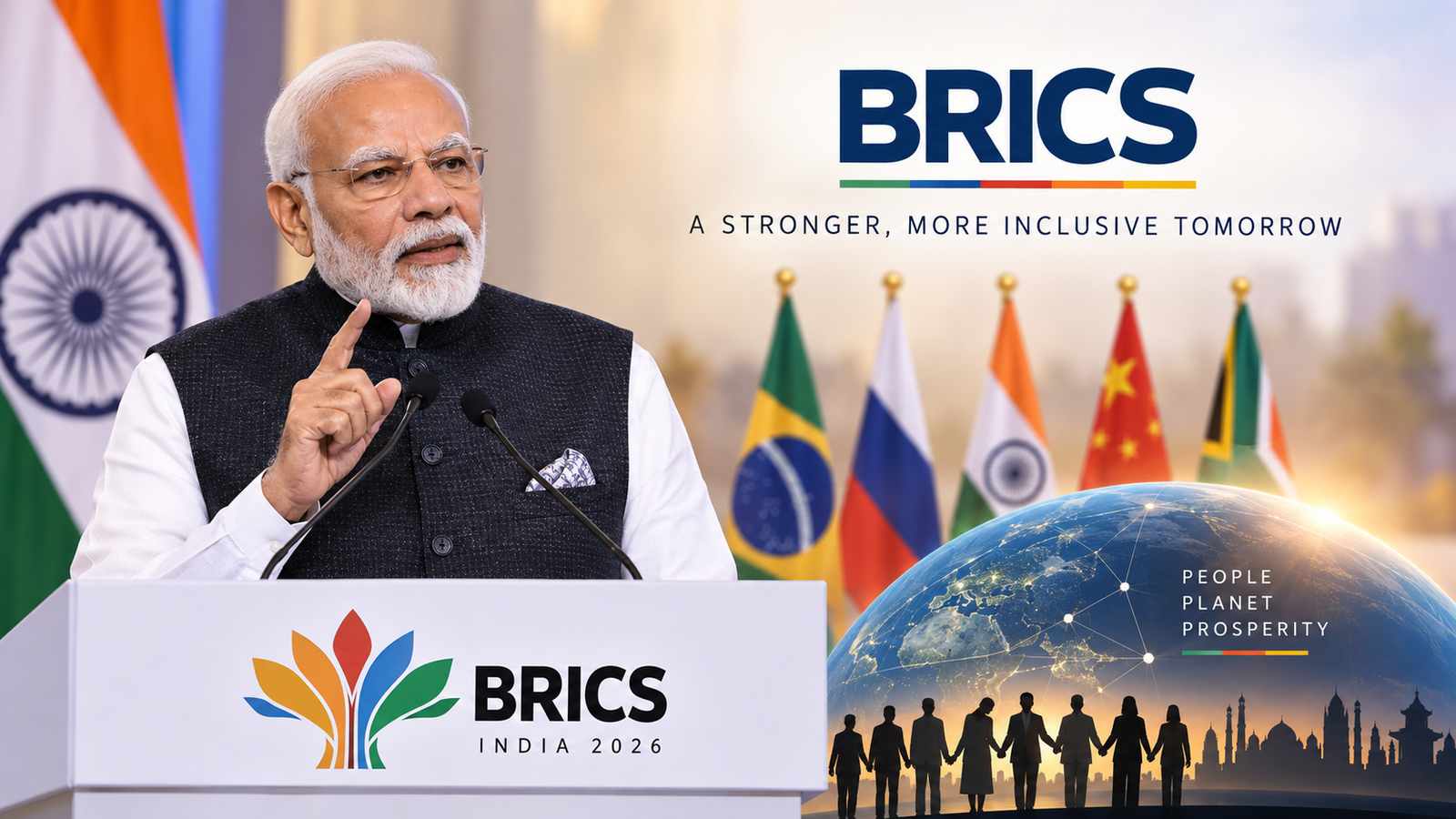
- PM Modi proposes a BRICS Continuity and Implementation Mechanism
- Calls for a roadmap with 10 proposals for global governance reform
- Seeks time-bound reform of the UN Security Council and financial institutions
- Urges BRICS to make the Global South “rule-shapers” in emerging technologies
By Kumar Rakesh
New Delhi, 12th Sept: Prime Minister Narendra Modi on Saturday called for a stronger and more inclusive global governance system, urging BRICS countries to translate their unity and consensus into concrete outcomes on the global stage.
Addressing the session on “Inclusive Global Governance and Strengthening” at the 18th BRICS Summit, Modi said India’s BRICS Chairship had followed a people-centric and humanity-first approach, with resilience, innovation, cooperation and sustainability as key priorities.
He said more than 350 meetings had been organised during India’s BRICS Chairship, with participating teams welcomed in nearly 30 cities across the country.
Marking the 20th anniversary of BRICS, Modi said the grouping had reached a “coming of age” moment and must now develop an ambitious agenda for the next 20 years.
To maintain institutional momentum despite the annual change in BRICS chairship, Modi proposed establishing a BRICS Continuity and Implementation Mechanism through the Troika. He suggested creating a secure digital repository recording each decision, its nodal point, timeline and implementation status.
Calling for reform of global governance, Modi said the existing system resembles a “pyramid” where decision-making power is concentrated at the top while countries affected by decisions have limited participation.
He called for transforming the “pyramid of privilege” into a “platform of partnership”, where every country has a voice and stake and humanity remains at the centre.
Modi proposed that BRICS work towards 10 proposals for global governance reform, with the aim of developing them into a BRICS Reform Roadmap by the next Summit. He identified three key principles for the roadmap: Representation, Responsiveness and Rule-making.
On representation, Modi said reform of the UN Security Council could no longer be delayed and called for text-based negotiations to be linked to a clear timeline and concrete outcomes. He also said voting power, leadership positions and policy priorities in international financial institutions should reflect present-day economic realities.
On responsiveness, Modi stressed that global institutions must provide effective solutions to global challenges and focus on the speed, scale and last-mile impact of collective action.
He proposed a Seafarers Emergency Support Network connecting maritime authorities and missions to facilitate distress alerts, medical assistance, communication with families and evacuation support for seafarers in difficulty.
On rule-making, Modi stressed the need for equal participation in shaping emerging global rules covering artificial intelligence, cyberspace, outer space, biotechnology and critical technologies.
He called for transforming the Global South from “rule-takers” into “rule-shapers”, including through BRICS programmes providing young diplomats and policymakers with negotiation skills, practical training and legal expertise.
Noting that the day also marked the United Nations Day for South-South Cooperation, Modi said India was ready to take the lead in strengthening cooperation among countries of the Global South.
“The message of the BRICS Summit being hosted by India should be loud and clear: If our future is shared, then the right to shape that future must also be shared,” Modi said.
He summed up India’s BRICS vision with the call: “From voice to impact. From privilege to partnership.”
