
India Becomes Russia’s Biggest Source of Fuel Imports, Supplies 70% in August

By Anjali Sharma
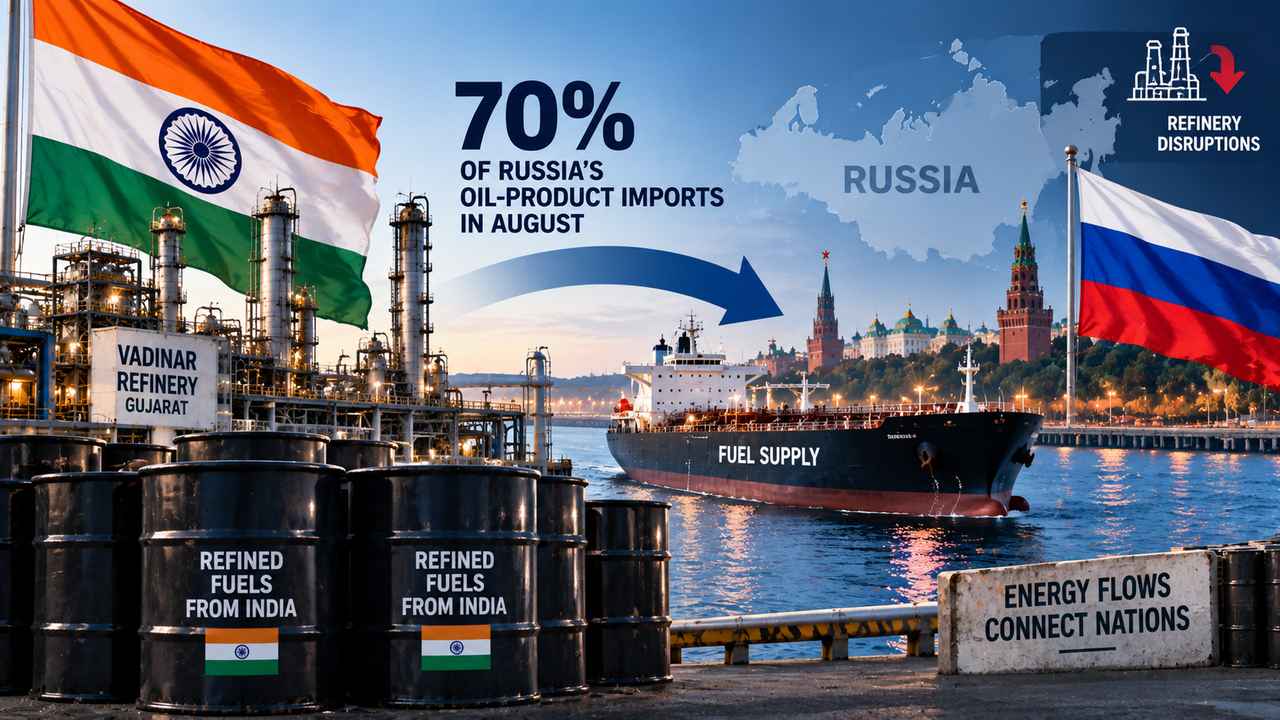
WASHINGTON – India on Sunday emerged as Russia’s largest source of imported oil products in August, as repeated Ukrainian drone attacks on Russian refineries disrupted domestic fuel production and pushed Moscow to source gasoline from overseas.
The development has created an unusual trade flow in which Russian crude is processed in India and refined products are shipped back to Russia
Russia imported 172,000 tonnes of oil products during the month, over 7 times its monthly record, according to an analysis by the Centre for Research on Energy and Clean Air.
India accounted for 70% of those imports.
Indian shipments, around 120,000 tonnes comprised gasoline valued at approximately 78 million euros. CREA said the fuel was loaded at Gujarat’s Vadinar refinery and supplied by Nayara Energy to Russia’s state-controlled Rosneft. Rosneft owns a 49.13% stake in Nayara Energy and is subject to EU sanctions.
The development has created an unusual trade flow in which Russian crude is processed in India and refined products are subsequently shipped back to Russia. CREA noted that the Vadinar refinery sourced all of its crude from Russia during the first eight months of 2026, compared with 81% of its crude supplies for the whole of 2025.
The surge in Russian fuel imports came amid a sustained Ukrainian campaign targeting oil refineries and energy infrastructure.
The attacks have reduced Russia’s domestic refining capacity and contributed to fuel shortages, according to CREA.
Gasoline accounted for 74% of Russia’s total oil-product imports in August, compared with an average share of only 6% between 2023 and 2025.
South Korea supplied 18,000 tonnes of oil products to Russia during the month, largely consisted of gasoil, while Egypt shipped around 25,000 tonnes of diesel valued at €16 million, CREA said.
The increase in imports coincided with a sharp decline in Russia’s own oil-product exports.
Seaborne shipments fell 21% by volume in August, while daily revenues from products unloaded at destination ports declined 32% from July to €78 million, the lowest level recorded since Russia launched its full-scale invasion of Ukraine.
Oil-product loadings from Russian ports have now declined for three consecutive months and were less than half their August 2025 level.
Tuapse, Russia’s fourth-largest oil-product export port, did not record any oil-product loading for the third straight month following repeated Ukrainian drone attacks since May.
Ukrainian strikes also affected crude exports through Novorossiysk on the Black Sea.
Crude loadings at the port plunged 58% month-on-month in August, with operations halted for9 consecutive days — the longest such disruption reported there since the beginning of the full-scale war.
India remained Russia’s second-largest fossil-fuel customer in August, behind China despite lower crude purchases.
According to CREA, India bought Russian hydrocarbons worth approximately €4.8 billion during the month, with crude oil accounted for €4.1 billion, or 87%, of the total.
Indian purchases of Russian crude declined 24% from July after reaching record levels in the preceding two months. Crude inflows at Jamnagar fell 15%, while Vadinar registered a 5% increase and Paradip saw a 1% rise.
China remained Russia’s biggest fossil-fuel customer, generating €8.4 billion, or 51%, of the revenues contributed by Russia’s five largest buyers. Chinese seaborne imports of Russian crude increased 16% from July and were 62% higher than in August 2025.
Russia’s fossil-fuel export revenues declined 8% in August to around €604 million per day, while export volumes fell 7%.
CREA said that higher global oil prices continued to support Moscow’s energy earnings.
The average price of Russia’s Urals crude rose 23% in August to $69.90 a barrel, substantially above the G7 and EU price cap of $44.10, CREA said.
The research group also estimated that the rise in global oil and gas prices following US-Israel strikes on Iran generated an additional €31 billion in Russia’s seaborne fossil-fuel export revenues over the subsequent six months.
