
Amit Shah’s Alleged Assurances to Tipra Motha on ADC Direct Funding and Land Rights Trigger Strong Reactions in Tripura

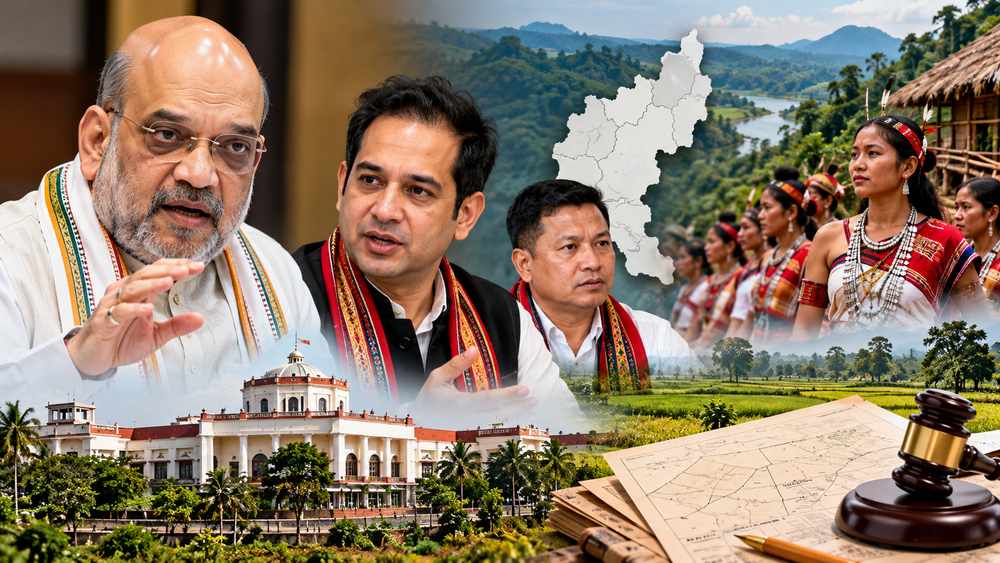

The reported assurance by Union Home Minister Amit Shah to Tipra Motha leaders on direct funding for the Tripura Tribal Areas Autonomous District Council (TTAADC) and faster implementation of land rights has triggered a wider political and constitutional debate in Tripura, particularly ahead of the ADC Village Council elections.
Tipra Motha founder Pradyot Kishore Manikya Debbarma and party MLA Ranjit Debbarma have claimed that during their September 4 meeting with Amit Shah in New Delhi, commitments were made to address these issues within a short timeframe. The claims have generated considerable political interest because the proposed measures involve questions of constitutional authority, land legislation and the financial relationship between the Union government, the state government and the Sixth Schedule council.
The 2024 Tripartite Agreement
The controversy is closely linked to the tripartite agreement signed on March 2, 2024, between the Government of India, the Government of Tripura and the Indigenous Progressive Regional Alliance, represented by Tipra Motha. The agreement envisaged addressing issues concerning the indigenous population, including history, land rights, political rights, economic development, identity, culture and language.
A Joint Working Group/Committee was envisaged to identify mutually agreed issues and implement them within a time-bound framework. However, more than two years have passed without the agreement’s provisions being fully implemented. The latest claims of a rapid settlement have therefore revived questions over whether the remaining commitments can realistically be executed within weeks.
Sixth Schedule Sets the Constitutional Framework
The TTAADC functions within the constitutional framework of the Sixth Schedule of the Indian Constitution, read with Articles 244 and 244A. The constitutional structure provides Autonomous District Councils with specified legislative and administrative powers, but those powers are not equivalent to the sovereign powers of either the Union or a State government.
Paragraph 3 of the Sixth Schedule permits an Autonomous District Council to make laws on specified subjects. However, the council’s legislative authority operates within constitutional and statutory boundaries. Laws made by the council are also subject to the prescribed process involving the Governor. The source document emphasizes that the constitutional arrangement requires coordination between the Council, the Governor and the State’s constitutional machinery.
This becomes particularly important when proposals involve fundamental changes to the Council’s financial or land-related powers.
Why Direct Funding Is Legally Complicated
One of the most politically significant claims concerns the proposed direct funding of the ADC by the Union government. The constitutional and financial framework described in the source does not provide a straightforward mechanism by which a Sixth Schedule Autonomous District Council can simply be declared a recipient of unrestricted “central direct funding.”
Financial administration involving the Union, states and local institutions is governed by constitutional provisions, including those dealing with the Consolidated Funds and public expenditure. Article 266, referred to in the source document, establishes the constitutional framework governing the Consolidated Fund of the State and the handling of government revenues and grants.
That does not necessarily mean that the ADC cannot receive additional financial support. A potentially workable approach could instead involve clearly defined tribal development programmes, project-specific allocations, earmarked funds and annual financial packages routed through an appropriate governmental mechanism. Such arrangements could target infrastructure, education, health, livelihood development and other identified areas without necessarily creating an entirely new constitutional funding relationship.
The crucial distinction, therefore, is between additional or earmarked funding for ADC areas and an unrestricted constitutional right to receive funds directly from the Union government.
Land Rights: The Existing Legal Framework
Land presents an even more complicated question. The Sixth Schedule gives the District Council authority to make laws concerning land for specified purposes, including residential and agricultural use. The source document notes that this authority operates alongside the broader land-revenue and land-reform framework applicable in Tripura.
The Tripura Land Revenue and Land Reforms Act, 1960, and its associated rules established the state’s legal framework for land revenue, land reforms, allotment and distribution. According to the source article, the abolition of the earlier talukdari system and recognition of eligible cultivators and occupants as raiyats formed part of this historical legal process.
The article further argues that land already legally allotted under the 1960 framework cannot simply be disturbed through a subsequent political announcement. Likewise, reserved and protected forest areas raise separate legal questions and cannot automatically be brought under a new ADC land-distribution regime.
Where undistributed government or khas land exists, its allotment may be possible under the applicable land laws and rules. But such distribution would still have to follow the statutory procedure. A political assurance by itself cannot create or transfer legal title to land.
What Could Be Done on Economic Development?
The economic-development component of the 2024 agreement may have more immediate administrative possibilities than proposals requiring major constitutional changes.
The government could consider dedicated tribal-development packages, project-based funding and clearly identified annual allocations for ADC areas. Existing mechanisms associated with tribal welfare and Article 275(1) could also provide a possible avenue for targeted development assistance, subject to the applicable guidelines and approval procedures.
Such an approach could potentially provide substantial financial resources for ADC areas while avoiding the more difficult question of creating a constitutionally independent direct-funding mechanism.
Culture and Language: Scope for Immediate Action
The agreement’s commitments relating to indigenous culture and language could potentially be pursued through institutions and programmes that fall within existing governmental powers.
Possible measures include strengthening cultural institutions, museums, archives and research centres, supporting traditional arts and heritage, and providing annual cultural grants. The state already has an institutional framework for tribal research through its Tribal Research Institute, which could potentially be used more extensively for documentation and preservation.
Language policy in primary education could also become an important area of implementation. Greater responsibility for indigenous-language education, preparation of textbooks, teacher training, dictionaries, grammar development, digital learning material and preservation of cultural records could strengthen the language and identity objectives referred to in the agreement.
Political Rights Require a Different Route
The political-rights component is considerably more complex. Changes involving Assembly or Lok Sabha representation, delimitation, creation of new constitutional institutions or major alterations to the electoral structure cannot ordinarily be accomplished simply through a state government executive order.
Depending on the specific demand, such changes could require amendments to legislation or the Constitution and, where constitutionally mandated, parliamentary approval. Consequently, political assurances and actual implementation may involve substantially different timelines.
Can Tripura Get an Article 371-Type Arrangement?
Another question raised in the debate is whether Tripura could receive a special constitutional provision similar to the arrangements available to certain other states under Article 371 and its related provisions.
The source article notes that the Article 371 series provides different forms of special constitutional arrangements for states including Maharashtra, Gujarat, Nagaland, Assam, Manipur, Andhra Pradesh, Telangana, Sikkim, Mizoram, Arunachal Pradesh, Goa and Karnataka. These provisions are not identical; they address different historical, cultural, administrative, economic and regional circumstances.
Tripura is not currently covered by an Article 371-type provision. Creating a new special constitutional arrangement specifically for Tripura would therefore involve the constitutionally prescribed amendment process rather than a simple administrative decision by the state government.
Importantly, such provisions do not place a state or region outside the Constitution. Their purpose is to provide constitutionally recognised mechanisms for addressing particular regional circumstances while remaining within India’s constitutional structure.
The Political Question Ahead of the Village Council Polls
The timing of the reported Delhi assurance has added another dimension to the controversy. With the ADC Village Council elections approaching, the commitments have become politically significant for Tipra Motha as well as the BJP and other parties operating in the state.
Sections of the Bengali community have reportedly expressed concern over proposals involving land and ADC powers, while some BJP leaders are said to be uncomfortable with the reported commitments. At the same time, Congress and CPI(M) have maintained a relatively cautious response, with electoral considerations likely influencing their approach.
The central issue, however, goes beyond electoral politics. The question is whether the reported assurances can be translated into legally enforceable decisions without conflicting with existing constitutional provisions and land and financial laws.
The Real Test Is Implementation
The 2024 agreement created political expectations around land, economic development, identity, culture, language and political rights. The latest reported assurances have renewed those expectations, but implementation will require a clear roadmap.
If direct funding is intended, the government will have to identify the precise constitutional and administrative mechanism through which the money would reach the ADC. If comprehensive land rights are intended, the authorities will have to clarify how those rights would interact with the Sixth Schedule, the Tripura land-reform framework, existing titles, forest laws and the rights of other lawful landholders.
Ultimately, the significance of the Delhi meeting will be determined not by the political announcement alone, but by the legal, constitutional and administrative mechanism through which the commitments are translated into action. The coming weeks could therefore be crucial in determining whether the reported assurances become concrete policy measures or remain political commitments awaiting a legally workable route.
Jayanta Debnath, Senior Journalist and Editor, TripuraInfo.Com
