
What’s in a Surname? The History Behind Britain’s Family Names
From professions and places to parentage and personal traits, English surnames carry traces of a long social history

Courtesy: The Purvai | English adaptation
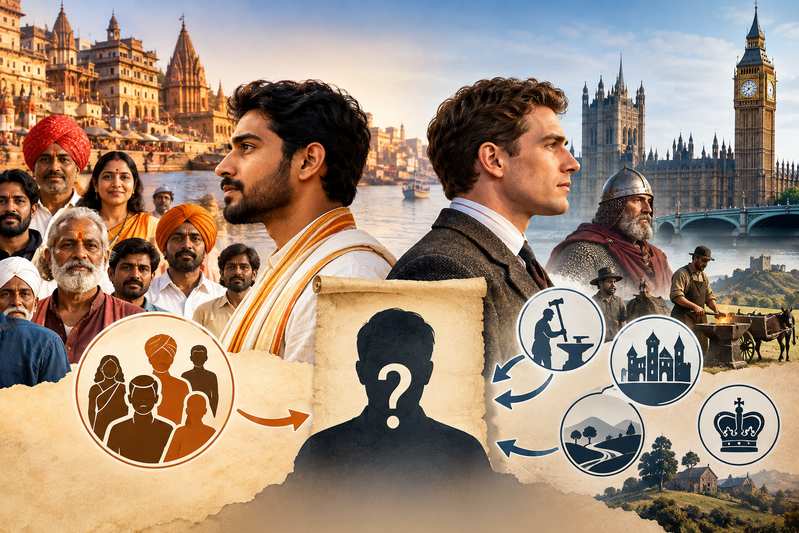
India is distinctive in many ways, and surnames are one of them. In many parts of the country, a surname can immediately suggest a person’s caste or community background. Names such as Mishra, Shukla, Dubey and Pandey, for instance, are commonly associated with Brahmin communities, while surnames such as Khanna, Kapoor, Sodhi, Bedi and Chopra have historically been associated with Khatri communities. Mathur and Bhatnagar are similarly associated with Kayastha communities, while surnames connected with Rajputs, Thakurs, Jats, Vaishyas and Dalit communities often carry their own social associations.
But Britain developed its surname traditions through a very different historical route. If there was no caste system comparable to India’s, how did surnames emerge in England—and why did people need them in the first place?
The familiar question, “What’s in a name?”, has a surprisingly long answer. England alone has thousands of surnames, each reflecting a particular history, occupation, place, parentage or personal characteristic.
How English surnames emerged
Before the Norman Conquest of 1066, people in England generally did not possess hereditary family surnames in the modern sense. In smaller communities, a single personal name was often sufficient to identify an individual.
As populations grew, however, distinguishing one person from another became increasingly necessary. Additional descriptions were therefore attached to personal names.
Someone might become known as John the Butcher, William the Short, Henry from Sutton, Mary of the Wood or Roger, son of Richard. Over time, many such descriptions became fixed family names.
After 1066, the Norman nobility helped popularise the use of surnames in England. Initially, these identifying names could change or disappear during a person’s lifetime. Gradually, however, they became hereditary and began passing from one generation to the next.
By the later medieval period, hereditary surnames had become widespread among English families and in Lowland Scotland.
Seven broad origins of English surnames
English surnames can broadly be understood through several categories. They may originate from a person’s father or mother, occupation, nickname, place of origin, geographical features or an estate associated with a family.
1. Patronymic surnames
Patronymic surnames are derived from a male ancestor’s first name. The suffix “-son” is often an indication of this origin.
Thus, Richardson literally refers to the son of Richard, while Davidson refers to the son of David.
In Wales, older naming traditions also produced surnames such as Griffiths, associated with Griffith or Gruffydd and his descendants.
2. Matronymic surnames
Names based on the mother’s name are much less common because English naming traditions historically followed the paternal line more frequently.
Examples include Marriott, associated with Mary, and Madison, associated with Maud or related forms.
3. Occupational surnames
Some of the most recognisable English surnames originated in people’s occupations.
Carpenter, Knight, Taylor, Miller and Fisher are examples of names linked to professions.
Such surnames can provide clues about the occupations of ancestors. However, historical context is important because many medieval occupations no longer exist in their original form.
Cartwright, for example, referred to someone who made carts or wagons—an occupation far more prominent in earlier centuries than it is today.
4. Surnames from personal characteristics
Some surnames originated as nicknames or descriptions of an individual’s appearance, temperament or other characteristics.
Names such as White, Black, Grey and Swift are examples. In some cases, they may have reflected an ancestor’s appearance or personality.
Over generations, a description that once identified a particular individual could become a hereditary family name.
5. Surnames derived from places
Places also played a major role in the development of English surnames.
People could be identified according to the town, village, county or region from which they came. Names such as Hampshire, Burton and Sutton reflect this geographical connection.
Natural features of the landscape also influenced surnames. Moor, Hill, Stone and Wood, for example, may have originated as descriptions of where ancestors lived or of the surrounding landscape.
A person living near a wood, hill or other prominent geographical feature could acquire a name associated with that location.
6. Estate-based surnames
Land ownership and estates also influenced family names. Those who owned land could take their names from their properties or estates.
The British royal family’s adoption of Windsor provides a prominent example. In 1917, King George V changed the royal family’s name from Saxe-Coburg-Gotha to Windsor, drawing on the name of Windsor Castle.
The change came during the First World War, when the royal family sought a name more closely associated with Britain.
7. Names linked to ancestry and affiliation
Some surnames also reflected relationships, affiliations or ancestral associations.
The Irish surname Kilpatrick, for example, carries the meaning of a follower or devotee of Patrick.
These examples demonstrate that surnames were not created according to one universal formula. They developed gradually from the circumstances in which individuals were identified.
Why surnames became hereditary
The original purpose of many surnames was practical: identification.
As communities expanded, a single first name was no longer enough. A second name helped distinguish one John from another, one William from another or one Richard from another.
Over generations, these descriptive identifiers became hereditary. A name that originally described an individual’s occupation could eventually become the surname of an entire family, even after descendants had moved into completely different professions.
That is why the original meaning of many surnames is not immediately obvious today.
A history hidden in everyday names
The history of English surnames is therefore less about a single system and more about centuries of social change.
A surname could tell us something about an ancestor’s occupation, parentage, place of residence, physical characteristics, social association or property. Yet tracing the precise origin of an individual surname can be difficult because several possible sources may exist.
Many surnames have evolved through changes in spelling and pronunciation, while others may have emerged independently in different places.
The next time an English surname catches your attention, therefore, it may be worth looking beyond the name itself. Hidden within it could be a reference to a medieval occupation, an ancestral home, a parent, a landscape—or a story that began many centuries ago.
Courtesy: The Purvai — translated and adapted from the original Hindi article.
