
When Suspicion is Weaponized : Why India Must Defend the Integrity of Its Election Commission

Poonam Sharma
Questioning an Institution—or Slowly the disgruntled elements are not Trusting Democracy?
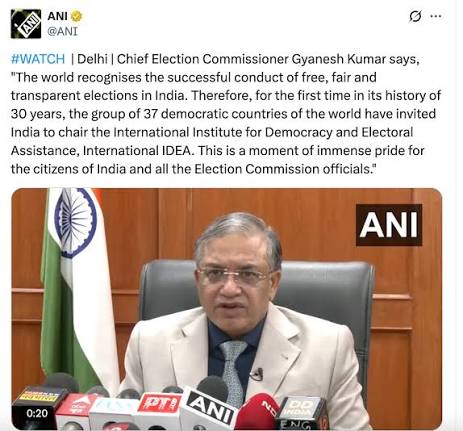
There comes a moment in every democracy when disagreement with an institution begins to transform into something more dangerous: distrust of the institution itself.Chief Election Commissioner Gyanesh Kumar today finds himself at the centre of an intense controversy involving the Special Intensive Revision (SIR) of electoral rolls, Form 6, internal Election Commission deliberations and allegations of unilateral decision-making.
Petitioners even asked the Supreme Court to immediately suspend him. But The Court refused.That refusal deserves more attention than the political noise surrounding it.
A three-judge Bench headed by Chief Justice of India Surya Kant, with Justices Joymalya Bagchi and V. Mohana, declined to remove or restrain the Chief Election Commissioner merely on the basis of allegations and newspaper reports.
The Court instead chose the constitutional route: seek the records, hear the Election Commission and other concerned officials, examine the evidence and then decide.That is not a technical distinction.It is the difference between the rule of law and rule by allegation.
What Exactly Is the Controversy?
The controversy originated from reports claiming that Election Commissioners Sukhbir Singh Sandhu and Vivek Joshi had raised written concerns on at least 14 occasions over approximately ten months regarding decisions connected with the SIR and electoral-roll administration.
Questions were also raised over changes associated with Form 6—the statutory form used for inclusion of names in electoral rolls—and over aspects of the Election Commission’s IT systems.
Petitions subsequently alleged that some decisions had been taken without the concurrence of the other two Commissioners.The Election Commission, however, presented a very different picture.
It said that differing views, suggestions and operational queries are a normal part of institutional deliberation and maintained that final decisions during the relevant period were unanimous.That point should not be casually ignored.Discussion inside an institution is not evidence that the institution is broken.
In fact, officers questioning proposals, suggesting improvements and debating administrative choices can be evidence that an institution’s internal deliberative mechanism is functioning.
Must every internal difference of opinion now be converted into a constitutional crisis?
If three constitutional authorities discuss a policy, disagree during its formulation and ultimately arrive at a decision, is the disagreement evidence of dysfunction—or evidence of deliberation?
That is the deeper question this controversy raises.
The Supreme Court Refused to Conduct a Trial by Newspaper.Perhaps the most important aspect of the hearing was the Supreme Court’s reluctance to issue an extraordinary interim order merely because a newspaper report had generated serious allegations.
The Bench made clear that reports could be correct, partly correct or require verification. The appropriate course was therefore to obtain the Election Commission’s formal response and examine the institutional record.
This principle should matter enormously to every Indian.
A newspaper investigation can expose wrongdoing.
Journalism can ask uncomfortable questions.
Opposition parties can challenge those in authority.
Citizens can demand transparency.
But a report cannot become a judicial verdict merely because it is sensational enough.If public officials could be removed simply because accusations against them became sufficiently loud, no independent institution would remain genuinely independent.
Today it is Gyanesh Kumar.Tomorrow it could be a judge, auditor, regulator, civil servant or another constitutional authority. What happens to institutional independence when accusation itself becomes punishment?
Form 6: The Question the Court Will Examine One of the most contentious elements concerns Form 6.
The petitioners argued that changes connected with the voter-enrolment process and additional requirements were introduced without following the prescribed statutory procedure. Chief Justice Surya Kant clarified during the hearing that the Supreme Court had not approved a modified Form 6 and indicated that the Court wanted to examine the records to determine who authorised the changes. That clarification must be reported accurately.
But so must another fact:
The Court has not concluded that Gyanesh Kumar personally committed an illegality.It has asked for the record.That difference is everything.
The Election Commission’s position has been that Form 6 itself was not amended and that the declaration at issue was an additional requirement connected with the SIR process.
Now the records will speak. That is how constitutional democracy should operate—not through hashtags, political verdicts or television trials, but through documents, law and evidence.
What About the Alleged “14 Objections”?
The reports concerning 14 instances of internal disagreement have naturally generated political controversy. But the Election Commission has said that the communications represented suggestions, queries and inputs arising during decision-making, rather than proof of an institution functioning illegally.
Think about the implication. Should Election Commissioners never disagree internally? Would that make the institution healthier? Surely the opposite is true.
An Election Commission in which senior officials can question proposals, debate implementation and recommend changes is not necessarily a weakened Commission. It may actually demonstrate institutional depth. The relevant question is not whether discussions occurred. The relevant question is whether the
final decisions complied with the law governing the three-member Commission.
And that is precisely what the Supreme Court is now examining. Why Was Immediate Suspension Such an Extraordinary Demand? Petitioners sought Gyanesh Kumar’s immediate suspension from office. Consider the constitutional consequences of such a step.
The Chief Election Commissioner occupies one of India’s most sensitive constitutional offices. Removing or disabling the officeholder before hearing the institutional response would have enormous consequences for the functioning of the Election Commission itself.
The Supreme Court therefore declined to grant such extraordinary interim relief.
That should serve as a reminder:
Constitutional positions cannot be governed by political impatience. If wrongdoing is established, the Constitution and law provide mechanisms to deal with it. But the presumption that an accusation must immediately result in punishment would itself undermine institutional stability.
Then Comes India’s Permanent Political Suspect: The EVM
Behind almost every modern controversy involving the Election Commission lurks another allegation: EVM manipulation. Whenever an election produces an inconvenient verdict, the Electronic Voting Machine somehow returns to the dock. But India’s EVM architecture is not the same as an ordinary internet-connected computer. The machines are designed to function independently rather than operate through the internet or Wi-Fi during polling. This distinction is fundamental.
The familiar image of a hacker sitting thousands of kilometres away, opening a laptop and remotely changing Indian votes does not correspond to the architecture of a standalone voting machine.But technological isolation is only one layer.The electoral process incorporates physical custody, checking of machines, randomisation, mock polls, sealing procedures, deployment protocols and participation or observation by representatives of political parties at different stages.VVPAT provides an additional paper-verification mechanism enabling a voter to visually confirm the candidate corresponding to the vote cast.
These safeguards exist precisely because electoral integrity cannot depend upon a single layer of trust.
“EVM Hacked”—Then Show India How
Anyone has the democratic right to question EVMs. But a serious allegation deserves serious evidence. If an EVM has been manipulated, then answer:
Which machine?
At which polling station?
Through what mechanism?
Which safeguard was defeated?
Where is the forensic evidence?
How were votes altered without detection through the surrounding procedures?
These are not political questions. They are technical questions.
And technical allegations require technical proof. Repeating “EVM hacked” ten thousand times on social media cannot transform an assertion into forensic evidence. The Most Inconvenient Question: Why Does the Same EVM Elect the Opposition? There is another question that critics of EVMs must confront.
The same electoral machinery has produced victories for virtually every major political formation in India.
Ruling parties have lost states. Opposition parties have returned to power .Regional parties have defeated powerful national organisations. Governments predicted to win comfortably have suffered setbacks.
Political giants have lost constituencies. Unexpected candidates have won. So how can an EVM be trustworthy when one party wins and suddenly suspicious when that party loses?
Can technology change its morality according to the election result?
If EVMs could simply be programmed to guarantee victory for whoever supposedly controls them, why would incumbent governments ever lose?
Why would ruling parties lose seats? Why would opposition parties win major elections conducted by the very same Election Commission?
This contradiction deserves an answer. The Greatest Casualty of the EVM Debate Is the Indian Voter .Perhaps the most troubling aspect of endless allegations about voting machines is something rarely discussed. They diminish the Indian voter.
When commentators cannot understand why people voted differently from what political strategists predicted, blaming a machine becomes easier than understanding the electorate.
But India does not have a politically naïve electorate.
Indian voters have repeatedly shown extraordinary sophistication.They can elect one party nationally and another in their state. They can reward welfare delivery while punishing local governance failures.
They can return a popular leader while defeating individual candidates from the same party.
They can overturn governments that once appeared invincible. Every time an electoral defeat is casually attributed to an EVM, millions of voters are indirectly being told: Your decision could not possibly have produced this result.”
What could be more dismissive of democracy than that?
Gyanesh Kumar Is Bigger Than the Controversy Around His Name
This debate should therefore not be reduced to the personality of one Chief Election Commissioner.
Gyanesh Kumar today represents a much larger constitutional question:
Can an independent institution take difficult decisions without every disagreement being converted into an allegation of dishonesty? Managing India’s elections is one of the world’s most formidable administrative responsibilities. Electoral rolls involving hundreds of millions of citizens must be maintained.
Polling stations must reach mountains, forests, deserts, islands and densely populated cities. Lakhs of officials must be trained and deployed. Security must be coordinated. Machines must be transported, checked, secured and monitored.Political parties must be accommodated within a common legal framework.
Disputes must be handled.And all of this happens under intense political scrutiny. The people who manage this extraordinary democratic machinery too are under scrutiny—but they also deserve fairness.
Is Internal Debate Now Evidence of Institutional Collapse?
If they raised questions internally, those questions deserve examination.But why should internal questioning automatically be interpreted as proof that the institution lacked integrity? Healthy institutions are deliberate.Healthy institutions disagree.Healthy institutions correct themselves.Healthy institutions maintain records precisely so their decisions can later be examined.An institution where nobody ever questions anything internally would arguably be far more worrying.The Election Commission has maintained that the final decisions were unanimous and that the suggestions formed part of the decision-making process.The Supreme Court will now examine the records.
That should be welcomed. If the records support the Commission, institutional confidence should emerge stronger.
The Kerala Issue and Political Pressure
It refers to reports concerning the reopening in Kerala of an old case relating to the suicide of a woman engineer, presenting it in the context of increasing pressure surrounding Gyanesh Kumar. Such matters, however politically dramatic, must also be separated from the legal questions presently before the Supreme Court. Otherwise completely different controversies can be assembled into a narrative of guilt before any competent authority has established that guilt. That is precisely the danger of politics by accumulation:One allegation is placed beside another. Then another.Eventually the sheer number of allegations begins to create an impression of proof.But ten unproven allegations do not automatically become one proven fact.A Constitutional Institution Cannot Function Under Permanent Suspicion.India must distinguish between vigilance and cynicism.Vigilance protects democracy. Cynicism destroys confidence in democracy.
If every Election Commission decision is assumed to conceal a conspiracy, every EVM is presumed manipulated, every electoral roll revision is treated as an attempt at disenfranchisement and every official is presumed politically compromised, what happens when the next election result arrives?
Will anyone accept it?
And if citizens are conditioned to accept only elections their preferred party wins, democracy itself becomes impossible.
A democratic system ultimately depends upon one fundamental bargain:We compete fiercely before the vote, but we respect a legitimately conducted verdict after the vote.Break that bargain and elections become meaningless. India’s Institutions Belong to Bharat, Not to Governments .Defending the Election Commission does not mean defending a political party.
The Election Commission existed before today’s government.
It will exist after today’s government. Governments change.Prime Ministers change.Chief Election Commissioners change.Opposition parties become ruling parties and ruling parties return to opposition.
But constitutional institutions remain.That is precisely why their credibility must not become collateral damage in everyday political warfare.Criticise decisions where necessary.Challenge them in court.Demand records.Seek explanations.Use constitutional remedies.
But do not first destroy the institution’s credibility and then ask it to conduct an election everyone will trust.The Supreme Court Has Shown the Better Way.Perhaps the most powerful lesson from the present proceedings is therefore not about Gyanesh Kumar at all.
It is about how India should resolve institutional disputes. The Supreme Court did not say: “The newspaper is wrong.”
Nor did it say: “The allegations are true.”It effectively said: Bring us the record.That is the constitutional answer to political noise.Evidence before verdict.
Records before conclusions.Law before outrage.And due process before punishment.That is also the standard India’s public discourse desperately needs.
Bharat Must Have Confidence in What Bharat Has Built
India runs the world’s largest democratic exercise.Its polling officials travel to locations that would challenge the administrative machinery of almost any country.ts election infrastructure serve citizens speaking hundreds of languages and living across vastly different geographic and social conditions. Its voters routinely overturn political predictions.Its EVM-VVPAT system was developed for this extraordinary democratic environment.None of this means the system should never be improved.Quite the opposite.A confident civilisation improves its institutions precisely because it values them.But improvement is not the same as permanent suspicion.National confidence does not mean blind obedience to institutions.
It means refusing to condemn Indian institutions without evidence while simultaneously demanding that they remain worthy of public confidence.
The Question India Must Finally Ask
The Gyanesh Kumar controversy leaves Bharat with a question much bigger than Form 6, SIR or even EVMs:Do we believe in institutions only when they give us the decisions we want? If the answer is yes, then the crisis is not inside the Election Commission.
It is inside our understanding of democracy.The Indian voter has the right to elect a government.The Indian voter has an equal right to throw that government out.
No political party owns that verdict.
No commentator owns it.
No government owns it.
And no opposition owns it. It belongs to the people of Bharat.So scrutinise the Election Commission—but do not casually delegitimise it. Examine every credible allegation—but do not convert allegation into conviction.Improve every safeguard—but do not call an election stolen merely because its outcome was inconvenient.
And question EVMs scientifically if necessary—but bring evidence worthy of the accusation.
Because the day Indians are persuaded that every institution is corrupt, every election is manipulated and every unfavourable verdict is fraudulent, the greatest casualty will not be Gyanesh Kumar. It will not even be the Election Commission. The casualty will be the Indian citizen’s faith in the Republic itself.
And protecting that faith—while insisting that institutions remain worthy of it—is among the highest duties of a democratic and patriotic society.
