
Shivraj Singh Chouhan Launches Global AgriVoltaics Conference
At the New Delhi event, the Agriculture Minister calls for solar farming models that protect crop production, raise farmers’ incomes and create rural jobs.

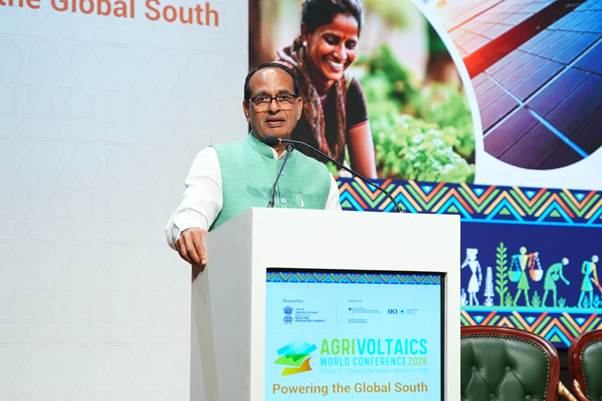
- Shivraj Singh Chouhan inaugurates seventh AgriVoltaics World Conference
- Policy focus urged on small and marginal farmers
- 47.5 million hectares identified as suitable for AgriVoltaics
- New PM-KUSUM phase to expand solar farming opportunities
GG News Bureau
New Delhi, 21st Oct: Union Agriculture and Farmers’ Welfare Minister Shivraj Singh Chouhan inaugurated the seventh AgriVoltaics World Conference at Bharat Mandapam on Wednesday, calling for the integration of solar power generation with agriculture to improve farmers’ incomes while protecting food production.
Addressing delegates, scientists and farmers, Chouhan said the technology could help farmers become both annadatas (food providers) and urjadatas (energy providers). He stressed that policies must be designed around the needs of small and marginal farmers, who account for more than 85 per cent of India’s farming community.
AgriVoltaics involves installing solar panels above agricultural land while allowing crops to grow underneath. Chouhan said the approach could enable farmers to use the same land for food production and electricity generation, provided the design does not interfere with cultivation.
He highlighted the need to adapt panel height, spacing and field layouts to allow ploughing, crop selection and changes in cropping cycles. He also called for proper rainwater drainage, reliable electricity connections, transparent payments and safeguards to protect farmers if companies abandon projects or contracts expire.
Chouhan said the Agriculture Ministry would work closely with the Ministry of New and Renewable Energy to develop practical models. He also urged the involvement of Farmer Producer Organisations and called for training rural youth and women to operate, repair and maintain solar equipment, creating employment opportunities within villages.
Union Minister for New and Renewable Energy Pralhad Joshi said India’s installed non-fossil energy capacity had crossed 308 GW. He highlighted the potential of AgriVoltaics to expand renewable energy generation without taking agricultural land out of production.
Citing a study by The Energy and Resources Institute (TERI), Joshi said around 47.5 million hectares of India’s agricultural land were technically suitable for AgriVoltaics. Maharashtra, Rajasthan, Andhra Pradesh, Madhya Pradesh, Karnataka and Uttar Pradesh together accounted for about half of this suitable area.
Joshi said that installing AgriVoltaics systems on 10 per cent of the identified suitable land could meet India’s projected electricity demand through 2050. He also cited studies indicating that the technology could increase crop yields by 10 to 20 per cent.
The minister announced that the government would launch an ambitious AgriVoltaics programme under the next phase of the PM-KUSUM scheme. He said the sector could generate approximately 3.32 lakh full-time local jobs, offering rural youth employment opportunities closer to home.
The conference brought together Indian and international delegates to discuss ways to combine agricultural productivity with renewable energy. Technical tools and communication materials were also launched to help farmers and other stakeholders make informed decisions about implementing AgriVoltaics projects.
