
Centre Sets 23-Point Action Plan for Viksit Bharat 2047
Plan focuses on sports, skilling, domestic technology, agriculture, industry and governance reforms

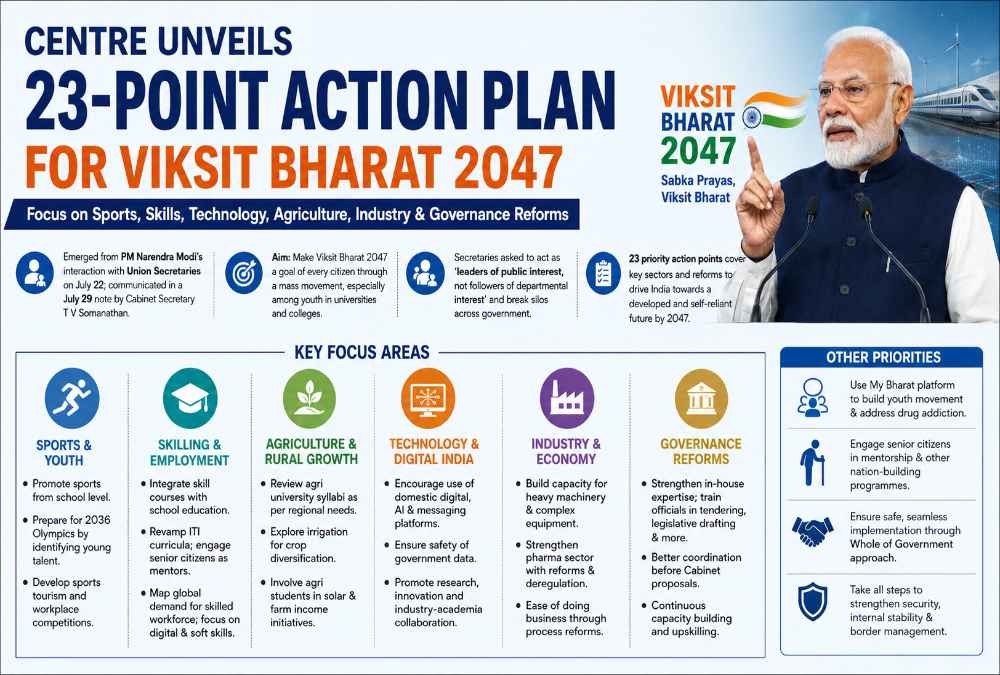
- PM Modi’s secretaries’ meeting identified 23 priority action points for government departments.
- Plan seeks to turn Viksit Bharat 2047 into a mass movement involving citizens and youth.
- Focus areas include sports, skills, agriculture, technology, industrial capacity and employment.
- Secretaries told to prioritise public interest and strengthen coordination across ministries.
GG News Bureau
New Delhi, 22nd Aug: The Centre has outlined a 23-point action plan to advance the government’s Viksit Bharat 2047 agenda, with priorities spanning sports, skilling, domestic technology, agriculture, industrial capacity and governance reforms.
The action points emerged from Prime Minister Narendra Modi’s interaction with Union government secretaries on July 22 and were communicated to secretaries through a July 29 note issued by Cabinet Secretary T V Somanathan.
The plan calls for Viksit Bharat 2047 to become a goal of citizens as well as the government, with efforts aimed at transforming it into a mass movement and building greater participation among young people through universities and colleges.
Sports and Youth Focus
The government has proposed a whole-of-government approach to developing a sports culture, noting that children who will participate in the 2036 Olympics are currently largely in the 5–10 age group.
Schools and colleges are expected to promote sporting achievements through competitions at different levels. The Sports and Tourism ministries have also been encouraged to explore sports tourism, while MSMEs, technology departments and startups could contribute to sports development.
The plan also proposes workplace sports competitions to encourage teamwork and wider participation.
Skills and Employment
The action plan calls for greater integration of skill courses with school education and a review of ITI curricula.
Senior citizens could be engaged as mentors at ITIs, while final-year engineering students may volunteer for short-term programmes to share technical knowledge. The government is also considering pathways for ITI diploma holders to pursue degree-level education.
A global mapping of demand for skilled workers has been proposed, with training programmes aligned with international requirements. Greater emphasis on digital capabilities and soft skills has also been recommended to improve overseas employment opportunities.
Agriculture and Technology
Agricultural universities have been asked to review their curricula according to regional agro-climatic requirements. The plan also proposes exploring irrigation expansion to support crop diversification while avoiding water-intensive crops in unsuitable areas.
Agriculture students could participate in initiatives such as installing solar panels along field boundaries, potentially creating additional income opportunities for farmers.
The government has also encouraged greater use of domestic digital, artificial intelligence and messaging platforms, including Zoho, Sarvam and Arattai, particularly for government data security.
Strengthening Domestic Industry
The action plan calls for building domestic capacity to manufacture heavy and complex machinery and equipment, while encouraging the development of more construction companies capable of executing complex projects.
It also stresses stronger industry-academia collaboration, with university and college curricula to be updated regularly in line with technological developments and industry requirements.
The pharmaceutical sector has been identified for process reforms and deregulation to improve ease of doing business while keeping pace with scientific developments.
Governance Reforms
The Centre has called for greater in-house expertise within government, including training officials in tendering, legislative drafting and dispute resolution instead of relying extensively on external consultants.
Ministries have also been encouraged to coordinate before Cabinet proposals are finalised to avoid delays and ensure smoother implementation.
The action plan emphasises continuous capacity building and upskilling of government personnel to meet future requirements.
The final principle calls on secretaries to act as “leaders of public interest, not followers of departmental interest”, with greater focus on cross-cutting priorities such as Swachhata, Swadeshi, deregulation and decriminalisation.
The government’s latest directions come amid a broader push to strengthen coordination across ministries and align administrative action with the long-term objectives of Viksit Bharat 2047.
