
Hindi Promotion Should Create Opportunities, Not Impose: Jitendra Singh
Union Minister stresses simple official Hindi, linguistic inclusivity and the growing role of AI in government translation

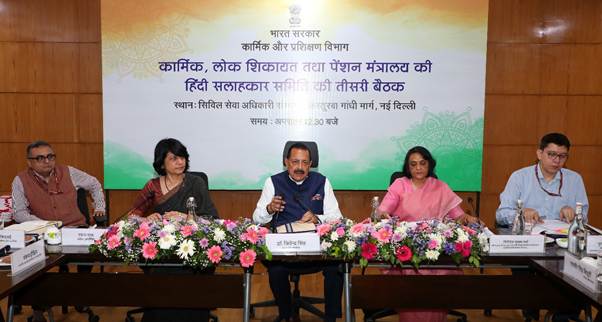
- Jitendra Singh backs opportunity-led Hindi promotion
- Official Hindi should remain simple and accessible
- AI is improving government translation
- DoPT to examine committee recommendations
GG News Bureau
New Delhi, 7th Oct: Union Minister of State (Independent Charge) for Science & Technology and Earth Sciences and MoS for PMO, Personnel, Public Grievances and Pensions, Atomic Energy and Space Dr. Jitendra Singh on Wednesday said Hindi should be promoted by creating opportunities and a sense of stake in the language rather than by making its use appear imposed.
Addressing the third meeting of the Hindi Advisory Committee of the Ministry of Personnel, Public Grievances and Pensions, Singh said people would naturally be encouraged to learn and use Hindi when proficiency in the language opens doors to employment and professional growth.
The Kaushal Patrika of the Department of Personnel and Training (DoPT) was also launched during the meeting.
Simple Hindi for official work
Singh stressed that official Hindi should be simple, accessible and close to everyday usage. Government communication, he said, should avoid unnecessarily difficult or highly formal language and should not read like a literal translation from English.
He also cautioned against insisting on complete use of Hindi in every situation, particularly in official communication with non-Hindi-speaking states. The linguistic sensitivities and convenience of people and officials in different regions, he said, need to be respected.
Hindi use has grown
The Minister said the use of Hindi has increased significantly over the past 10–12 years, including among officers from southern parts of the country.
He cited examples of officers and personnel in scientific and technical establishments using Hindi extensively in their official work despite being based in predominantly non-Hindi-speaking regions.
Singh said this growing usage demonstrated that Hindi could expand naturally when people see practical value in learning and using the language.
AI improving translation
Singh also highlighted the role of technology and artificial intelligence in improving the quality of Hindi translation in government work.
He said incorrect or misleading translations had been a concern in the past, but such instances had reduced considerably with improved technology, AI-based systems and the availability of larger datasets.
The Minister noted that these tools were particularly useful in technically sensitive areas where accurate translation is important.
At the same time, he cautioned that language should not become a barrier to acquiring knowledge. In specialised fields where Hindi terminology or literature may be limited, he said original technical terms could be retained while explanations and teaching could be provided in Hindi.
Focus on opportunities, not compulsion
Singh reiterated that creating a stake in Hindi is more effective than imposing its use.
He said the language would gain greater acceptance when knowledge of Hindi becomes increasingly useful for jobs and professional opportunities. He also pointed to growing interest in learning Hindi in regions where it has traditionally been less prevalent.
The Minister said suggestions from the Hindi Advisory Committee would be examined seriously by DoPT. Proposals falling outside the Department’s mandate, he said, would be forwarded to the concerned Ministries and Departments.
He also discussed suggestions to provide wider language options in skill-development competitions, saying this could make such initiatives more accessible to people from smaller towns, cities and rural areas.
On a proposal to involve Hindi Advisory Committee members in school-level Hindi teaching programmes, Singh said the matter could be taken up with the Ministry of Education.
He said the broader objective should be to expand the reach and use of Hindi in a simple, natural and inclusive manner, while remaining sensitive to India’s linguistic diversity.
